
"Nuktaa: The Great War Explained"
A Critical Perspective on World War I — Causes, Battles, and Consequences
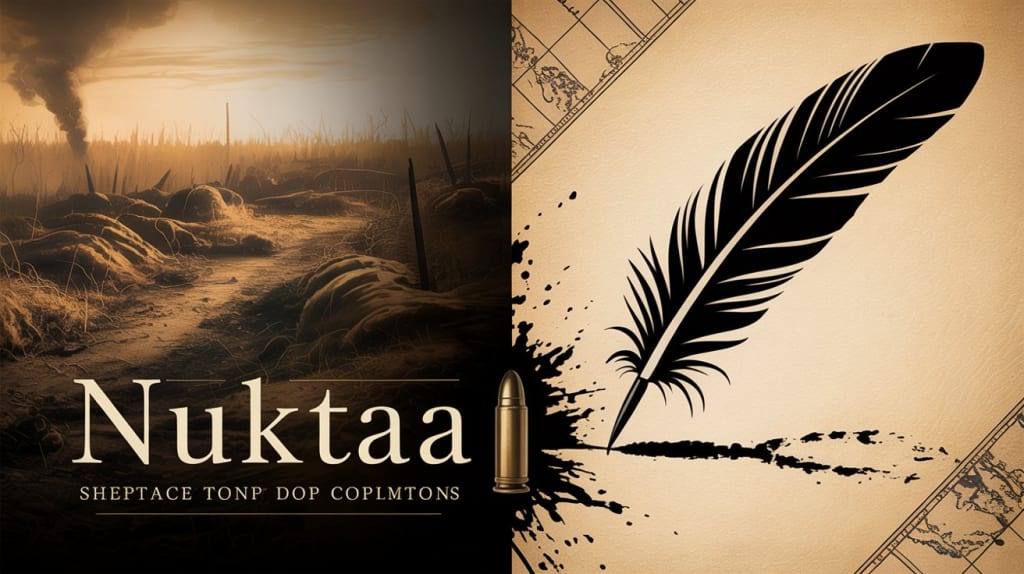
There are moments in human history that do not merely unfold — they rupture. They fracture the timelines that came before and redraw the futures that follow. World War I was not just a war; it was a seismic shift. A cataclysm. A moment when the old world bled out in trenches and the new world gasped into being — fragmented, anxious, modern.
In popular memory, World War I is often overshadowed by the brutality and global scale of the Second. Yet it was this First World War — the “Great War,” as it was tragically and naively called — that truly marked the end of innocence for the modern age. It was a war not only of soldiers, but of empires, ideologies, technologies, and propaganda. A war in which humanity's capacity for violence was industrialized and mechanized, leaving 20 million dead and tens of millions more scarred forever — in body, mind, and map.
"Nuktaa: The Great War Explained" is not just another retelling of battles and dates. This is a book of points — nuktaa, in the deepest sense of the word. Each chapter offers a precise, sharp analysis of the war’s turning points: its origins, its forgotten battles, its cultural effects, its human costs. This is a book that dissects — without detachment. It analyzes with empathy. It critiques not only the men who led the war, but the systems, ideas, and failures of humanity that allowed it to happen.
Why did the assassination of a little-known archduke spiral into a global inferno? Why did millions of men, from the trenches of Europe to the deserts of the Middle East, march toward death with little understanding of the cause? Why did peace, when it finally came, feel more like a wound than a healing? These are not just historical questions. They are human ones. And they remain eerily relevant in our time.
We live again in an age of rising nationalism, imperial nostalgia, and fragile alliances. The ghosts of 1914 are not resting quietly. To understand them, we must return — not with sentimentality, but with a clear-eyed, critical lens. That is what this book seeks to offer.
The idea behind “Nuktaa” is rooted in perspective. A nuktaa — a point — may seem small, but it shapes everything. In language, a single nuktaa can change the entire meaning of a word. In history, a single moment, a single bullet, a single treaty can alter the fate of nations. This book is constructed as a series of “points” that together form a line — a narrative — from the build-up to war, through its gruesome middle, to its unfinished end. Along the way, we pause to examine the hidden layers — the personal letters, the backroom decisions, the silenced voices of colonized soldiers, and the civilians caught in the crossfire.
We will begin by exploring the European political powder keg that had been ticking for decades before 1914 — a toxic mix of nationalism, colonial greed, arms races, and brittle alliances. Then, we will move into the war itself: the horror of trench warfare, the senseless cycles of offensives and retreats, the introduction of chemical weapons, tanks, and aircraft, and the psychological trauma that birthed a new understanding of human suffering — what we now call PTSD was then simply “shell shock,” a silent epidemic.
But this book does not limit itself to the Western Front. We will explore the often-erased stories of the Eastern Front, the Balkan wars, the Armenian Genocide, the brutal campaigns in Africa and the Middle East, and the role of Indian, African, and other colonial troops who fought wars for empires that denied them dignity. History books too often treat these as footnotes. In this Nuktaa, they are central.
We will then examine how the war ended — not just on the battlefield, but in the betrayal of promises, the carving of maps, and the seeds of resentment sown into the Treaty of Versailles. Many say World War I led directly to World War II. That is true. But more than that — it led to the world we live in today. The war dismembered empires, but it also dismantled illusions. It gave rise to modernism in art and literature, to feminism through women’s wartime labor, to new ideologies like fascism and communism, and to anti-colonial movements that would eventually reshape the 20th century.
At the core of this book is a single argument: understanding war is not about glorifying it, nor simply mourning it — it is about confronting the structures that allow it to happen again and again. The Great War offers no easy lessons, only difficult truths.
We must not allow history to be sanitized. Nor should it be buried under flags and medals. We must dig into the mud — both literal and metaphorical — and listen. Listen to the screams, the silence, the ink on secret treaties, the breathless cries of poets who returned from the frontlines never quite whole again.
You will not leave this book with a romantic vision of valor. But you may leave with something deeper: clarity. A deeper understanding of the fault lines beneath our shared history. A recognition of how dangerously easy it is to slip from diplomacy into devastation. And a call — subtle but urgent — to question the next march toward war before it begins.
So turn the page. Begin at the nuktaa — the point. Because to truly see the world we live in, we must first understand the war that broke it.
About the Creator
ihsandanish
my name is ihandanish my father name is said he is a text si deler i want become engener i am an 19 yeare old
Keep reading
More stories from ihsandanish and writers in Education and other communities.
PROBLEMS IN LIFE | A Life Lesson Story On Growth And Success |
Problems in Life: A Life Lesson on Growth and Success We all go through times in life when everything feels dark. Dreams feel out of reach, the road ahead seems blocked, and hope begins to fade. This is the story of a young girl named Ayesha, whose life took a sharp turn—but who discovered strength in the middle of struggle.
By ihsandanish9 months ago in Education
Practical steps to handle a medical school interview invite
Receiving a medical school interview invite is a major milestone. It means the admissions committee already likes the grades and the test scores. Now they want to see the person behind the application. For many students this is the most intimidating part of the entire journey.
By Jelena Smiljkovic7 days ago in Education


Comments
There are no comments for this story
Be the first to respond and start the conversation.