
NSFDC- SC ST Education Loan for Abroad Studies
NSFDC Education Loan Scheme for SC & ST Students

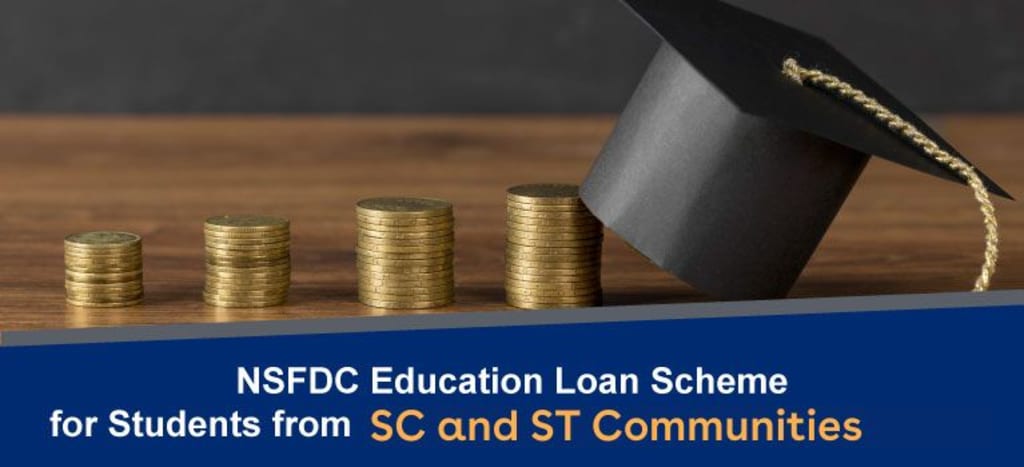
We all are aware of the fact that pursuing higher education, especially abroad, can be a life-changing experience that will shape us professionally as well as personally. However, the financial burden often poses a significant challenge, particularly for students from underprivileged backgrounds.
Recognizing this, the Government of India’s Ministry of Social Justice and Empowerment, through the National Scheduled Castes Finance and Development Corporation (NSFDC) has introduced a unique SC ST education loan for abroad studies in the late 90s. Its aim? To provide them with the financial assistance required to achieve their academic and professional aspirations still many of the students doesn’t have heard of this scheme. So, to all those underprivileged students save this article as a bookmark.
What is the NSFDC Education Loan Scheme?
The NSFDC education loan scheme is a specialized financial support program designed exclusively for students from the Scheduled Caste community. It covers full-time professional and technical courses offered by recognized institutions in India and abroad. This scheme ensures that no deserving student has to compromise on their educational dreams due to financial constraints.
The loan provides a comprehensive package covering tuition fees, admission costs, books, travel expenses, and even protective clothing for extreme weather conditions. This makes it an all-encompassing solution for students venturing into higher education, whether domestically or internationally.
Loan Limits and Interest Rates
One of the standout features of this scheme is its generous loan limit. Students can avail up to ₹30 lakhs for education in India and ₹40 lakhs for studies abroad, or 90% of the total course fee, whichever is lower. The interest rates are structured to ensure affordability:
- For studies in India, students pay 6% interest per annum, while NSFDC charges the State Channelizing Agencies (SCAs) only 2%. Female beneficiaries enjoy an additional 0.5% interest rebate.
- For studies abroad, the rate is slightly higher, with students paying 7% and women receiving 0.5% concession under the interest subsidy scheme for education loan abroad as set by the Government of India.
Additionally, the repayment terms are flexible, extending up to 10 years for loans below ₹10 lakhs and 12 years for higher amounts.
Courses Covered Under the Scheme
The NSFDC education loan scheme covers a wide array of professional and technical courses, ensuring students have ample options to choose from based on their interests and career aspirations. Some of the key fields supported by the scheme include:
- Engineering (Diploma, B.Tech, M.Tech)
- Medicine (MBBS, MD, MS)
- Architecture (B.Arch, M.Arch)
- Biotechnology and Microbiology
- Pharmacy (B.Pharma, M.Pharma)
- Nursing, Physiotherapy, and Pathology
- Management (BBA, MBA)
- Law (LLB, LLM)
- Chartered Accountancy (CA), Cost Accountancy (ICWA), and Company Secretaryship (CS)
- Journalism, Hotel Management, and Geriatric Care
Students aspiring for doctoral studies leading to M.Phil or Ph.D. in recognized institutions are also eligible. This extensive coverage ensures that students can pursue almost any professional course of their choice.
Eligibility Criteria
To benefit from this scheme, students must meet specific eligibility requirements. The primary criterion is that the applicant must belong to the Scheduled Caste community. Additionally, the family income of the applicant should not exceed ₹3 lakhs per annum, ensuring that the assistance reaches those who need it most.
The applicant must have secured admission to a full-time professional or technical course in a recognized institution, either in India or abroad, based on merit. It is also important that no other education loan or scholarship is availed for the same course.
What Does the Loan Cover?
The NSFDC education loan is designed to be a one-stop solution for all educational expenses. Here is a detailed breakdown of what it includes:
- Tuition fees and admission charges
- Cost of books, stationery, and equipment
- Examination, library, and laboratory fees
- Hostel and mess expenses for students residing on campus
- Travel expenses, including visa charges for studying abroad
- Insurance premium for policies covering the borrower against death or permanent disability
- Additional costs like caution money, development fees, and weather-protective clothing for students in colder regions
With this comprehensive coverage, students can focus entirely on their studies without worrying about financial hurdles.
How to Apply for the NSFDC Education Loan?
Applying for this loan is a straightforward process, but attention to detail is crucial to avoid delays. Here is a step-by-step guide:
- Download the application form: Visit the official NSFDC website and download the education loan application form.
- Submit the form to SCAs: Fill out the form and submit it to the respective State Channelizing Agency (SCA) in your state or Union Territory.
- Document submission: Ensure you have all the required documents, such as caste and income certificates, address proof, and the admission letter from the university.
- Evaluation and approval: The SCA evaluates the application and forwards it to NSFDC for final approval.
- Loan disbursement: Upon approval, the funds are disbursed as per the agreed terms.
It is advisable to begin the process as soon as you receive the admission letter to ensure timely approval.
Documents Required
To apply for the NSFDC education loan, students need to provide the following documents:
- Completed application form with signatures of the student and co-applicant (parents or guardian)
- Two passport-size photographs
- Scheduled Caste certificate and income certificate
- Proof of address (e.g., ration card, voter ID, electricity bill)
- Admission letter from the university
- Academic certificates from previous institutions
Given the strict scrutiny of documents by NSFDC, applicants must ensure there are no errors or discrepancies in the submitted information.
Points to Remember
While the NSFDC education loan offers immense benefits, there are some key points to keep in mind:
- Students must obtain prior approval from the SCA before changing their course or institution.
- Part-time employment during the course is permitted, but it must not interfere with studies.
- Beneficiaries are not eligible for any scholarships for the same course.
These guidelines ensure that the loan is utilized effectively and that students maintain their focus on academics.
Benefits of the NSFDC Loan Scheme
This scheme is more than just financial assistance; it is a bridge to a brighter future for SC students. By covering all major educational expenses, it empowers students to pursue their dreams without financial stress. The low interest rates and flexible repayment terms make it an attractive option, particularly for families with limited income.
Moreover, the scheme’s emphasis on professional and technical courses ensures that beneficiaries are equipped with skills that enhance their employability and career prospects. For women, the additional interest rebate is a step toward promoting gender equality in education.
In conclusion, NSFDC student loan India for study abroad is a testament to the Government of India’s commitment to empowering Scheduled Caste students through education. By addressing the financial barriers to higher education, this initiative opens doors to opportunities that were once out of reach for many.
For SC students aspiring to study abroad, this scheme is a lifeline to a brighter, more promising future. If you are eligible, don’t hesitate to apply and take the first step toward achieving your academic dreams.
About the Creator
Riya Niar
I am dedicated professional counselor at ELAN Overseas Education Loan, specializing in assisting students with obtaining the best study abroad loan options. With a passion for helping students achieve their dreams of studying abroad.
Whiskey At Dusk
Guess the whiskey was more important to you in the end, wasn’t it? It was more than the well-being of your friends; more vital than showing up to the places you promised you would and could come to; more critical of a matter than fulfilling your damn responsibilities and getting the press off your back.
By Snarky Lisaa day ago in Humans


Comments
There are no comments for this story
Be the first to respond and start the conversation.