
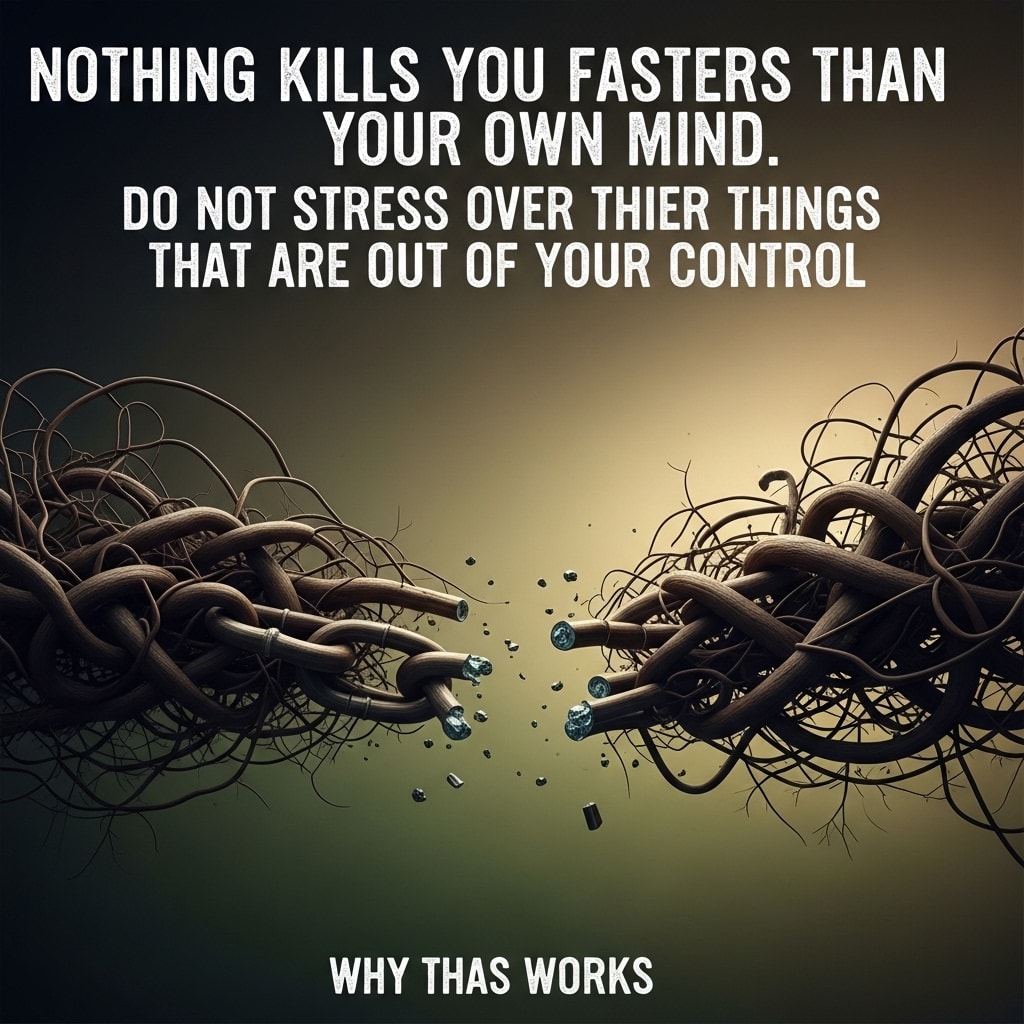
Nothing Kills You Faster Than Your Own Mind. Do Not Stress Over Things That Are Out of Your Control
The Hidden Danger of Overthinking
There was a time when Lena believed her mind was her greatest ally. She trusted her thoughts, her plans, and the endless possibilities she imagined for her future. But slowly, that trust began to erode. The very mind she depended on became the battleground where her peace was lost.
It started with small worries—missed deadlines, forgotten texts, small mistakes at work. She brushed them off initially. Everyone had moments of anxiety. But those moments soon turned into hours, then days. The worries grew like wild vines, choking her thoughts, twisting her confidence into knots. She replayed conversations, analyzed every gesture, every word. What had she said wrong? What if she missed a crucial sign? What if everything was falling apart and she just couldn’t see it yet?
Her mind began to trap her in cycles of “what ifs” and “if onlys.” Sleep became elusive, replaced by a restless haze of endless thoughts. Lena's appetite disappeared, her energy drained. Friends reached out, but she declined, convinced they wouldn’t understand. She told herself she was just tired, just stressed—normal phases everyone went through. But deep down, she felt herself slipping away.
One evening, while sitting on the balcony, staring blankly at the city lights, Lena realized she was exhausted—not from physical labor but from the storm raging inside her head. The more she tried to control her thoughts, the more chaotic they became. It felt like trying to hold water in clenched fists—only to watch it slip away.
That night, she found a quote online that caught her eye: “Nothing kills you faster than your own mind. Do not stress over things that are out of your control.”
The words hit her like a gentle wave. She had been fighting a battle with herself—a war she could never win because she was trying to control the uncontrollable. The past couldn’t be changed. The future was uncertain. But she had been punishing herself for not being able to predict or fix everything.
Over the next few days, Lena started to change her approach. Instead of spiraling down in worry, she began practicing small moments of mindfulness—simple breathing exercises, focusing on one thing at a time, and reminding herself gently, “This is out of my control.”
It wasn’t easy. Old habits clung tightly, and the mind’s voice was persistent. But she kept returning to that calm place inside herself, the quiet space untouched by fear or doubt. Slowly, she noticed her sleep improving. Her appetite returned. The fog in her mind began to lift.
One afternoon, while walking in the park, Lena saw a child struggling to untangle a kite caught in the branches of a tree. The child was frustrated, pulling and tugging harder, making the knots tighter. Lena approached and offered to help. Together, they gently loosened the knots, freeing the kite to fly freely in the wind.
That moment struck her deeply. Her mind had been like that tangled kite—caught in branches of worry and stress. But just like the kite, she didn’t need to fight harder or pull tighter. She needed patience, kindness, and the courage to let go.
Weeks passed, and Lena began to share her experience with close friends. She spoke honestly about her struggles, her fears, and how she learned to release control over things she couldn’t change. Many nodded in understanding—some admitted they felt trapped in their own minds too.
Lena realized she wasn’t alone. So many of us carry invisible burdens, wrestling with our thoughts, trying to manage the uncontrollable chaos around us. But the key to peace lies not in control—it lies in acceptance.
One quiet evening, as the sun set, Lena sat again on her balcony. The city lights twinkled softly below, but this time, her mind was calm. The storm had passed. She smiled softly to herself and whispered, “I cannot control everything, but I can choose peace.”
And in that moment, she understood: nothing kills you faster than your own mind, but nothing heals you faster than the courage to let go.
About the Creator
Keep reading
More stories from Mahayud Din and writers in Education and other communities.
Hurt someone with the truth, but never make them happy with a lie
The shard of mirror trembled slightly in Mara’s hand, reflecting a fractured image of her own tear-streaked face. It was an imperfect reflection—distorted, broken, but undeniably real. In her other hand, she clutched a fragile, crumpled piece of paper, its edges worn from countless folds and unfolded attempts to smooth it out.
By Mahayud Din9 months ago in Education
Building Stronger Teams Through Diversity
Diversity in the workplace is more than a trend. It is a key part of building strong and creative teams. Companies today serve people from many cultures, backgrounds, and life experiences. Because of this, businesses need teams that reflect the world around them.
By Aaron Khieu8 days ago in Education
How Long the Sun Has Left: The Future Life and Death of Our Star Explained
Every day, the Sun rises and sets with remarkable consistency. It has illuminated Earth for billions of years, sustaining life and shaping the environment of our planet. Because the Sun appears stable and unchanging, it is easy to imagine that it will shine forever.
By shahkar jalal2 days ago in Education



Comments
There are no comments for this story
Be the first to respond and start the conversation.