
Not My Future, Not My Class
A Researched Opinion on Requirements

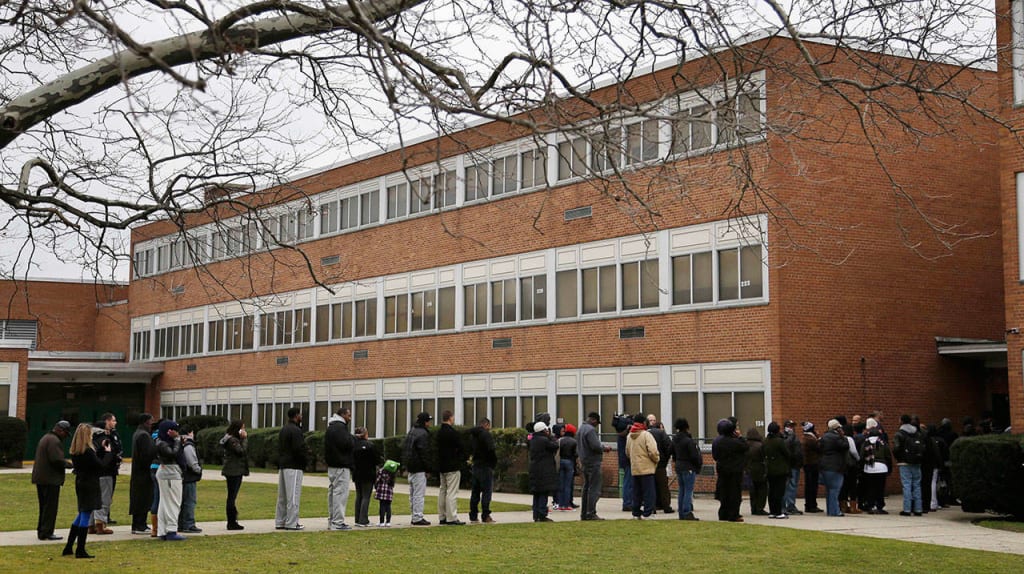
Everything is so bright, so new. Nervousness ripples inside you as you struggle to find the correct room. A meeting with your guidance counselor for the next four years is waiting. You pass many classrooms, and most are labeled. You pass the science wing and shudder. Science was not a strong spot for you in high school and you're glad that those days are behind you.
Finally you're greeted at the door by a kind, middle-aged man in glasses. He ushers you in and offers you a peppermint.
You both go through your upcoming classes, and what you need to graduate. Then he says those dreadful words: “You still need a credit of science to get your degree.”
Basic education in the fundamental subjects should be covered in primary education. I shouldn’t have to pay to take classes in college that won’t teach me what I need to be successful in my career. Global sciences, calculus. The major is mass communications; I’m going to be a graphic designer/advertiser. Why do I need to know radians and the chemical formula in atoms?
Most colleges and universities require to some extent general education courses in order to obtain a “coherent general education requirement consistent with the institution's mission and designed to ensure breadth of knowledge and to promote intellectual inquiry" (North Central Association 1997). Close to 25 to 50 percent of a degree is made up of these general courses. Thousands of dollars, months, and years go to create “distinguished graduates.” It was towards the end of the 19th century that universities began to teach different subjects along with the classes that students were taking with their majors. It’s not clear why this started happening, and why it’s required today (Review, Peer).
Many college students and alumni feel that general education courses are a waste of time and money. Alyssa Pracz from The Northern Star said, “When I took classes such as these my freshman year, I initially thought college was a joke. It wasn't until I got more into the classes required for my major that I began to take college seriously and feel as if I was actually learning and gaining valuable skills.” She goes on to say that most skills taught in general education classes are either useless to her future career, could be picked up from other classes, or taught out in the real world (Pracz, Alyssa).
What good is an art appreciation course to a math major and future mathematician? What good is the pythagorean theorem to a journalism major and future writer? Why study skills that won’t do any good five years down the road. David Becker from Logos Lite, a student paper from North Iowa Area Community College said, “College is supposed to get us ready for our future, and I’m sorry, but businesses do not care if you know how to take and pass a standardized test. A business wants you to be an expert in your field so that you can (hopefully) have a successful career in doing what you love to do.” He feels that the only time that a student should have to take general courses is when they are undecided in their major. This way they can explore classes in college, and find which subject fits them best (Becker, David).
One excuse universities use to defend general education is to give students a well-rounded education. The truth, however, is that we have been taking general education all our lives. Everything general we need we learned already in twelve long years. Using this excuse, universities are sucking away students' time and money on things they don’t care for. Astrophysicist Neil deGrasse Tyson commented, “When students cheat on exams, it’s because our school system values grades more than students value learning.” When forced to take a class they aren’t interested in; students aren’t learning (Pracz, Alyssa).
The system insists that these general education courses need to be in place. They say that it will produce better workers and better minds. In reality, it’s shoving useless trivia down the throats of exhausted students. In the career world, a CEO would hardly care if a prospective employee took a pottery class as a required art credit. An employer would care that the student had experience and knowledge in the field. The only use for general education in secondary education is when a young adult is undecided in their career. Otherwise, it is a waste of time and money.
Works cited:
-- Pracz, Alyssa. “General Education Courses Are a Waste of Time and Money.” Northern Star Online, 13 Apr. 2011, northernstar.info/opinion/columnists/general-education-courses-are-a-waste-of-time-and-money/article_9c52826c-6639-11e0-8c12-0019bb30f31a.html.
--Becker, David. “The Time Has Come to Get Rid of General Education Requirements.” Logos Lite, NIACC, www.niacc.edu/logoslite/2015/11/10/the-time-has-come-to-get-rid-of-general-education-requirements/.
--Vise, Daniel de. “Three-Fifths of Colleges Get C or Worse in General Education.” The Washington Post, WP Company, 30 Aug. 2011, www.washingtonpost.com/blogs/college-inc/post/three-fifths-of-colleges-get-c-or-worse-in-general-education/2011/08/30/gIQAn1VepJ_blog.html?utm_term=.1a2f73a28857.
--Review, Peer. “Reality Check: What's in a Name? The Persistence of ‘General Education.’”Association of American Colleges & Universities, Association of American Colleges & Universities, 29 Dec. 2014, www.aacu.org/publications-research/periodicals/reality-check-whats-name-persistence-general-education
About the Creator
Keep reading
More stories from Jasmine Lass and writers in Education and other communities.
Review: 'Prisoner of the Night and Fog'
Prisoner of the Night and Fog by Anne Blankman A Critical Review by Jasmine Becker Gretchen Muller is the adopted niece of Hitler. She calls him by the cozy name “Uncle Dolf”. This book follows her experiences with Nazi Germany, and the National Socialist Party. She is brainwashed until she meets a Jewish reporter, which leads her to find information about her father which could change everything she ever believed to be true.
By Jasmine Lass8 years ago in Geeks
How Binocular Astronomy Compares to Telescopes
Understanding the Basics: How Each Instrument Works Both binoculars and telescopes collect and magnify light from distant objects. The main goal is simple: gather more light than your eyes alone can collect and make distant objects appear closer.
By shahkar jalal2 days ago in Education
What to Expect From Bookkeeping Outsourcing Services
Money has a way of revealing how well a business is truly operating. Clean records signal control. Messy books hint at missed opportunities, tax risks, and sleepless nights. Many growing companies reach a point where spreadsheets, late-night reconciliations, and rushed reports are no longer sustainable. That’s usually when leaders begin exploring Bookkeeping Outsourcing as a smarter, scalable solution.
By Charles Bright2 days ago in Education




Comments
There are no comments for this story
Be the first to respond and start the conversation.