
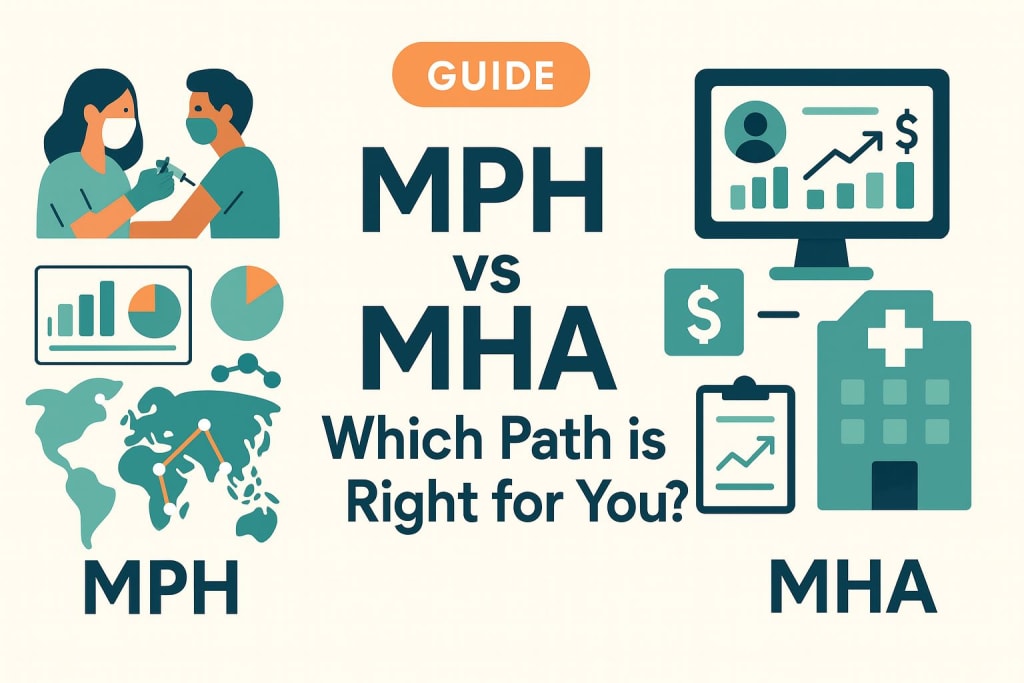
Thinking about grad school but torn between a Master of Public Health (MPH) and a Master of Health Administration (MHA)? Here’s a plain-English breakdown to help you choose the path that matches your goals, strengths, and the kind of impact you want to make.
Deep dive, examples, and comparisons: MPH vs MHA — What’s the Difference?
The 10-second answer
• MPH = improving health of populations: prevention, policy, data, epidemiology, community programs.
• MHA = running healthcare organizations: operations, finance, strategy, quality, patient experience.
Both serve health, but they solve different problems in different settings.
What is an MPH?
An MPH trains you to understand and improve population health—how environments, behaviors, and policies influence disease and well-being. You’ll learn to design interventions, analyze data, and translate evidence into programs and policy.
Typical courses
• Epidemiology & biostatistics
• Social & behavioral sciences
• Environmental & occupational health
• Health policy & management
• Program design & evaluation
Where MPH grads work
• Health departments, CDC-style agencies
• NGOs & global health orgs
• Hospitals/health systems (population health, quality)
• Research institutes & think tanks
• Community coalitions and nonprofits
What is an MHA?
An MHA prepares you to lead healthcare delivery organizations—think hospitals, clinics, and payer/provider systems. You’ll focus on operations, finance, strategy, technology, and performance.
Typical courses
• Healthcare finance & revenue cycle
• Operations & process improvement
• Strategy & competitive positioning
• Quality, safety, & accreditation
• Health IT, analytics, and compliance
Where MHA grads work
• Hospitals & multi-site health systems
• Ambulatory networks & practice groups
• Payers/insurers & value-based care orgs
• Consulting, revenue cycle, and health tech
• Service line leadership (e.g., oncology, cardiology)
Side-by-side snapshot (at a glance)
• Primary goal:
• MPH: prevent disease & improve population outcomes
• MHA: deliver efficient, high-quality care in organizations
• Core toolkit:
• MPH: epidemiology, biostats, program design, policy analysis
• MHA: finance, ops, strategy, quality, leadership
• Day-to-day work:
• MPH: data + communities + policy + research translation
• MHA: budgets + teams + dashboards + patient flow
• Impact lens:
• MPH: community & systems “outside the hospital”
• MHA: performance “inside the hospital/health org”
Who tends to thrive in each program?
Choose MPH if you:
• Light up when you see patterns in population data and maps
• Want to reduce disparities and prevent disease upstream
• Enjoy research translation, policy, and community partnerships
Choose MHA if you:
• Love shaping teams, processes, and budgets to run smoothly
• Get satisfaction from patient access, throughput, and quality metrics
• Want a leadership track inside provider or payer organizations
A quick 5-question self-check
1. Do you prefer population-level impact (MPH) or organizational impact (MHA)?
2. Are you more energized by research & policy (MPH) or operations & finance (MHA)?
3. Would you rather build community programs (MPH) or service lines & clinics (MHA)?
4. Do you want to influence laws and environments (MPH) or budgets and teams (MHA)?
5. Which classes sound fun: epidemiology & evaluation (MPH) or strategy & revenue cycle (MHA)?
If you answered mostly left column → MPH. Mostly right → MHA.
Admissions, time, and cost (what to expect)
• Length: 12–24 months full-time for both, with part-time and online options common.
• Backgrounds: MPH welcomes diverse majors (not only premed); MHA often favors applicants with some exposure to healthcare or business, but it’s not always required.
• Testing: Many programs are test-optional now (varies by school).
• Funding: Scholarships, assistantships, employer tuition benefits, and loan-forgiveness programs (for qualifying public-service roles) are worth exploring early.
For examples of program types (online, no-GRE, accelerated) and selection tips, see the full comparison on BestPublicHealth.com: MPH vs MHA — What’s the Difference?
Career paths and outcomes (illustrative, not one-size-fits-all)
• MPH: epidemiologist, program manager, health policy analyst, community health director, population health specialist, evaluation lead.
• MHA: hospital/clinic administrator, operations manager, service line director, strategy/BD manager, quality & patient experience leader, healthcare consultant.
Note: Titles, salaries, and advancement depend on region, organization size, prior experience, and the value you create on the job.
How to choose (a simple 4-step plan)
1. Write your “impact sentence.” “I want to improve ___ for ___ by doing ___.”
2. List 5 daily tasks you enjoy. Match them to MPH vs MHA course topics above.
3. Browse 8–10 real job postings you’d love in 2–3 years; note the degree preference.
4. Shortlist programs that align with your preferred modality, timeline, budget, and career services.
Bottom line
Both degrees are powerful. The best choice depends on where you want to spend your time—and what kind of change excites you. If you’re drawn to upstream prevention and policy, you’ll likely feel at home in an MPH. If you’re energized by leading teams and running care delivery, an MHA may be your launchpad.
About the Creator
Wuthering Heights uni module given content warning for students"
The 1847 novel Wuthering Heights has long been considered one of the most intense works in English literature. Written by Emily Brontë, the book explores obsession, revenge, cruelty and emotional torment on the Yorkshire moors. Now, nearly two centuries after its publication, the novel has become the center of a modern academic debate after a university module introduced a content warning for students studying the text.
By Fiaz Ahmed 4 days ago in Education
EdTech for Early Childhood Market to hit USD 55.6 Bn By 2034
EdTech for Early Childhood Market Overview The EdTech for Early Childhood Market was valued at USD 13.4 billion in 2024 and is projected to reach approximately USD 55.6 billion by 2034, expanding at a CAGR of 15.30% from 2025 to 2034. The increasing integration of digital learning tools into early childhood education is supporting this expansion. Educational technology platforms designed for young learners are helping educators deliver interactive learning experiences through digital content, educational games, and adaptive learning applications that support cognitive and language development.
By Roberto Crumabout 2 hours ago in Education
A Transparent Look at Vocal Challenges and Top Stories
Almost three years ago, we shared a resource article that served as a place for people to suggest new challenge prompts. We thought it would be a good idea to refresh that thread, and take the opportunity to answer a few common questions about top stories, how challenges are judged and how submissions are reviewed.
By Vocal Curation Team4 days ago in Resources




Comments
There are no comments for this story
Be the first to respond and start the conversation.