
Mother Hen and Chicks
A Tale of Courage, Love, and Feathers Under Fire

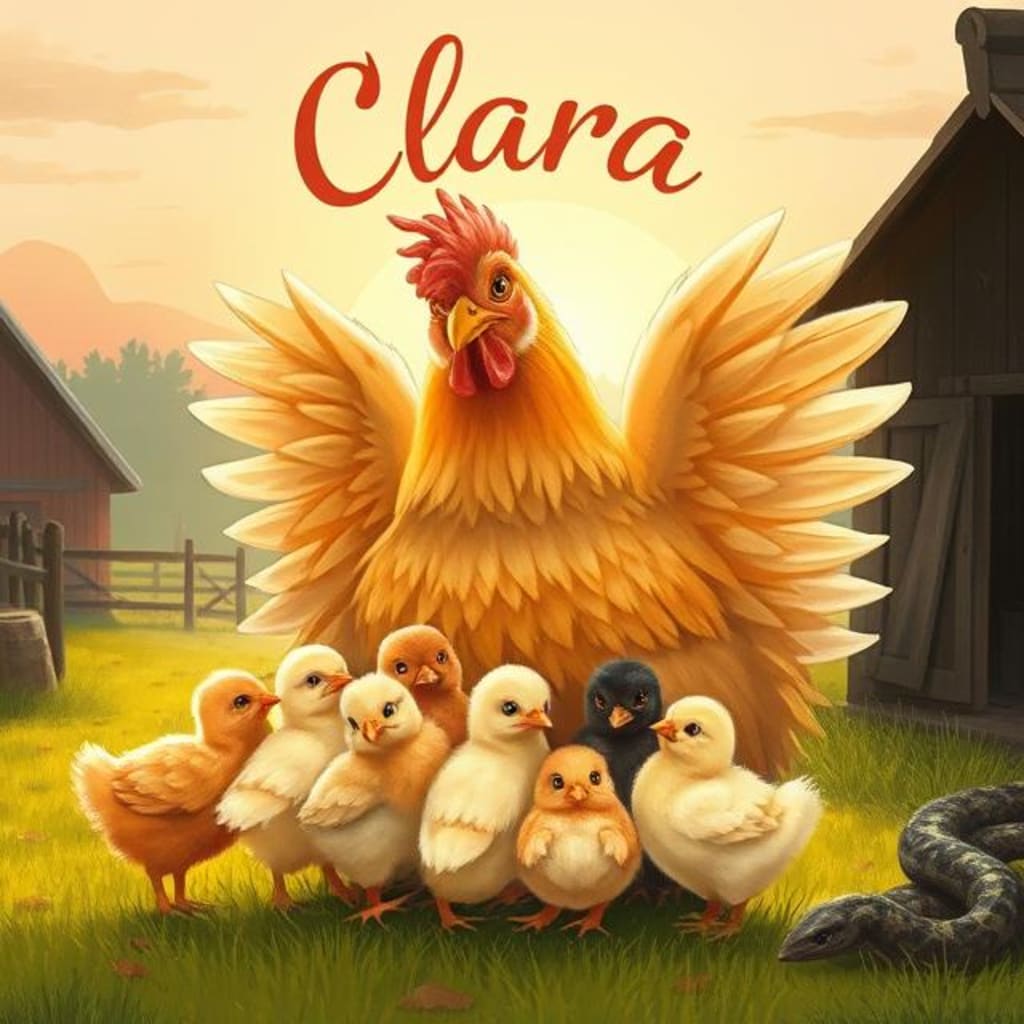
In a quiet village nestled between green hills and winding brooks, there was a cozy little farm run by a kind-hearted old woman named Granny Marla. The farm was modest but alive with animals and love—mooing cows, baaing sheep, clucking chickens, and the ever-curious goats. But among all the animals, one creature stood out the most.
Her name was Clara, a golden-feathered hen with a crown of deep red comb and eyes that sparkled with wisdom. Clara wasn’t just any hen—she was known far and wide among the village children as Mother Hen. And she had earned that name with every flap of her wings and every cluck from her beak.
Every spring, when the earth began to warm and the flowers peeked through the soil, Clara would begin to sit on her clutch of eggs. It was a sacred time on the farm—no child dared disturb her, and even the usually rowdy roosters kept their distance.
One year, as the cherry blossoms fell like pink snow, Clara hatched seven perfect little chicks. Each one fluffed up like a cotton ball, chirping and tumbling over each other. She named them: Pip, Peep, Fluff, Nugget, Speckle, Mimi, and Boots. Each had their own quirks—Pip was the loudest, Boots had dark feet that looked like tiny shoes, and Fluff was always sleepy.
Clara loved them fiercely. From the moment they cracked out of their shells, she was their shelter, their teacher, and their hero.
She taught them how to scratch the dirt for worms, how to stay away from the edge of the pond, and how to run for cover when the shadow of a hawk passed overhead. Every day was a lesson, and every night they curled under her wings, chirping softly until sleep took them.
But not everything in the world was warm and safe.
One morning, as the dew still clung to the grass and the air was cool with mist, Clara led her chicks to the edge of the cornfield. It was their first time venturing that far, and she was cautious. She checked every bush and watched the sky. The chicks chirped and darted through the stalks, their eyes wide with wonder.
Then, a sudden rustle.
Clara froze.
Out from the tall grass slinked a fox—lean, red, and hungry. His eyes locked on the chicks, and Clara's heart skipped a beat.
The chicks squealed and huddled behind her.
The fox stepped closer, licking his chops. “Good morning, Miss Hen,” he purred. “Out for a stroll with the little ones, are we?”
Clara puffed up her feathers, flared her wings, and clucked in the deepest voice she could muster. “Back away,” she warned. “You’ll not touch my chicks.”
The fox chuckled, low and smooth. “Oh, but I haven’t had breakfast. And they look so... tender.”
With a burst of courage, Clara did something unthinkable. She launched herself forward, flapping and screeching, pecking at the fox’s nose. Her wings were a blur of gold and fury. The fox yelped and jumped back, startled by the sudden assault.
At that moment, the loud barking of Granny Marla’s sheepdog, Rusty, echoed from the farmhouse. The fox didn’t wait. He vanished into the cornfield, tail low and pride wounded.
Clara rushed back to her chicks, who were trembling and peeping in fright. She clucked gently and nudged them close. “You’re safe now,” she whispered.
From that day on, the chicks looked at their mother with new eyes—not just as a warm place to hide or a guide through the fields, but as a protector stronger than fear.
Weeks turned into months. The chicks grew, their baby fluff replaced with feathers, their legs longer, and their curiosity even greater.
One sunny afternoon, as they pecked about near the barn, Pip—always the boldest—wandered off a little too far. Clara noticed at once and called out, “Pip! Stay close!”
But Pip had already disappeared around the side of the barn.
Behind it was the storage shed where Granny Marla kept old tools. The ground there was cracked and dry, and the shed hadn’t been opened in years. Pip peered inside curiously.
And there, curled in the shadows, was a snake—long, coiled, and silent.
Pip’s chirps of wonder quickly turned into panicked squeals as the snake slithered forward, its tongue flicking.
Clara came racing, faster than ever before. With a war cry that echoed through the farm, she flung herself at the snake. Her beak pecked, her claws scratched, and her wings beat the dust into the air. The snake hissed and tried to wrap around her, but Clara didn’t give up.
Rusty the dog, hearing the commotion, came bounding over. The snake sensed the danger and slipped away, defeated once again.
Clara was bruised and tired, but she stood tall. Pip ran to her, shaking, and buried his head in her feathers. “I’m sorry, Mama,” he whimpered.
She kissed the top of his head with her beak. “Just stay close, little one.”
Time passed, and the chicks grew into fine young hens and roosters. Clara watched with pride as they began to find their own place on the farm. But even as they grew, they never strayed too far from her. They still listened when she clucked, still came running when she called.
Granny Marla often sat on her porch, a cup of tea in hand, watching the golden hen with admiration. “You’re the bravest heart on this farm,” she would say.
And indeed, Clara was more than a hen—she was the heart of the flock, the keeper of the little ones, and the brave soul who stood up to every threat for the love of her children.
Epilogue
Years later, the stories of Mother Hen were still told. The village children would gather around Granny Marla as she spoke of the day Clara fought the fox, or how she saved Pip from the snake. They marveled at the golden hen who was more lioness than bird.
And sometimes, if they listened closely while walking past the coop at night, they could still hear the soft, soothing clucks of a mother whispering love to her sleeping brood.
Because a mother's love, whether feathered or not, is a force stronger than fear—and more enduring than time.
About the Creator
Keep reading
More stories from Muhammad Asad and writers in Education and other communities.
Two Little Kittens
– A Tale of Friendship, Survival, and Home In a quiet town nestled between rolling hills and golden wheat fields, the arrival of autumn always brought with it a touch of magic. Leaves danced through the streets, the scent of cinnamon hung in the air, and warm light spilled from the windows of cozy homes.
By Muhammad Asad11 months ago in Families
Legends of the Diamond: How Baseball’s Greatest Players Built a Timeless Legacy
Since its early days in dusty fields and growing towns, baseball has captured the imagination of millions. At the heart of this enduring appeal stand baseball legends who transformed the sport into a symbol of excellence and aspiration. These remarkable athletes did more than compete; they defined eras, inspired communities, and elevated the expectations of what players could achieve. As fans filled grandstands and tuned in from home, they witnessed moments that would echo across generations.
By Matthew Pothoff7 days ago in Education


Comments
There are no comments for this story
Be the first to respond and start the conversation.