
"Men Who Transformed America: Pioneers of Innovation and Entrepreneurship"
"Explore America's Visionary Entrepreneurs: Their Innovations, Contributions, and Legacy"
Introduction:
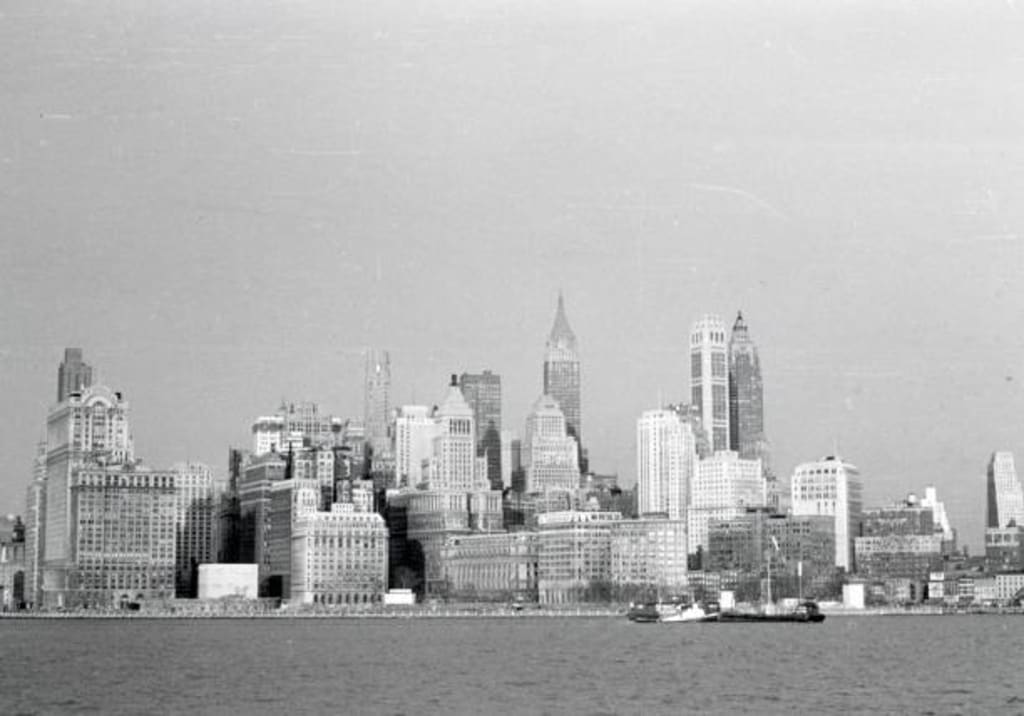
The men who built America were a group of visionary industrialists and businessmen who transformed the United States in the late 1800s and early 1900s. These visionaries turned America from an agrarian culture into a modern industrial powerhouse. They were driven by an unwavering determination to innovate and achieve, and their contributions to America's economic growth and progress are being felt today. These people had a lasting effect on American civilization and helped form the nation that we live in, from the oil industry to steel manufacturing, railways, and automobiles. This blog will examine some of the most notable people who helped to create America, their lives and legacies, and their contributions to American history.
Cornelius Vanderbilt:

Cornelius Vanderbilt, popularly known as the "Commodore," was a renowned American businessman and philanthropist who helped shape the American transportation sector. Vanderbilt started out as a ferry operator on Staten Island, New York, in 1794, and later moved into the steamship sector. He swiftly rose to prominence as a successful entrepreneur, expanding his shipping business to eventually dominate the sector.
Vanderbilt also had an important role in the development of railroads in the United States. He made significant investments in railways, and his commercial acumen aided in the establishment of rail transit as a major means of transportation in America and connected America from east to west. His talents aided in the transformation of America into an industrial powerhouse, and his impact may still be seen today. Vanderbilt's business techniques and entrepreneurial drive inspire future generations of business executives.
John D. Rocker feller:

John D. Rockefeller was born in 1839 in Richford, New York, and grew up in humble beginnings. He went to a public school before enrolling in a business school in Cleveland, Ohio. Following a few unsuccessful business efforts, he formed the Standard Oil Company in 1870, which would go on to become the world's largest and most profitable oil corporation. Rockefeller transformed the oil industry by establishing a vertically integrated company model that controlled all aspects of production, refining, and distribution. He used cutting-edge techniques including horizontal integration, which meant purchasing competing oil businesses and building a pipeline network that allowed his company to control the bulk of the oil sector.
Rockefeller's business practices were frequently condemned as monopolistic, and his corporation was finally broken up under antitrust laws by the US Supreme Court in 1911. Yet, Rockefeller's legacy as a visionary businessman and philanthropist live on. He was well-known for his charitable contributions, including substantial quantities of money to causes such as education, medical research, and social welfare. He established the Rockefeller Foundation, which still funds vital research and activities today. Rockefeller's creative business methods and humanitarian endeavours contributed to the development of America into the modern industrial civilization that it is today, and his legacy continues to inspire future generations of entrepreneurs and business leaders.
Andrew Carnegie:
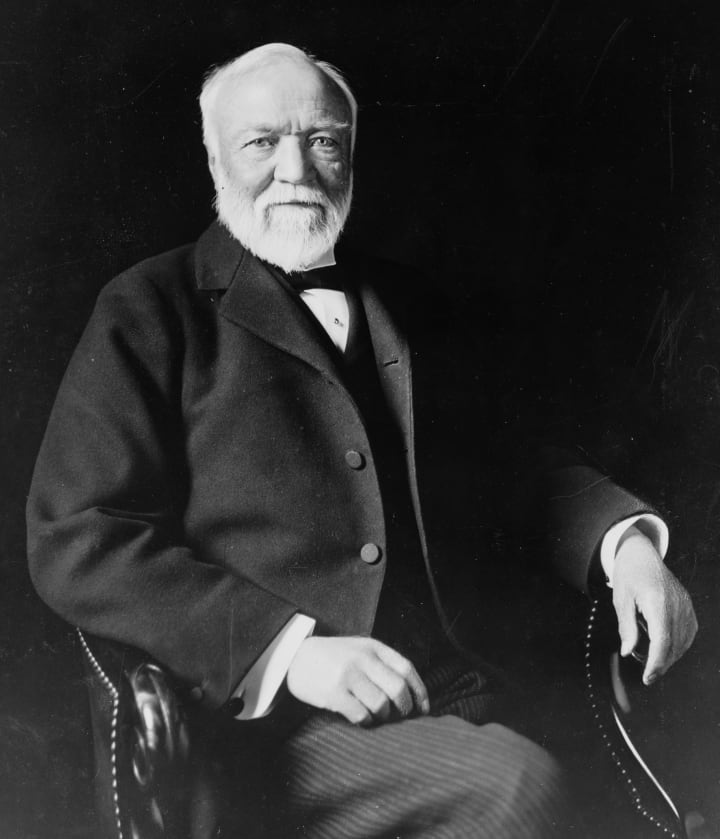
Andrew Carnegie was born in Scotland in 1835 and moved to the United States as a child with his family. He was raised in poverty and worked in a variety of professions before joining the steel industry in the late 1800s. Carnegie eventually formed the Carnegie Steel Corporation, which grew to become the world's largest steel maker and aided in the transformation of the United States into an industrial powerhouse.
Carnegie's commercial techniques were creative, and he is most remembered for introducing the Bessemer process, a way of mass-producing steel that was more efficient and less expensive than prior methods. Carnegie's success enabled him to collect a great fortune, and he rose to become one of the world's richest men.
Despite his enormous wealth, Carnegie was also noted for his charitable endeavours. He thought that the wealthy owed it to society to give back, and he contributed a large portion of his income to various organizations, including education and the arts. Carnegie is also remembered for creating hundreds of public libraries around the United States, which provided millions of people with access to literature and education.
Carnegie's business tactics and humanitarian initiatives had an indelible mark on American culture, and his legacy continues to inspire future generations of entrepreneurs and philanthropists.
Henry Ford:

Henry Ford was born in a tiny rural hamlet in Michigan in 1863. He grew up on a farm and was always fascinated by machinery and mechanics. He created the Ford Motor Company in 1903 after working as an apprentice machinist and engineer and transformed the car industry with his unique ideas.
Ford is most renowned for introducing the assembly line idea to mass manufacturing, which enabled efficient and cost-effective automotive manufacture. His Model T, released in 1908, was the first inexpensive and accessible vehicle to the common American. The Model T was manufactured on an assembly line, which drastically decreased manufacturing time and cost, making vehicles affordable to millions of Americans.
Ford was also a labour relations pioneer, having established the 40-hour workday and the minimum pay for industrial workers. He thought that providing good treatment to employees would increase their productivity and loyalty towards the organization.
Ford was a prolific inventor who owned over 150 patents in his name, in addition to his contributions to the automotive industry and labour relations. He was also a major supporter of renewable energy and experimented with various biofuels and electric vehicles.
Ford's history as an inventor and entrepreneur continues to influence business executives and engineers today. His influence on the car industry and on American culture in general is tremendous, and his inventive ideas continue to alter the world we live in today.
JP Morgan:

JP Morgan was born in Hartford, Connecticut in 1837 to a rich family. He rose to prominence as a banker and financier, playing an important part in the growth of the American economy in the late nineteenth and early twentieth century. Morgan was a key figure in the establishment of numerous important firms during his lifetime, including US Steel and General Electric.
Morgan's business tactics were forward-thinking, and he was well-known for his ability to arrange mergers and acquisitions that helped to consolidate sectors and simplify production. He was also a big railroad investor, contributing to the development of a large network of transportation infrastructure that aided the rise of the American economy.
Despite criticism of his commercial tactics, Morgan was well-known for his charitable contributions. He made major contributions to several causes, including education and the arts, and was crucial in the establishment of several prominent cultural institutions, including New York City's Metropolitan Museum of Art.
Morgan's reputation as a financier, businessman, and philanthropist lives on, and his contributions to the creation of the American economy have left an indelible mark on American culture.
Thomas Edison:
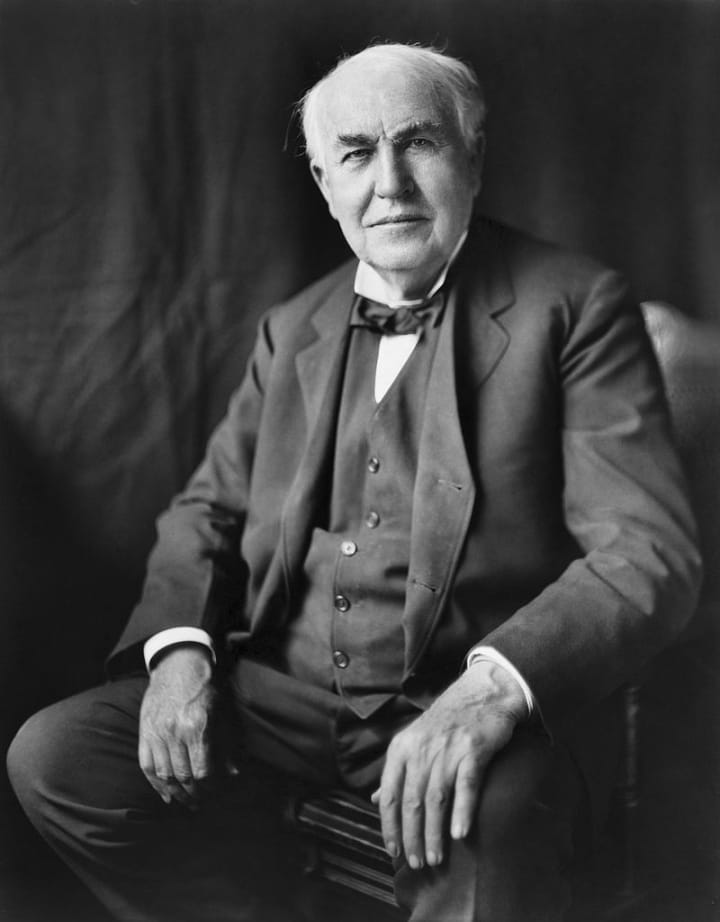
Thomas Alva Edison was born in Milan, Ohio in 1847 and grew up in Port Huron, Michigan. He was a prolific inventor and one of the most significant men in American history. Edison is well recognized for inventing the electric light bulb, the phonograph, and the motion picture camera.
Edison's early years were distinguished by a love of science and experimentation. He established a laboratory in his family's basement and conducted various experiments before inventing his first invention, a telegraph repeater, at the age of 21. In the years that followed, Edison continued to develop and innovate, filing over 1,000 patents during his career.
Edison's most renowned innovation was the incandescent light bulb, which he showed for the first time in 1879. The light bulb was a game-changer for American society, providing a reliable source of light that was safe, convenient, and affordable. Edison's electrical and lighting breakthroughs helped to alter American cities, making them safer, cleaner, and more efficient.In addition to his work in lighting and electricity, Edison is also known for his creation of the phonograph, which allowed for the recording and playback of sound, and the motion picture camera, which revolutionized the entertainment business. Edison's ideas and creations had a major influence on American civilization, ushering in a new era of technological advancement and growth.
Edison's reputation as an inventor, visionary, and entrepreneur continues to inspire scientists and engineers to this day. His contributions to American civilization are incalculable, and his impact on contemporary technology can still be felt today.
Conclusion:
Finally, Cornelius Vanderbilt, John D. Rockefeller, Andrew Carnegie, Henry Ford, J.P. Morgan, and Thomas Edison were visionary entrepreneurs and innovators who helped shape the American economy and society. They created new industries, streamlined production processes, and changed the way Americans lived and worked because of their business acumen, determination, and willingness to take risks. Their contributions to American society, such as the development of transportation and communication infrastructure, job creation, and the promotion of philanthropy and charity, have left an indelible mark on the world we live in today. Their legacies continue to inspire new generations of entrepreneurs and business leaders, and their forward-thinking ideas and visions for the future continue to shape the world we live in.
About the Creator
Keep reading
More stories from Rohith Medaboina and writers in Education and other communities.
"Unlocking Success: The Significance of Emotional Intelligence"
Emotional intelligence (EI) is a phrase that has grown in popularity in recent years, and for good cause. It refers to our ability to detect, comprehend, and control our own emotions, as well as to perceive, comprehend, and affect the emotions of others. Here are some of the reasons why emotional intelligence is essential:
By Rohith Medaboina3 years ago in Education
Do you really need to take 10,000 steps a day?
While most people avoid spending the night in jail, Jean Béliveau jumped at the opportunity. For the past three years, Béliveau had been walking from country to country, with the goal of circumnavigating the globe on foot. This required sleeping in tents, strangers’ homes, and the occasional jail cell along the way. But this morning, as Béliveau was ready to leave, the police chief, who had agreed to his sleeping arrangement, was nowhere to be found, and the guards weren’t buying his story. Few people have the time or desire to walk such extreme lengths.
By Munesh Yadav4 days ago in Education
What’s the best position to sleep in?
In the 1970s, psychoanalyst Samuel Dunkell proposed a curious, albeit almost completely unsubstantiated, theory that the position you sleep in reflects your personality. For example, preferring to snooze in the so-called royal position indicated self-confidence, while sleeping semi-fetal meant you’re sensible and well adjusted. While Dunkell’s ideas lack any definitive proof, how we sleep can impact our health. So, what’s the best position to sleep in? Sleep positions go by countless creative names—
By Munesh Yadav4 days ago in Education




Comments
There are no comments for this story
Be the first to respond and start the conversation.