
Maximizing the Power of Python in Data Science
A Look at the Best Libraries and Tools Available

DEFINITION OF PYTHON
Python is a powerful programming language that is widely used in data science. It has a variety of libraries and frameworks that make it easy to work with data, perform complex calculations, and visualize results.
TOOLS FOR RUN THE PYTHON CODE
There are several tools available for running Python code, some of the most popular include:
1. IDLE: IDLE is the built-in development environment for Python, it provides basic features for editing and running Python code. It is simple to use and is a good option for beginners.
2. Jupyter Notebook: Jupyter Notebook is a web-based interactive development environment that allows you to create and share documents that contain live code, equations, visualizations, and narrative text. It is widely used in data science and scientific computing.
3. PyCharm: PyCharm is a professional Integrated Development Environment (IDE) for Python development. It provides advanced features such as code completion, debugging, and refactoring. It is a good option for larger projects and professional development.
4. Visual Studio Code: Visual Studio Code (VS Code) is a lightweight, open-source code editor that is gaining popularity for Python development. It has a wide range of plugins and extensions, including the Python extension, which provides features such as linting, debugging, and IntelliSense.
5. Anaconda: Anaconda is a distribution of Python that comes with a variety of libraries and tools for data science and scientific computing. It also includes the Jupyter Notebook and Spyder IDE.
Ultimately, the best tool to run Python depends on your personal preferences and the specific project you are working on. IDLE and Jupyter Notebook are great for beginners, PyCharm is a good option for professional development, Visual Studio Code is a versatile tool and Anaconda is great for Data Science
LIBRARIES IN PYTHON
There are many libraries available in Python that are widely used in data science. Some of the most popular libraries include:
1. Numpy: This library provides support for large, multi-dimensional arrays and matrices of numerical data, as well as a large library of high-level mathematical functions to operate on these arrays.
2. Pandas: This library provides fast, flexible, and expressive data structures designed to make working with "relational" or "labeled" data both easy and intuitive. It is a great tool for data wrangling and preparation.
3. Matplotlib: This library provides a plotting system for Python, similar to that of MATLAB or Mathematica. It provides an object-oriented API for embedding plots into applications using general-purpose GUI toolkits like Tkinter, wxPython, Qt, or GTK.
4. Seaborn: This library is based on Matplotlib and provides a high-level interface for creating attractive and informative statistical graphics.
5. Scikit-learn: This library is built on top of NumPy and SciPy and provides a wide range of simple and efficient tools for data mining and data analysis. It is a great tool for machine learning.
6. TensorFlow: This library is an open-source software library for machine learning in various kinds of perceptual and language understanding tasks. It is developed by Google Brain Team and widely used in industry and academia.
7. Keras: This library is a user-friendly neural networks library written in Python. It is capable of running on top of TensorFlow, Microsoft Cognitive Toolkit or Theano.
8. PyTorch: This library is an open source machine learning library based on the Torch library. It is primarily developed by Facebook's artificial-intelligence research group.
These are just a few of the many libraries available in Python for data science. Each library has its own strengths and weaknesses, and the choice of which library to use will depend on the specific task or problem that you are trying to solve.
PYTHON IN DATA SCIENCE
1. Data Handling: Python has several libraries, such as Pandas and Numpy, that make it easy to work with data. These libraries allow you to import, manipulate, and clean data, making it ready for analysis.
2. Machine Learning: Python has several popular libraries for machine learning, such as scikit-learn and TensorFlow, that make it easy to build and train models. These libraries provide a wide range of algorithms, including supervised and unsupervised learning, which can be used for tasks such as classification, regression, and clustering.
3. Visualization: Python has several libraries, such as Matplotlib and Seaborn, that make it easy to create beautiful and informative visualizations. These libraries provide a wide range of chart types, including line charts, scatter plots, and histograms, that can be used to explore and communicate data insights.
4. Big Data: Python has several libraries, such as PySpark, that make it easy to work with large data sets. These libraries allow you to perform distributed computing, which allows you to analyze large data sets in a fraction of the time it would take to process them on a single machine.
5. Web Scraping: Python has several libraries, such as Beautiful Soup and Scrapy, that make it easy to scrape data from the web. These libraries allow you to extract data from websites, which can be used for tasks such as sentiment analysis, price comparison, and market research.
Overall, Python is a versatile and powerful programming language that is widely used in data science. Its libraries and frameworks make it easy to work with data, perform complex calculations, and visualize results, making it an essential tool for data scientists.
EXAMPLE
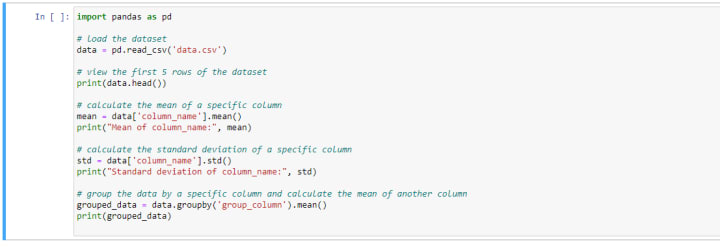
A Simple python program used for data science. I used Jupyter notebook for implementing this program.
Explanation:
- The program imports the Pandas library and assigns it the alias pd.
- The program loads the data from a CSV file using the pd.read_csv() function and assigns it to the variable data.
- The program uses the data.head() function to view the first five rows of the dataset.
- The program calculates the mean of the column specified by the column_name using the data['column_name'].mean() function.
- The program calculates the standard deviation of the column specified by the column_name using the data['column_name'].std() function.
- The program groups the data by the column specified by the group_column using the data.groupby('group_column') function, and then calculates the mean of other columns using the .mean() function.
- This is a simple example of how you can use Python and the Pandas library to load and analyze a small dataset in data science.
About the Creator
Keep reading
More stories from Ajay Marimuthu and writers in Education and other communities.
A comprehensive guide to data science tools and techniques: Tableau, MySQL, Python, EDA, Machine Learning, and Excel
INTRODUCTION Data science is the process of extracting insights and knowledge from structured and unstructured data using a combination of scientific methods, algorithms, and technologies. It involves collecting, cleaning, and organizing data, analyzing it using statistical and machine learning techniques, and then visualizing and communicating the insights to support decision-making. Data science can be applied in various fields such as healthcare, finance, marketing, and e-commerce to make predictions, identify patterns, and improve decision making.
By Ajay Marimuthu3 years ago in Education
How did Hitler rise to power?
How did Adolf Hitler, a tyrant who orchestrated one of the largest genocides in human history, rise to power in a democratic country? The story begins at the end of World War I. With the successful Allied advance in 1918, Germany realized the war was unwinnable and signed an armistice ending the fighting. As its imperial government collapsed, civil unrest and worker strikes spread across the nation. Fearing a Communist revolution, major parties joined to suppress the uprisings, establishing the parliamentary Weimar Republic.
By Munesh Yadavabout 20 hours ago in Education



Comments
There are no comments for this story
Be the first to respond and start the conversation.