
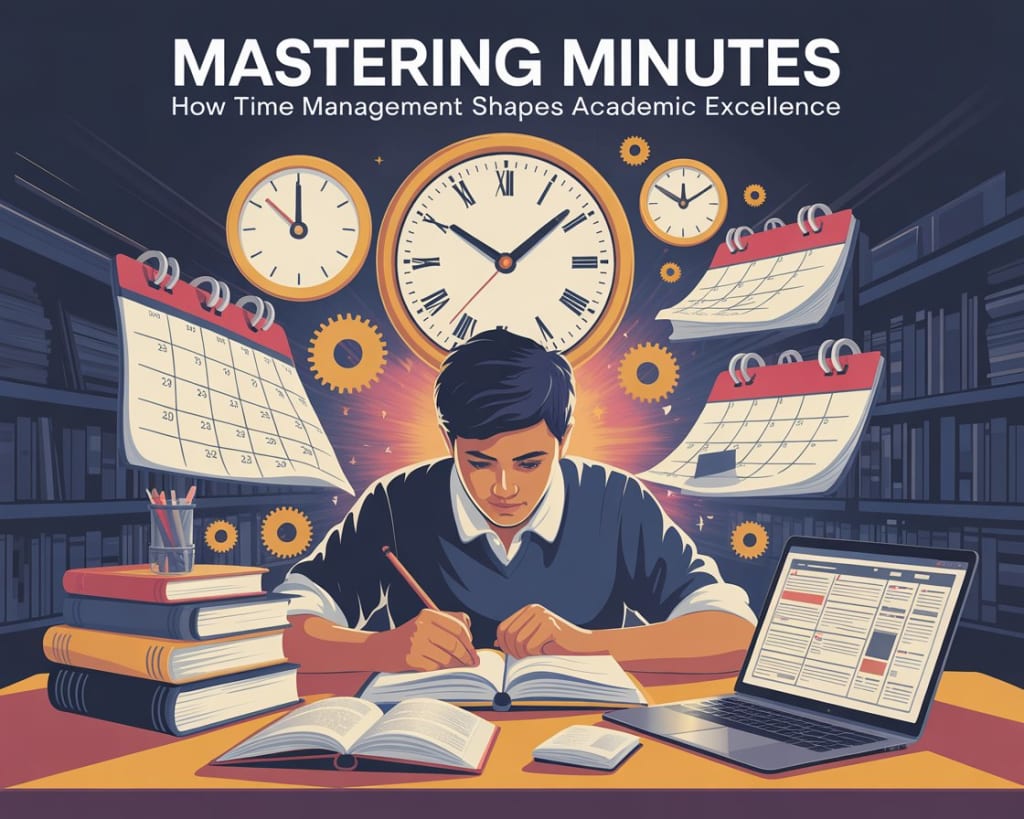
Mastering Minutes: How Time Management Shapes Academic Excellence
Discover how strategic use of time can transform your academic performance, reduce stress, and build success habits for life.

“Time isn’t the main thing. It’s the only thing.” — Miles Davis
In an era where distractions are just a click away, academic success no longer belongs solely to the most intelligent—it belongs to the most disciplined. And at the heart of discipline lies one irreplaceable tool: time management.
Students across the globe often face the same challenge—how to balance assignments, projects, exams, part-time jobs, and personal lives without losing their sanity or sleep. Some do it effortlessly; others struggle despite their potential. What separates the achievers from the overwhelmed isn’t always ability. More often, it’s how they manage their time.
The Real Currency of Success: Time
“Time is what we want most, but what we use worst.” – William Penn
Students typically start each semester with the best intentions: “This time, I’ll stay ahead of deadlines.” But as weeks pass, procrastination creeps in, tasks pile up, and the stress snowballs. Why does this happen?
It’s not a lack of time. We all have the same 24 hours. The key difference lies in how we allocate and prioritize those hours. Effective time management transforms limited time into measurable progress. Without it, even the smartest students find themselves caught in a web of anxiety, underperformance, and burnout.
Active Ownership: Taking Charge of Your Day
Time management isn’t just about using planners or making to-do lists. It’s a mindset shift. Successful students own their time—they don’t let it own them.
Here are a few habits that high-performing students cultivate:
Set clear, achievable goals – Instead of vague aims like “study more,” they define outcomes: “Review two chapters of biology tonight.”
Break large tasks into smaller chunks – They turn overwhelming assignments into manageable action steps.
Schedule everything—including breaks – Productivity doesn’t mean working nonstop. Scheduled breaks prevent burnout and refresh the mind.
Track and reflect – At the end of the day, they review: What worked? What didn’t? Where was time wasted?
Every hour is treated like a resource. When students begin viewing time as an asset—not an unlimited supply—they naturally become more responsible with it.
Academic Benefits Backed by Research
The connection between time management and academic performance isn’t just anecdotal—it’s backed by data.
A study published in Educational Research Quarterly found that students who practiced effective time management scored higher GPAs and reported lower stress levels compared to their peers who didn’t. Another study from the Journal of Educational Psychology indicated that students who prioritized time for self-study and minimized procrastination achieved consistently better grades.
Time management doesn’t just improve academic performance—it enhances overall student well-being.
Life Beyond Grades: Building Transferable Skills
“Don't say you don’t have enough time. You have exactly the same number of hours per day that were given to Helen Keller, Pasteur, Michelangelo, Mother Teresa, Leonardo da Vinci, Thomas Jefferson, and Albert Einstein.” – H. Jackson Brown Jr.
What makes time management even more valuable is its application beyond academics. Employers today seek candidates who can self-manage, meet deadlines, and handle pressure—all qualities developed through effective time use.
When students learn to plan their weeks, stick to priorities, and complete tasks without constant reminders, they’re actually practicing professional discipline. Whether you’re in engineering, business, medicine, or the arts, this skill becomes a foundation for lifelong success.
Digital Distractions: The Hidden Time Thief
Let’s face it—social media, streaming platforms, and smartphones have redefined the way we engage with time. What seems like a “quick scroll” turns into an hour lost.
Students who proactively manage their screen time tend to gain a competitive edge. Many high achievers use apps like Forest, Notion, or Pomodoro timers to stay focused. They know that attention is a currency, and every notification is a withdrawal from their productivity bank.
One student shared, “Once I turned off non-essential notifications and started working in 25-minute sprints, I was shocked at how much more I accomplished without feeling overwhelmed.”
From Chaos to Clarity: A Real Example
Take Sara, a university student juggling a part-time job and full-time coursework. Her grades began slipping when she tried to “wing it” day to day. After attending a workshop on time management, she started planning her week every Sunday night, allocating specific time slots for reading, assignments, work, and even rest.
Within a semester, her GPA improved by 0.8 points. She also found time for her hobbies again. “It’s not that I became smarter,” she admitted. “I just stopped wasting time.”
Final Thought: You Run the Clock
Time management is the silent partner behind every academic success story. It doesn’t promise perfection, but it does guarantee direction. In a world that celebrates hustle and productivity, managing time isn’t a luxury—it’s a necessity.
As students, you don’t need more hours in a day. You need more purpose in your hours.
“The bad news is time flies. The good news is you’re the pilot.” – Michael Altshuler
Start piloting your day with intent and watch how your academic path aligns with success.
Want to stay ahead of your deadlines and stress less? Start with your next hour—because how you spend it could shape your next grade, goal, or even your career.
About the Creator
Irfan Ali
Dreamer, learner, and believer in growth. Sharing real stories, struggles, and inspirations to spark hope and strength. Let’s grow stronger, one word at a time.
Every story matters. Every voice matters.
VFX in Education Market to Reach USD 6.9 Bn by 2034, Driven by Immersive Learning Demand
Introduction The VFX in education market refers to the integration of visual effects technologies into formal and informal learning environments. It encompasses tools, software, and course content that use visual effects to create realistic simulations, animated visualizations, and interactive learning aids. These elements are designed to help students grasp complex concepts more easily and support educators in delivering engaging lessons.
By Roberto Crum8 days ago in Education
Olena Kalaitan on Mariupol, Journalism, Language, and War in Ukraine
Olena Kalaitan is a Ukrainian journalist and editor best known for leading Mariupol’s Pryazovskyi Robochyi newspaper and heading the Donetsk regional organization of the National Union of Journalists of Ukraine. During Russia’s 2022 siege of Mariupol, she stayed in the city for 23 days, survived the destruction of her home, and escaped on foot with her son. She later became a prominent voice for displaced journalists, media freedom, and the revival of independent Ukrainian journalism in occupied and war-affected regions. Kalaitan has also warned publicly against Russian propaganda issued under the stolen name of her newspaper during wartime occupation there.
By Scott Douglas Jacobsenabout 14 hours ago in Education



Comments
There are no comments for this story
Be the first to respond and start the conversation.