

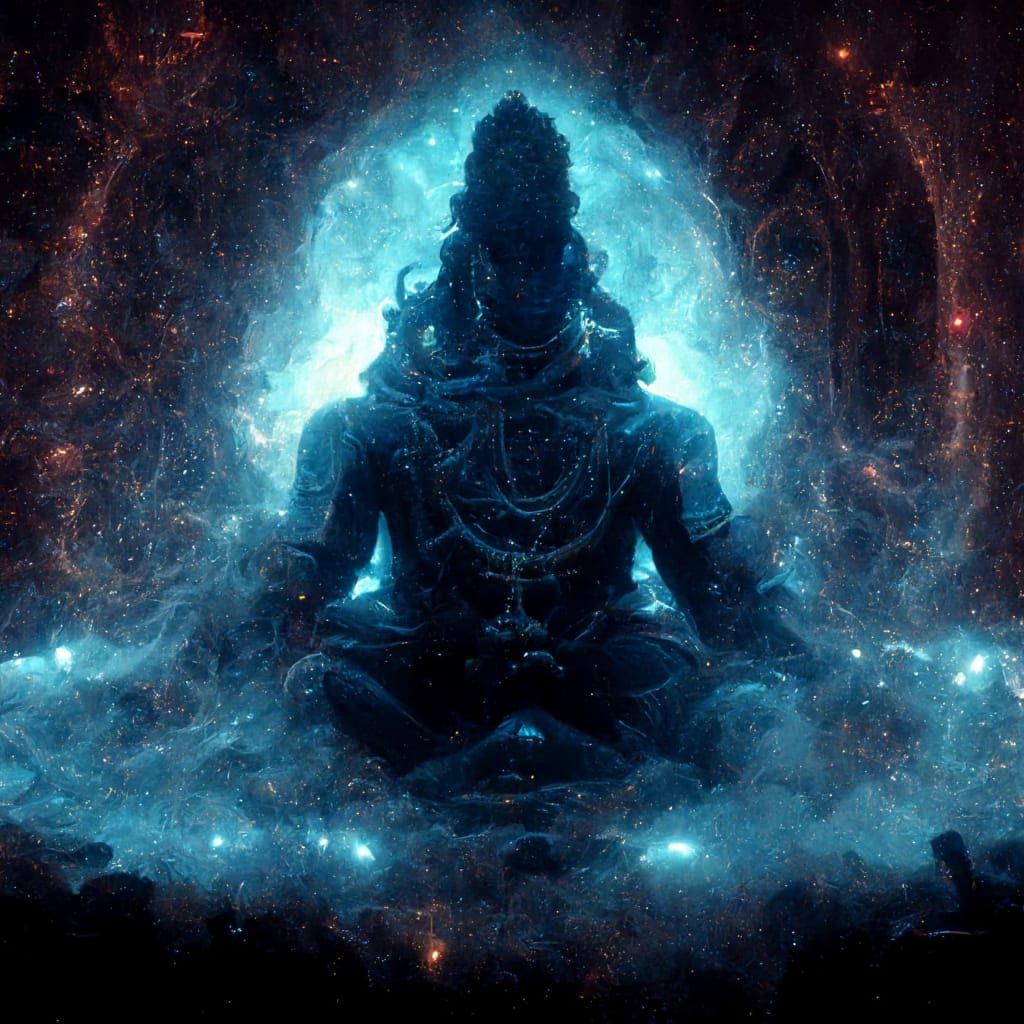
The Legend and Glory of Lord Shiva, the Maha-Deva
Shiva—The word Shiva refers to the third God of the Trinity, and the one who has been assigned the task of bringing the world to an end. The word itself briefly means the eclectic, glorious, and beautiful virtues of truthfulness, purity, auspiciousness, wisdom, enlightenment, erudition, sagacity, blissfulness, dispassion, detachment, holiness, and divinity. These are accompanied by a high degree of peace, tranquility, serenity, and their attendant happiness, joy, and bliss. Since ‘truthfulness and auspiciousness’ are qualities that are beautiful, this word also means something that is beautiful and beyond reproach.
Briefly therefore, the word ‘Shiva’ means ‘one who is auspicious, always pure, holy, divine, truthful, beautiful and blissful’. Shiva is the Lord who is self-realized and a personified form of the cosmic Consciousness and the Absolute Truth.
He is also known as ‘Rudra’, the angry one. Lord Shiva is uncompromising and unrelenting in his pursuit of immaculacy, purity, auspiciousness, righteousness, nobility, probity and propriety, and hence called Rudra, the angry God.
‘Rudra’ has zero tolerance for impertinence, mischief, and nonsense. ‘Shiva’ is, on the other hand, calm, tolerant, and forgiving. Shiva always remains in a state of meditation and contemplation, a state that is depicted in his posture of blissfulness and half-closed eyes.
Rudra, on the other hand, spews fire and brimstone. While Shiva symbolizes the virtues of Brahm marked by blissfulness, tranquility, calmness, wisdom, enlightenment, self-awareness and contentedness, Rudra represents the qualities of dynamism, vitality, vigor, strength, and energy present in Brahm.
The question arises ‘why did Shiva become Rudra (angry)?’
The answer is that when Shiva found that his sense organs and mind did not allow him the peace that he sought by meditation and contemplation upon the ‘Atma, the self’, he became angry over them, and severely took them to the task—i.e. he became ‘Rudra’ or angry. It is like the case of a teacher who is of a very calm nature and loves his students like they were his own sons, but when he finds that his kindness and loving nature are being misused by the students who create a ruckus in the class, he has to become stern and spank them in order to restore discipline and decorum. But that does not mean that he is cruel or wishes to harm his students in the least. This same thing applies to Shiva.
Shiva becomes Rudra in order to ruthlessly punish the creatures of this creation who behave like savages or animals. This is necessary for him as he is the Supreme Being who has the mandate to maintain order and balance in this creation, and he would be failing in his moral duties and obligations if he tries to maintain a false exterior of calmness when his interior is agitated by the upheaval all around. The Supreme Being that Shiva has an obligation to uphold positive traits and the virtues of auspiciousness, righteousness, probity, and propriety in this creation even if it means that his own image of being calm and forgiving is questioned and overshadowed by anger and vehemence.
Just in the case of severe and malignant diseases like cancer and tuberculosis requiring an equally strong medicine, the evil, pervert, and demonic forces of creation require an equally strong antidote to be overcome.
Lord Shiva has many other names also as follows:--
1. Aashutosh—meaning one who fulfills all wishes of his devotees instantly.
2. Bhairav—meaning the Lord of Terror.
3. Bhole-Nath—meaning the Lord who is simple-hearted, unpretentious, straightforward, honest, sincere, and humble inspite of being the Lord God.
4. Bhu-Dev—meaning the Lord of the earth.
5. Devaa-dhi-dev—meaning the Lord of all the Gods; the supreme God; the primordial God; the first amongst the Gods; the God who was present before the coming into being of all the other Gods.
6. Gangaa-dhar—meaning the Lord who holds the mighty river Ganges in the lock of hairs on his head.
7. Jagdish—meaning the Lord of the world, the universe.
8. Kailash—meaning the Lord who eliminates miseries and torments, restoring peace and happiness to the creature. It also means the Lord of the sacred mountain with the same name, viz. Mt. Kailash.
The Shiva Loka
The Devipuran Mahabhagwat, Canto 43 describes the ‘Shiva Loka’ in terms used in ancient mythological histories known as the Puranas. It is described along with the abodes of other Gods of the Trinity, i.e. Vishnu the sustainer of creation, and Brahma the creator.
Their locations have been mentioned specifically in verse nos. 9-10, 13, 17, 22, and 25 are as follows—
“Verse nos. 9-10 - The netherworld (subterranean world), the terrestrial world, the heaven and the Brahma Lok (residence of Brahma)—they progressively extend out in consecutive layers (i.e. in concentric circles) far deep into the recesses of the boundless universe (9).
Brahma Lok is situated in the outer layer (i.e. on the fringes) of the universe, and further afield from it, at a distance of 1 lakh Yojans (1 Yojan = 8 miles; hence, at a distance of 8 Lakh, or roughly 8 hundred thousand miles), is the Shiva Lok (abode of Shiva) which is faultless, sinless, healthy, and divine (10).
“Verse no. 13 = 1 lakh Yojans (8 hundred thousand miles) higher than the Shiva’s abode is the Vishnu’s Loka where he (Vishnu) resides with Kamla (Laxmi). He holds a conch, a discus, a mace, and a divine lotus in his hands (13).
“Verse no. 17 = To the left of the Shiva’s abode is the most pleasant and enchanting ‘Gauri Loka’, which is adorned with a large treasure trove of strange and magnificent gems such as rubies etc. (17).
“Verse no. 22 = Better and more magnificent than all the ‘Brahma Lokas’ put together, endowed with a divine ethereal illumination, most marvelous, glorious, and pure is the ‘Goloka’ where Sri Krishna resides with Radha (22).
“Verse no. 25 = Fifty crore Yojans above it (1 crore = 10 million; 1 Yojan = 8 miles) is the divine abode of the great Goddess where she resides most secretly (25).”
Non-duality or oneness between Shiva and the other great Gods of the Trinity
It is well established that one of the names of Lord Shiva is ‘Maha-deva’, the ‘Great God’. One is called ‘great’ only when he has certain virtues and qualifications that are extraordinary, magnificent, and grand.
The three Gods of the Trinity represent the three fundamental facets or phases or aspects of this creation—viz. creation, growth and development, and conclusion. They are represented by Brahma the creator, Vishnu the sustainer and protector, and Rudra the concluder.
As we have already studied in the above pages, ‘Rudra’ is one function of Shiva, and it is to conclude. But Rudra is not the complete identity of Shiva, for Lord Shiva is genuinely and inherently calm and tranquil, being lost in meditation and contemplation, as opposed to the obvious angry and wrathful form of Rudra.
After all, being the ‘Great God’ who is a manifestation of the Supreme Being known as Brahm, one of his duties is to bring to an end whatever has come into being, because change is the fundamental law of Nature, and the old becomes stagnant, stale, and staid at some point of time when it is no more possible for further development and growth, i.e. when the outer boundary of creation and renovation are reached, thereby creating a need for change, restructuring, rejuvenation and replacement. Then Shiva becomes ‘Rudra’.
Being the ‘Great God’, he is also responsible for sustaining this creation, and this form of Shiva is known as ‘Vishnu’. When the time comes to start a new phase of creation, Shiva becomes the creator ‘Brahma’.
In his cosmic form, Shiva is Brahm, the cosmic Consciousness, and in his the microcosmic form he is the pure conscious Atma, the soul, the ‘self’ of all living beings.
Non-duality or oneness or uniformity between Shiva, Vishnu, and Brahma as Trinity Gods, Jiva and Brahm—The entire Rudra Hridaya Upanishad and Skanda Upanishad of the Krishna Yajur Veda is dedicated to this theme.
Some of the concepts on non-duality as propounded in Skanda Upanishad are as follows—
(i) Non-duality or oneness or uniformity between Shiva and Vishnu = verse nos. 4, 8-9. [This fact has also been highlighted in the book ‘Vinai Patrika’ of saint Goswami Tulsidas, in its verse no. 49.]
(ii) Non-duality or oneness or uniformity between Shiva and Jiva or the living being = verse nos. 6, 9.
(iii) Non-duality or oneness or uniformity between Shiva, Brahm, and Jiva = verse no. 9.
(iv) Non-duality or oneness or uniformity between the three Gods of the Trinity = verse no. 13.
(v) The relationship between Shiva and Shakti has been explained in Yogshikha Upanishad, Canto 1, verse no. 167.
(vi) The non-duality or oneness between Shiva and Vishnu has been explained in Rudra Hridaya Upanishad of Krishna Yajur Veda; the Brihajjabal Upanishad, Brahman 6, verse nos. 8-9, and the Sharav Upanishad of the Atharva Veda.
(vii) The non-duality or oneness between Brahm and Shiva has been expounded in (i) Krishna Yajur Veda’s Varaaha Upanishad, Canto 4, verse no. 32; Dakshin Murti or Dakshin Mukhi Upanishad. (ii) Atharva Veda’s Atharva-shir Upanishad.
(viii) The question ‘how Shiva, the personification of the eternal Truth of creation known as Brahm, becomes a Jiva or the living being’ has been answered in Skanda Upanishad of Krishna Yajur Veda, verse no. 7, 13.
(ix) Non-duality between Brahm, Atma, and Shiva—Rudra Upanishad, verse no. 3, stanza no. 1-2.
(x) Non-duality between Lord Nrisingh/Narsingh and Shiva—Nrisingh Purvatapini Upanishad, Canto 1, verse nos. 10, 12.
(xi) Non-duality between Lord Ram, Narayan (Vishnu), and Shiva—refer to Ram Rahasya Upanishad of Atharva Veda, Canto 5, verse no. 3.
About the Creator
Vishal Kumar Biswas
My passion for storytelling started at a young age, and since then, I have devoted myself to perfecting the art of crafting narratives that captivate and resonate with readers. I invite you to read more from me with every word I write
Keep reading
More stories from Vishal Kumar Biswas and writers in Education and other communities.
"Capybara Cuteness: Why These Adorable Animals are Taking the Internet by Storm"
If you spend any time online, it's likely that you've come across the capybara, a large rodent that has recently taken the internet by storm. With their round faces, adorable expressions, and tendency to snuggle up with other animals, it's easy to see why these creatures have become such a popular internet sensation. But what is it about capybaras that makes them so appealing? Let's take a closer look.
By Vishal Kumar Biswas3 years ago in Petlife
Becca
"Everything is so... flat." Denille said stupidly as she looked around her new neighborhood. She looked around at the muted desert where even the smallest sign of life seemed to have given up. The plant life was shrubs that were half cooked by the heat and where there should have been a lawn, a mess of white rocks laid glistening in the sun. Even the sky looked stretched thin, like the sun had ironed it smooth. She’d moved from Riverside, where at least there were hills, but here in Barstow, everything felt baked and brittle.
By Sara Wilson6 days ago in Fiction



Comments
There are no comments for this story
Be the first to respond and start the conversation.