
Leveraging Data Science to Improve Water Tanker Routes in Mumbai Suburbs
Leveraging Data Science to Improve Water Tanker Routes in Mumbai Suburbs
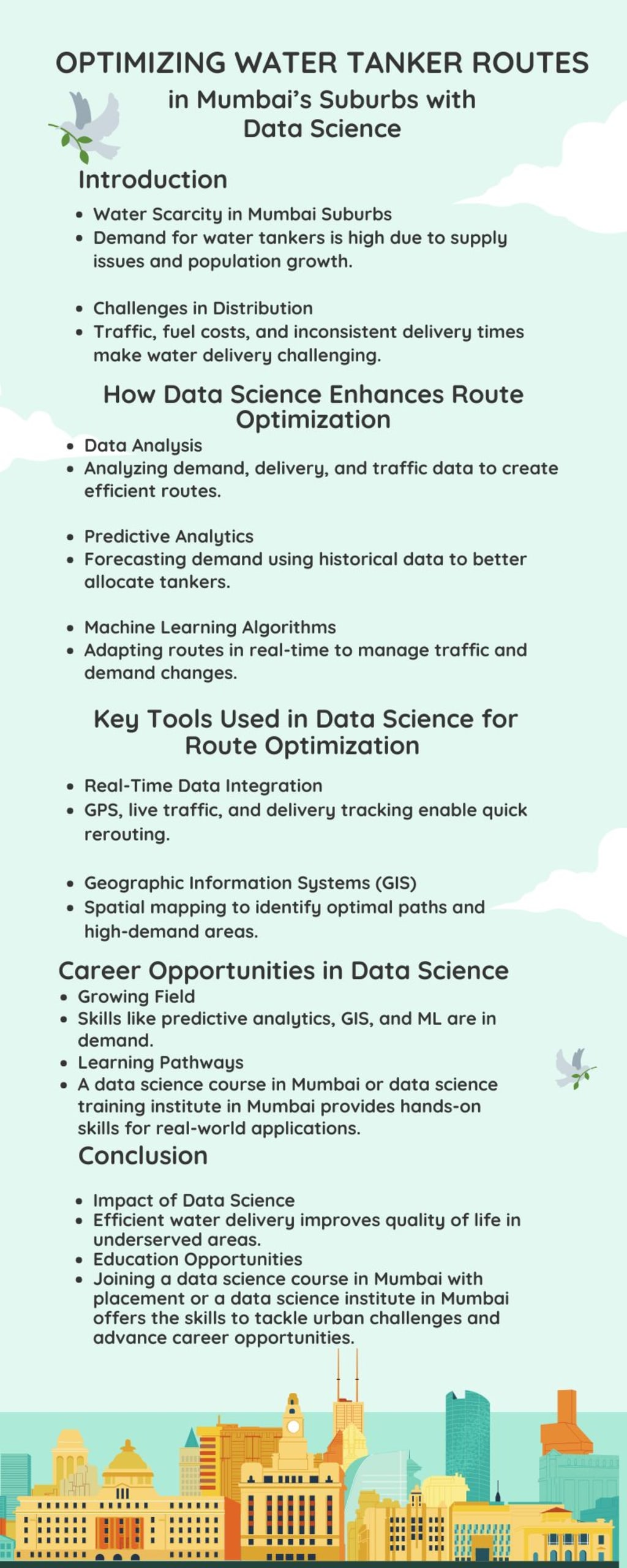
Introduction
Many neighborhoods in Mumbai, which has recently emerged as one of the most populated cities in the world, are still struggling to cope with the demands of water supply. There are unexpected changes in rainfall and high growth of urbanization leading to water rationing, which has become rampant; most of the suburban residents rely on water tankers to get water. This leads to some problems with logistics because water tankers have to negotiate crowded city streets and have very small options with which they can get the water into the homes. These challenges, however, can be controlled with the help of data science. With the help of data science solutions, it becomes possible not only to improve the routing of water tankers but also to improve the efficiency of transportation and reduce the overall cost, along with delivering water where it is needed the most.
The Need for Efficient Water Distribution in Mumbai
Some of the populations are residents of Mumbai’s suburbs, which are amongst the most rapidly urbanized in the country but rarely have ‘first-world’ services such as a workable water supply system. There is a high demand for water tankers, especially during the dry season, thus exerting much pressure on the authorities and private tankers to deliver this product on time. However, whenever there is no optimized route system, distortion occurs, and hence many problems, such as delays, high fuel costs, and high carbon emissions, among others, due to unnecessary circulation. Through data science, better route plans can be identified, and Mumbai can be more efficient, convenient, and eco-friendly.
How Data Science Enhances Route Optimization
From a rather broad spectrum of analytical and predictive data tools, Data science easily helps to turn raw data into insights. For example, in water tanker routes, combine the factors that include flow, geography, and demand to produce the most suitable route. The information presented in this paper can assist the water supply authorities in minimizing waste, removing costs, and guaranteeing timely delivery.
For instance, the optimization of the routes used in supply chain management such as logistics and transportation invitations, multiple aspects of data that entail road conditions, past traffic patterns, and even weather. The end product is a sound and evidence-based logistics plan for the right location for water tankers to refill and the shortest and fastest distance between those points in a network.
Applying Predictive Analytics to Demand Forecasting
An important factor of water tanker distribution includes the ability to forecast water demand. Data science is applied, and data is used to make predictions of water requirements that depend on population, previous and current consumption, and time of the year. For example, some residents’ areas may be characterized by high demand at some particular seasons while others may demand water tankers at irregular intervals.
Data science courses in Mumbai and advanced training in a data science institute in Mumbai normally contain topics on predictive analytics, which helps data scientists design that kind of demand forecasting models. The real datasets help understand how demand will change in the future and help the design of a set of models to control the changing routes and schedules of water tankers so that the resources will be in place where they will be most needed.
Optimizing Resource Allocation with Machine Learning
Another technique of smart data operation in the tanker route solution is the machine learning technique, commonly referred to as ML. MLA is capable of determining some parameters like available water tankers, operational distance, traffic conditions, and delivery schedule to find the proper routes. These algorithms can be refined in a dynamic way thus guaranteeing that water is delivered as soon as possible.
Currently, training institutes in Mumbai have come up with courses that focus especially on machine learning programs in logistics. By working through these algorithms, students can gain an understanding that allows them to create solutions that can be self-optimised with live data. All these skills are especially useful to anyone wanting to work in certain fields like city planning, and inventory control, among others focused on resource management.
Real-Time Data Integration for Improved Routing Decisions
Real-time data integration is important for dynamic route optimization. Having instantaneous information inputted from GPS-equipped aqua-tankers and traffic provisions, data analysts are able to modify the path in real time. For instance, if there is a constraint on movement, such as traffic congestion, the algorithm can reroute the tankers and minimize the time taken waiting for delivery of water.
When it comes to data science courses in Mumbai with placement, students get practical exposure to the latest in real data. In incorporating such data, data scientists will provide dashboards depicting the current location of tankers, expected time of arrival, and traffic information to enable dispatchers to make prompt decisions.
Implementing Geographic Information Systems (GIS)
Geographic information systems are sources used to plot locations and carry out spatial analysis on the best routes to take. Benchmarking is important in the management of a city because GIS avails information relating to the topographical features of the city, including the transport infrastructure and traffic pattern, and this makes it easier to identify appropriate routes for the water tankers. Also, using GIS data, the high water demand can also be identified to enhance the placement of tankers.
There are several data science institutes in Mumbai, and most of them have embraced GIS study so that students can learn more about spatial data analysis. Since GIS is an ideal route optimization tool, data science learners get relevant skills to participate in resource distribution projects for urban areas.
Benefits of Data Science-Driven Route Optimization
Reduced Fuel Consumption and Costs: Optimised routes mean that the tankers cover less distance and hence less fuel and emissions are used. Considering optimised routes means that the tankers cover a shorter distance, which leads to minimal fuel and emission usage.
Improved Delivery Times: Successful avoidance of crowded regions by applying data science means that water gets delivered to the targeted communities without delay.
Enhanced Customer Satisfaction: Standard water delivery gives a certain level of confidence to the population in a given region, whereby in certain areas, people rely on water tankers for their daily water needs.
Better Resource Management: By so doing, demand forecasts help authorities to allocate tankers where most needed while minimizing utilization of the resources and hence constant usage which puts much strain on the vehicles.
Case Study: A Data-Driven Approach to Water Distribution
Supposing the Mumbai suburban authorities approach the Data Science Institute situated in Mumbai to those who want to optimise its water tanker routes. The data science team gathers information about past water consumption, the time it takes tankers to move from one area to another, and the movement of vehicles in certain areas. With this data, they develop a quantitative model to estimate demand in each of the neighbourhoods and another one for delivery routes.
Having adopted the model, the average time in transit for tankers is reduced by twenty per cent, and fuel consumption is reduced by fifteen per cent a major improvement on the financial front. The project enhances water delivery while showcasing how data science solutions execute logistics problems.
Career Opportunities in Data Science for Urban Resource Management
Knowledge of data science in enhancing the routes of water tankers in the suburbs of Mumbai explained this area's impact in managing urban resources. With this learning, many students who are joining a data science course in Mumbai with placement are now sealing jobs in areas that are outside the normal IT realm, focusing on vibrant positive changes within society. Education received at a Data Science Training Institute in Mumbai sometimes involves solving problems in a given city to ensure the students are ready for both private and government sector jobs.
Graduates from data science programs can work in urban planning, logistics, and municipal resource management. Their knowledge of route optimization, the use of predictive analytics, and real-time data integration make them more valuable. Such skills are becoming more valuable because of the emerging attempts to enhance the organizational performance of service cities like Mumbai.
Final Thoughts
The use of data science in improving the routes of water tankers in the suburbs of Mumbai is one of the outstanding developments of resource management in urban areas. Through the use of predictive analytics, machine learning, and real-time data interconnectivity, authorities can provide effective water delivery in the required areas. In addition, data science training institutes in Mumbai serve the important purpose of providing better training to future data science professionals to deal with such real-life issues.
For anyone interested in becoming a data scientist, getting into a Data Science Course in Mumbai means learning real-life activities such as predictive modeling, GIS, and machine learning. Due to the increasing need for professionals with relevant skills in the management of the growing urban cities, data science courses in Mumbai with placement provide an opportunity for graduates to contribute to society. This means that what data scientists are doing via projects such as water tanker route optimization is making people’s lives better in Mumbai in very tangible ways, starting with the optimization of just one specific route.
About the Creator
How Global Experiences Shape Smarter, More Creative Leaders
Leadership today demands more than experience and technical skill. It requires imagination, empathy, and the ability to see problems from new angles. One of the most potent ways leaders develop these qualities is through travel. When leaders step outside familiar routines, they gain insight that books and meetings cannot offer. Exposure to new cultures, environments, and ways of thinking shows clearly how creative leadership through travel can unlock ideas that change how leaders think, decide, and inspire others.
By Nathalie Kyriakou4 days ago in Education
Can You Really Earn Money With Transcription? The Real Income Reality
The short answer is yes—you can earn money with transcription. But the more honest, useful answer is this: transcription only becomes worthwhile when you understand how the income actually works, not how it’s often presented online.
By Mahesh Kumar5 days ago in Education


Comments
There are no comments for this story
Be the first to respond and start the conversation.