

Thought for a couple of seconds
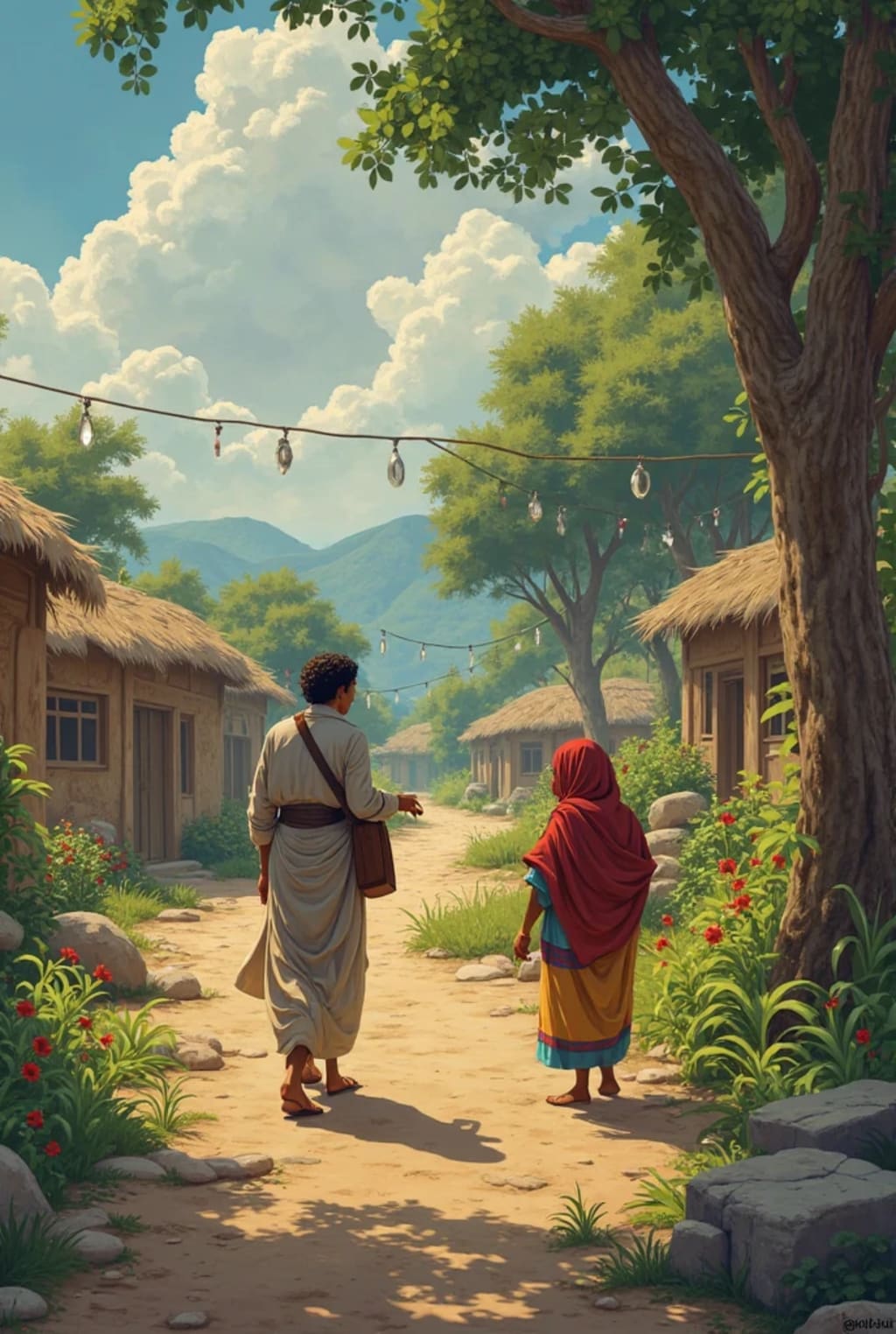
In a land once divided by walls of fear and whispers of hate, there lay a village called Amani—“peace” in an old tongue. Though its fields were green and its rivers clear, the people of Amani carried heavy hearts. Long years of mistrust had taught them to look at neighbors with suspicion, and even children learned to hide their joys behind cautious smiles.
One dawn, a wandering minstrel named Ziya arrived at Amani’s gates. She carried nothing but her lute and a satchel of stories. As she walked through the market, her gentle song drew curious faces. She sang of distant lands where strangers shared bread, of mothers teaching children to hold hands instead of fists, and of forests where the wind itself whispered words of kindness. The melody wove its way into the bones of the listeners, awakening memories of laughter they had forgotten.
An old potter named Farid, who had long ago closed his kiln in anger at a friend’s betrayal, found tears on his clay-stained hands. A baker’s apprentice, Laila, remembered the first time she had offered a roll to a passing traveler and felt warmth light her chest. Even the village chief, Ismail, sat in silence as Ziya’s music painted visions of unity in his mind.
After the song ended, Ziya spoke: “Music and stories carry the power to mend what is broken. Will you share your own tales and songs, that your hearts may remember how to beat in time with one another?” Hesitantly, Farid began to speak of the old days, when he and his fellow potters shaped clay side by side, their laughter as much a part of the work as the spinning wheel. Laila hummed a lullaby her mother once sang, and others added lines until a new song blossomed—one of shared dreams and hands joined across differences.
Over the next week, the villagers gathered each evening in the town square. They rebuilt fallen fences not as boundaries, but as benches for neighbors to sit together. They planted trees along the dusty roads, each sapling a promise of growth and cooperation. Children of different families held painting contests on each other’s doorsteps, and laughter echoed where silence had reigned.
One night, under a sky full of stars, Ziya invited everyone to bring a stone—small, smooth, and weathered. “Place it before you,” she said, “and tell its story.” A farmer spoke of the pebble that sat forever in his field, a reminder that even small obstacles could be moved with patience. A seamstress held up a beach stone, polished by waves, and said, “As this stone was shaped by the tides, so too can our hearts be smoothed by understanding.”
When each story was told, Ziya asked them to set their stones in a circle around a single lantern. “May this light be your pact,” she said. “That every time you see its glow, you will remember how easily fears can be replaced by friendship.” The lantern’s flame danced across hopeful faces, and for the first time in many seasons, Amani felt truly alive.
Before dawn broke the next day, Ziya slipped away as quietly as she had come. But her song remained, carried on children’s laughter and on the breeze that rustled through the leaves of the newly planted trees. And when travelers passed through Amani, they found not a village of wary eyes, but a place where strangers were welcomed as family, and peace was not merely a name, but the way people lived—one shared song, one planted tree, one lantern-lit promise at a time.
About the Creator
Reader insights
Nice work
Very well written. Keep up the good work!
Top insight
Excellent storytelling
Original narrative & well developed characters
Keep reading
More stories from Khizar khan and writers in Education and other communities.
The Whispering Grove"
**Title: The Whispering Grove: The Silent Bond Between Humans and the Wild** In a village tucked between two towering mountains, where the rivers sang to the skies and the winds carried the scent of pine and moss, there was a forest called the Whispering Grove. The villagers often spoke of it in hushed tones, revering it as a place of ancient magic. It was said that within the depths of the forest, the trees could speak, the animals could understand, and the winds carried the voices of those who knew how to listen.
By Khizar khan10 months ago in Education
Olena Kalaitan on Mariupol, Journalism, Language, and War in Ukraine
Olena Kalaitan is a Ukrainian journalist and editor best known for leading Mariupol’s Pryazovskyi Robochyi newspaper and heading the Donetsk regional organization of the National Union of Journalists of Ukraine. During Russia’s 2022 siege of Mariupol, she stayed in the city for 23 days, survived the destruction of her home, and escaped on foot with her son. She later became a prominent voice for displaced journalists, media freedom, and the revival of independent Ukrainian journalism in occupied and war-affected regions. Kalaitan has also warned publicly against Russian propaganda issued under the stolen name of her newspaper during wartime occupation there.
By Scott Douglas Jacobsen5 days ago in Education
Creating Connections: How Churches Unite People Beyond Sunday
For many people, church is more than a place for worship. It becomes a center where relationships grow, and communities find strength. Creating Connections: How Churches Unite People Beyond Sunday reflects the idea that church life extends far beyond weekly gatherings. It provides opportunities for people to support one another, share experiences, and develop meaningful friendships.
By Mike Signorelli4 days ago in Education


Comments (2)
Good 😊
Nice