
Lalbagh Botanical Garden: A Heaven for Nature Lovers
Lalbagh Botanical Garden
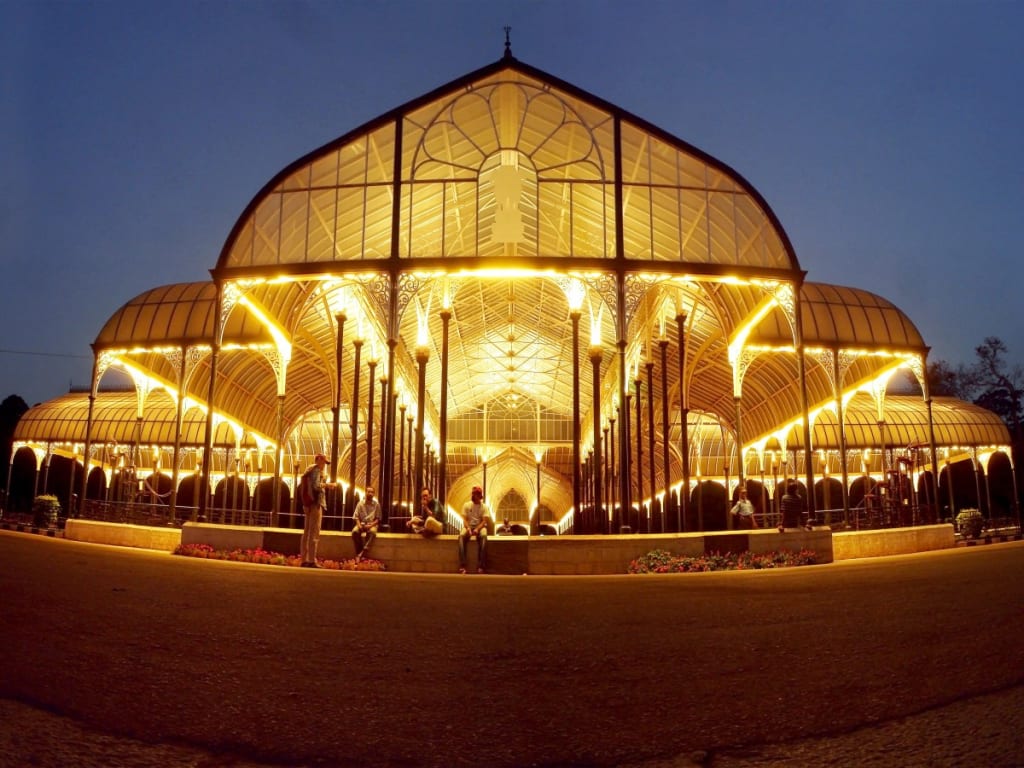
Lalbagh Botanical Garden: A Heaven for Nature Lovers
Sprawling over an area of 240 acres in Bangalore, which contains nearly 1854 species of plants, Lalbagh Botanical Garden is a nationally and internationally recognized center for botanical art, scientific study of plant species, and conservation, and is a heaven for nature lovers.
Hyder Ali commissioned the Lalbagh Botanical Garden in 1760, and it was later completed by his son Tipu Sultan. The Lalbagh Botanical Garden features rare plants from French, Persian, and Afghani origins and has been designated a Government Botanical Garden. The Lalbagh Rock, which is more than 3000 million years old and is a popular tourist attraction, is also one of the highlights.
The famous glass house, which is also the focal point of this botanical garden, hosts an annual flower show and also houses an aquarium and a lake. Historically speaking, Tipu Sultan imported plants and trees from around the globe and planted them here.
Booming with rich foliage and offering one of the biggest habitats for various species of birds, such as myna, parakeets, and crows, brahminy kite, pond heron, common egret, and purpole moor hen, Lalbagh Botanical Garden also boasts of being one of the world’s largest collections of rare plants.
History of Lalbagh
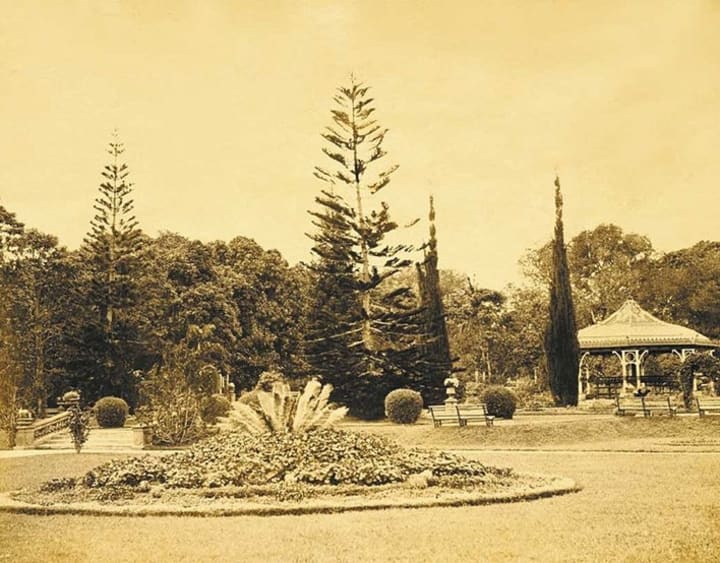
Lalbagh Botanical Garden, which was built by Haider Ali in 1760, was known as the Rose or Cypress Garden until 1856. Haider Ali was an avid admirer of Mughal Gardens and wanted one in his city as well. He was influenced by his father, who used to work for Dilawar Khan, a viceroy of the Mughals, and was especially passionate about setting up gardens.
The garden is modeled on another one in Sira, which was situated 120 km from Lalbagh. Many rare species of plants, trees, and shrubs have been added to Lalbagh over the years, and most of these were added by Tiu Sultan himself. The garden area stood at 45 acres in 1874, with major additions done in 1889 (30 acres) and 1891 (94 acres). The foundation of the famous Glass House was laid down in the year 1898 and was further built by John Cameron in the image of London’s Crystal Palace.
The layout of Lalbagh Botanical Garden
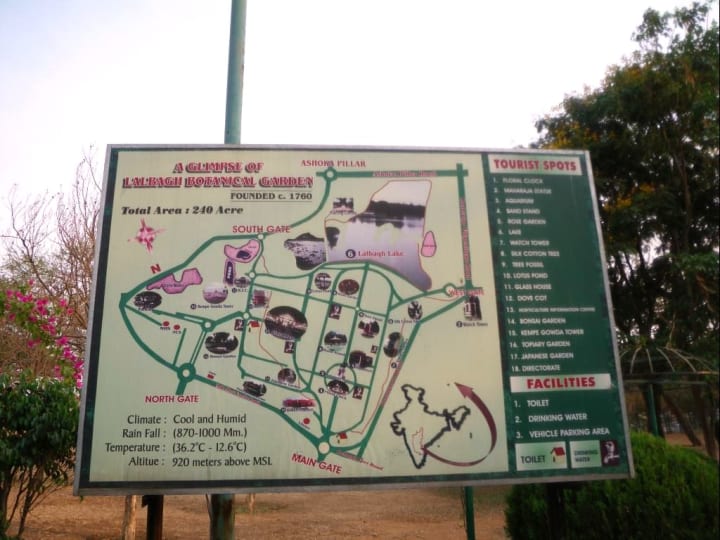
Lalbagh, is located in South Bangalore and covers an area of 240 acres. It is situated around a tower built by the founder of Bangalore, Kempe Gowda.
Its sophisticated irrigation system, which can irrigate over 1,000 species of flora, including trees over 100 years old, is the most important part of the garden’s construction. The garden comprises a variety of flowerbeds, a lotus pool, fountains, and lawns.
The rock formation is also believed to be over 3,000 million years old. There are four ways to get into the gate. The northern gate allows easy access to the Glass House. While the southern gate opens up to Lalbagh Road, it is commonly considered the main gate. The eastern gate is located near Jayanagar, while the western gate can be found close to the Siddapura Circle.
Flowers in Lalbagh
The garden’s caretakers have maintained a diverse and vibrant plant collection since its inception. In medieval times, rulers imported plants from faraway places such as Persia, Cape Town, Kabul, Turkey, etc. Exotic species are brought in from around the globe, acclimatized, and further multiplied. This results in an impressive 1854 species stock that continues to grow.
Some of the exotic plants here include Amherstia Nobilis, Adansonia digitata, Ficus bengalensis var – krishnae, Araucaria Cookie, Bombax Ceiba, and Dillenia Indica, among many others. These plants make this area one of the most beautiful horticultural hotspots in the nation.
Points of Interest in Lalbagh Botanical Garden
Flower Show at Lalbagh Botanical Garden
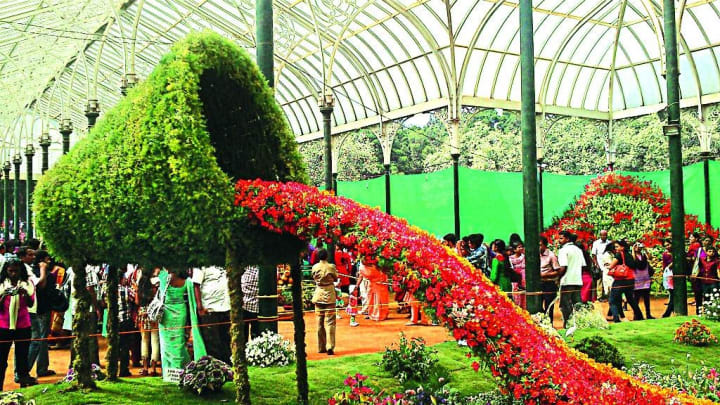
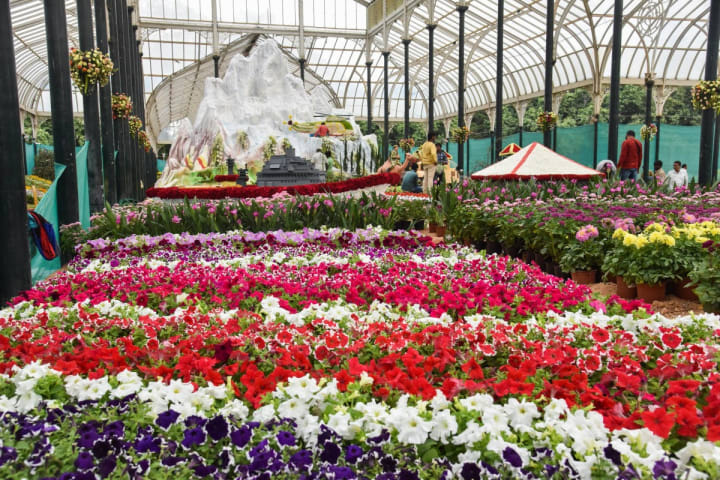
The Lalbagh Botanical Garden hosts a bi-annual flower show that is an amazing sight to see. Visitors travel from all over India to see the millions of flowers and thousands of plants, as well as the amazing artistry involved in creating the flower structures and figurines.
It is held twice a year, once in January during the Indian Republic Day week and again in August during Independence Day. A new theme is selected every year, and floral arrangements are created according to that theme.
Over 20 million flowers and plants are imported annually from around the globe. The spectacular Glass House, located within the Botanical Gardens hosts the show. The show runs from 9:00 AM to 6:00 PM.
Even though it is best to see the show in the morning, when all the flowers are in full bloom in their vibrant colors, the night is an entirely different experience; the entire Glass House glows in a golden glow, making the structures appear even more magical and ethereal.
About the Creator
Keep reading
More stories from Abhishek Saini and writers in Education and other communities.
What are the Key Advantages of Investing in an IRA?
What are the Key Advantages of Investing in an IRA? If you have an IRA or are considering investing in one, you probably already know that it can be an ideal way to save for retirement. But you may not know some of the lesser-known aspects of IRA accounts, such as the different types of IRA forms and their functions, the tax benefits of IRA contributions, and more. As you consider investing in an IRA, here are some essential things you need to know.
By Abhishek Saini3 years ago in Education
How I Minimized My Digital Shadow Without Disappearing From the Internet
A few months ago, I did something uncomfortable. I searched my own name. Not just on Google. I checked social media platforms, old forums, public directories, and even usernames I used years ago. I searched my email address. I searched my phone number. I wanted to see what someone else could see.
By Stephano kambeta3 days ago in Education
Discovering the Art of Fly Angling: A Complete Beginner’s Guide to Getting Started
Fly fishing is widely considered one of the most rewarding and artistic forms of fishing. Unlike traditional fishing methods that rely on heavy bait or lures, fly fishing uses lightweight artificial flies that imitate insects and other small aquatic creatures. The technique requires patience, rhythm, and a strong understanding of water conditions and fish behavior. For many anglers, learning fly fishing opens the door to a deeper appreciation of nature and the peaceful environments where fish thrive.
By Joe Sottolano2 days ago in Education
Tatt~Master
— Assembly Line Tatt Machine ~ Impressions to Impress — As I begin to understand more about the Tattoo Phenomenon. I've written silly, yet verbatim, dating site anecdotes in 'Frazzled.' So let me ask you: Would you be More attracted to someone slathered with tattoos, or Less?
By Jay Kantor5 days ago in Humor


Comments
There are no comments for this story
Be the first to respond and start the conversation.