
Key Sections in Program
Basic Structure Of "C" Programming
Documentation:
A Comprehensive Guide
Introduction:
In the realm of programming, effective documentation is paramount for understanding, maintaining, and collaborating on code. A well-documented program enhances its readability and facilitates seamless collaboration among developers. In this blog post, we will delve into the various sections that constitute a program's documentation, each serving a specific purpose in making code comprehensible and manageable.
Documentation Section:
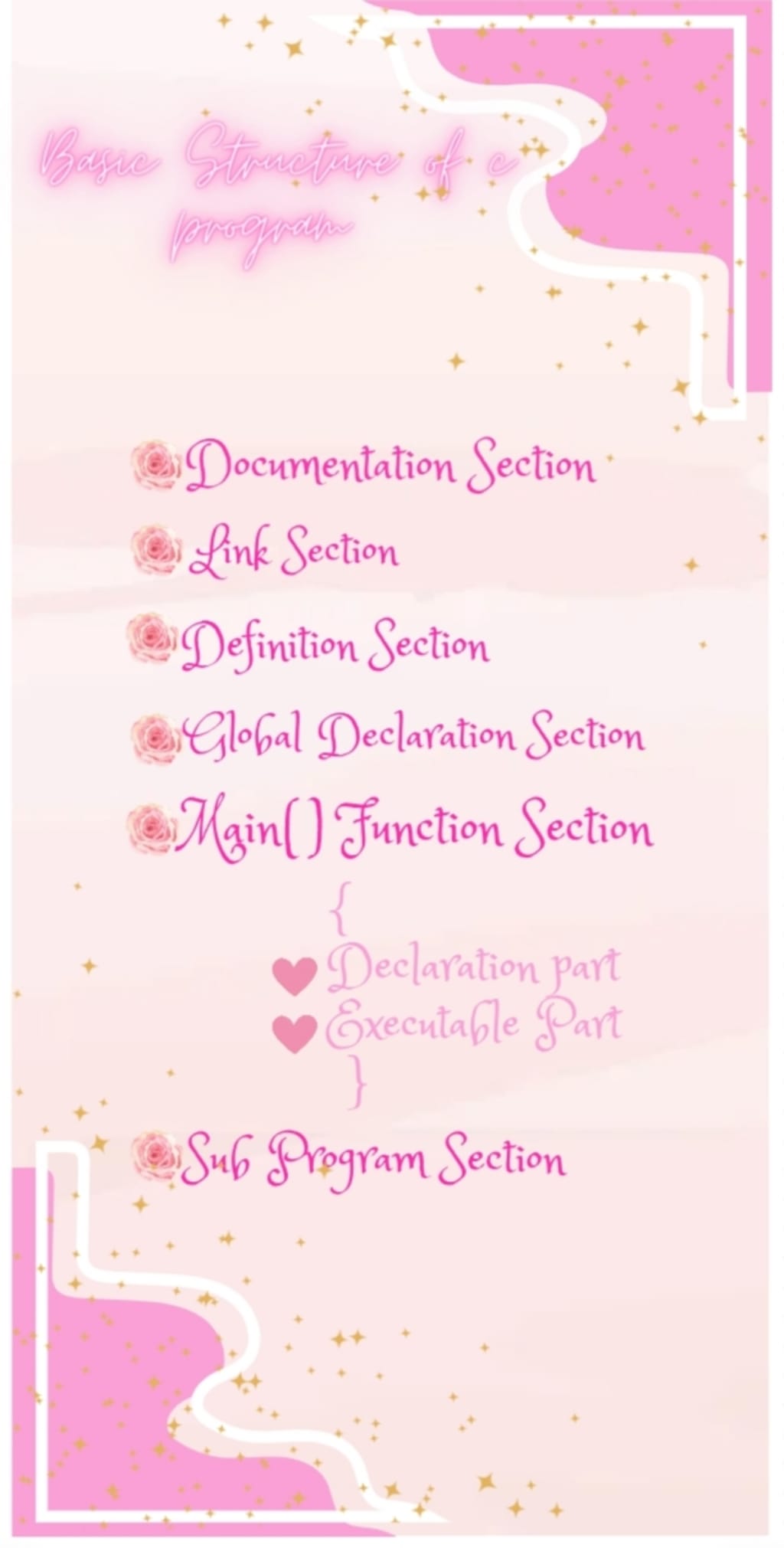
Providing Context and Overview At the beginning of every program, you'll find the Documentation Section. This section comprises comment lines that offer valuable insights, including the programmer's name, authorship details, and the date and time the program was written. The primary function of the Documentation Section is to provide an overview of the program's purpose, offering a quick reference point for anyone who encounters the code.
Link Section:
Connecting to External Resources The Link Section is where you'll encounter the essential header files that define the functions used within the program. These header files instruct the compiler on how to link functions from the system library, ensuring seamless integration of external resources into the codebase. This section plays a pivotal role in the program's functionality, enabling it to tap into system-level functionalities.
Definition Section:
Symbolic Constants and Macros In the Definition Section, you'll encounter symbolic constants and macros, both of which contribute to code readability and maintainability. Symbolic constants serve as placeholders for specific values, making the code more intuitive and easier to modify. Macros, a type of symbolic constant, provide a way to streamline code by encapsulating complex or repetitive tasks. This section is crucial for understanding the core constants and building blocks that underpin the program's logic.
Global Declaration Section:
Declaring Global Scope The Global Declaration Section is where global variables, accessible throughout the entire program, are declared. These variables hold values that persist across various parts of the codebase. Additionally, user-defined functions are declared in this section, encapsulating specific functionalities and promoting modular design. This section's significance lies in providing a clear delineation of global elements and reusable functions.
Main() Function Section:
The Program's Entry Point Every "C" program is required to have a Main() Function Section. This pivotal section comprises two parts: declaration and executable. The declaration part initializes variables that will be used in the executable portion. It's important to note that both parts must be enclosed within opening and closing braces. Each statement within these parts is terminated with a semicolon, contributing to the program's structural clarity. The program's execution commences at the opening brace and concludes at the closing brace of this section.
Sub Program Section:
Modularizing with User-Defined Functions The Sub Program Section hosts user-defined functions, each tailored to perform specific tasks within the program. These functions are designed to enhance code modularity and reusability. By isolating distinct functionalities into separate functions, developers can easily manage, debug, and enhance specific components of the program. These user-defined functions are invoked within the Main() Function Section, leading to a well-organized and comprehensible codebase.
Conclusion:
In the realm of programming, documentation is more than just comments and explanations—it's a structured approach to enhancing code readability, maintainability, and collaboration. By understanding and implementing the key sections outlined above, developers can create programs that are not only functional but also comprehensible to both current and future stakeholders. Effective documentation empowers developers to navigate through code with confidence, fostering a culture of efficient coding practices and collaborative development.
Example:
#include<stdio.h>
#include<conio.h>
Void main()
{
Clrscr();
Printf("welcome to first BCA");
Getch();
}
Output:
"Welcome to first bca"
About the Creator
Keep reading
More stories from Ayshanasrin Aysha and writers in Education and other communities.
Exploring the Power and Evolution of the C Programming Language
Diving into the Depths of C Programming In the year 1972, a realm of boundless possibilities within the realm of computer programming was unveiled. This groundbreaking event transpired within the hallowed halls of renowned laboratories, where Dennis Ritchie conceived an innovation that would forever alter the course of programming history. The birth of the "C" programming language marked a pivotal moment that would shape the foundations of modern computing. Characterized by its modular structure and exceptional versatility, "C" emerged as a programming language of unparalleled significance. Its profound impact was soon to resonate throughout the technological landscape, and its legacy would become inextricably intertwined with the evolution of the Unix operating system.
By Ayshanasrin Aysha2 years ago in Education
Seeing More for Less: Smart Budget Travel Strategies for Modern Explorers
Traveling the world is often seen as a luxury reserved for those with deep pockets, but that idea is outdated. Today, budget travel is not only possible—it’s incredibly rewarding. With the right planning, mindset, and tools, you can explore new countries, cultures, and cuisines without draining your savings. Affordable travel is about making smart choices, not sacrificing meaningful experiences.
By Darke Hullabout 12 hours ago in Education
One Unchecked Box
"Republished" because it was the only way to add the embed for the newly recorded audio version of this story due to the Top Story badge. Plus it serves as a nice, informal announcement of the podcast's revival for another season (go subscribe!):
By Stephen A. Roddewig6 days ago in Fiction



Comments
There are no comments for this story
Be the first to respond and start the conversation.