
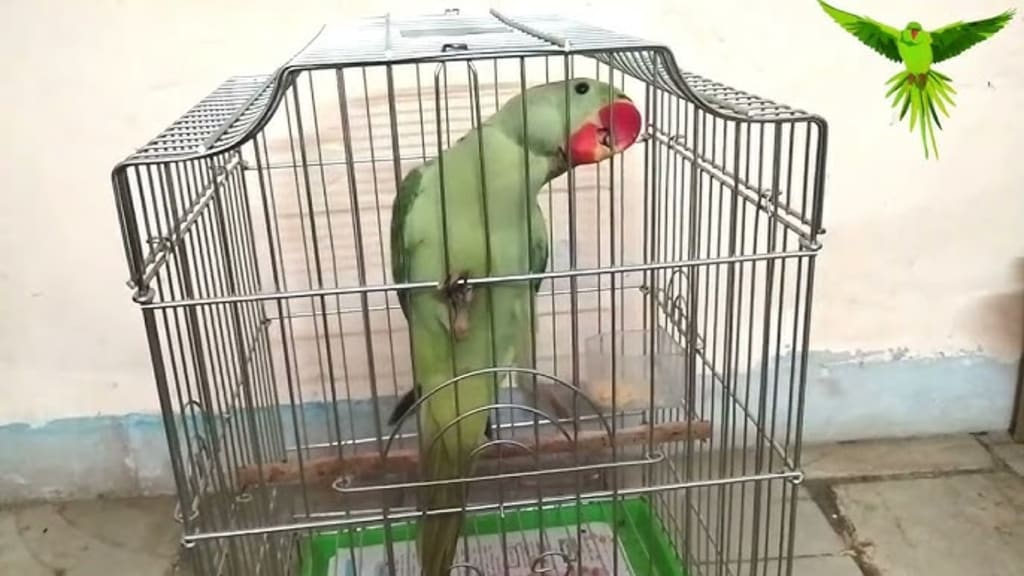
The spirit of the dead parrot lingered in the air, its voice soft but firm. “Why blame him? He only sought to free a prisoner. My death is not his doing, but the consequence of my own awakening. I chose to listen to my heart, to speak my own language, and to reject the chains that bound me. If my freedom came at the cost of my life, then so be it. At least I died with my spirit unbroken.”
The Pandit’s son stood frozen, his anger slowly giving way to confusion. He looked at the lifeless body of the parrot and then at the wild parrot, which remained perched nearby, its eyes filled with a quiet sadness. The wild parrot spoke again, this time addressing the boy. “Your family kept this bird in a cage, thinking you were protecting it. But tell me, is a life without freedom truly a life? You fed it, gave it water, and sheltered it from the cold, but you also clipped its wings and silenced its voice. Can you not see the cruelty in that?”
The boy lowered his head, his heart heavy with guilt. He had never thought of it that way. To him, the parrot had always been a pet, a companion to entertain the family. But now, he saw the truth—the cage was not a home; it was a prison. The parrot had been a captive, not a guest.
The wild parrot continued, “In the jungle, we live by our own rules. We soar through the skies, build our nests where we please, and answer to no one. Yes, life is dangerous, and we face many threats—predators, storms, and scarcity. But we face them on our own terms. That is the essence of freedom. Your parrot may have had food and shelter, but it never knew the joy of flying through the open air or the thrill of choosing its own path.”
The boy nodded slowly, tears welling up in his eyes. “I understand now,” he whispered. “We thought we were caring for it, but we were only imprisoning it. I see the truth in your words.”
The wild parrot’s gaze softened. “It is not too late to learn from this. Let my brother’s death be a lesson to you. Freedom is the greatest gift you can give to any living being. Do not cage what is meant to fly.”
With that, the wild parrot spread its wings and took to the sky, disappearing into the vast expanse of blue. The boy watched it go, his heart filled with a mix of sorrow and newfound understanding. He gently picked up the lifeless body of the parrot and carried it to the garden. There, he dug a small grave and buried the bird beneath a flowering tree. As he placed the last handful of soil over the grave, he whispered, “May you find the freedom in death that you were denied in life.”
From that day on, the boy became an advocate for freedom. He convinced his family to release the other birds they kept in cages and to treat all living beings with respect and compassion. The story of the parrot spread throughout the village, and many began to question their own practices of keeping animals in captivity.
The spirit of the parrot, now free, watched over the boy and his family, its presence a gentle reminder of the importance of liberty and the dignity of all creatures. And though it had paid the ultimate price for its freedom, its legacy lived on, inspiring others to break free from their own cages—whether physical or metaphorical—and to embrace the boundless possibilities of a life lived on their own terms.
About the Creator
Keep reading
More stories from writers in Education and other communities.
The Power of Perspective: Rich Thinking vsTraditional Thinking
The Power of Perspective: Rich Thinking vs. Traditional Thinking Success in life is often less about external circumstances and more about the mindset we adopt. Two dominant approaches to thinking—rich thinking and traditional thinking—illustrate how perspective shapes opportunities, decisions, and ultimately, outcomes. While traditional thinking emphasizes stability, caution, and conformity, rich thinking thrives on vision, risk-taking, and innovation. Understanding the differences between these two mental frameworks provides valuable insight into why some individuals achieve extraordinary success while others remain confined to predictable paths.
By Alhouci boumizzia day ago in Education
The Clockmaker’s Apprentice
In a narrow street tucked between busy markets stood a small clock shop that most people passed without noticing. The wooden sign above the door read “Hassan & Son – Fine Timepieces,” though Hassan had no son, only an apprentice named Idris. At seventeen, Idris was restless, ambitious, and impatient. He had joined the shop hoping to learn a skill quickly and move on to something bigger. What he did not realize was that time itself would become his greatest teacher.
By Sudais Zakwana day ago in Education
When True Love Never Questions Your Soul
“And she’s going to learn that this life will hit you, hard, in the face, wait for you to get back up, just so it can kick you in the stomach but getting the wind knocked out of you is the only way to remind your lungs how much they like the taste of air.” — Sarah Kay’s Poem — If I Should Have a Daughter
By Chantal Christie Weiss7 days ago in Humans
The Pride Flag and the Diversion
For nearly a decade, the LGBTQIA Pride Flag rippled in the wind at Christopher Park, a kaleidoscope of color staked into the soil of America’s first national monument to LGBTQIA+ liberation. That flag came down this week. Federal officials, citing new guidance from the Trump Administration, silently lowered the rainbow flag from its pole across the street from the Stonewall Inn. The birthplace of the modern gay rights movement now flies only the United States flag.
By Tim Carmichael4 days ago in Pride




Comments
There are no comments for this story
Be the first to respond and start the conversation.