
Japan's Stock Market Crash: Causes, Impacts, and Recovery Outlook
Japan's Stock Market Crash

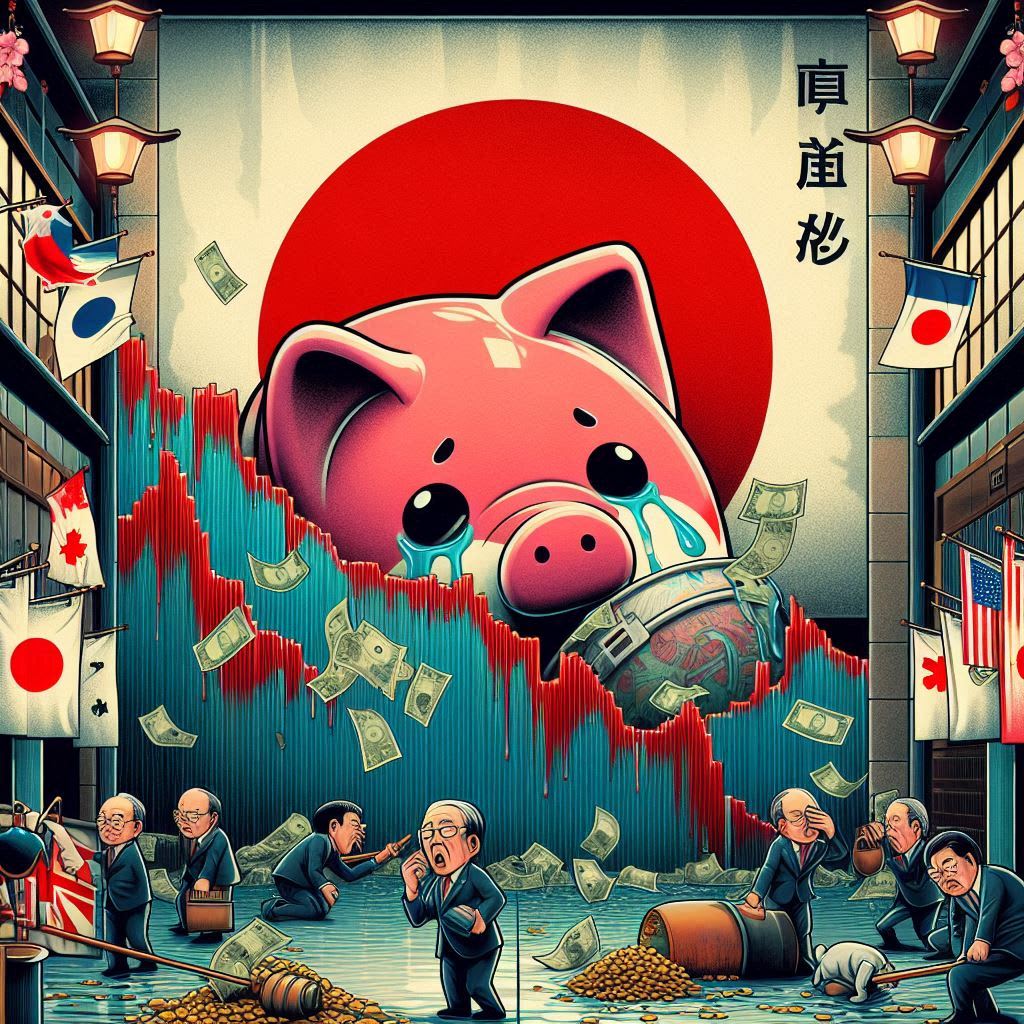
The recent crash of Japan's stock market, marked by the Nikkei 225 index's staggering decline of 12.4% on August 5, 2024, represents one of the most significant financial upheavals since the infamous Black Monday of 1987. This article delves into the underlying causes of the crash, the ripple effects on global markets and industries, and the anticipated timeline for recovery.
Causes of the Crash
Economic Indicators and Monetary Policy
The catalyst for the crash can be traced back to a combination of domestic and international economic pressures:
Bank of Japan's (BOJ) Rate Hike: On July 31, the BOJ raised interest rates for the second time in 2024, aiming to combat rising inflation. This decision led to a stronger yen, which adversely affected Japanese exporters reliant on competitive currency rates. The yen's appreciation made Japanese goods more expensive abroad, diminishing profit margins for export-driven companies.
Concerns Over U.S. Economic Slowdown: Concurrently, fears of a recession in the United States intensified following a disappointing jobs report from the U.S. Department of Labor. The report indicated a sharp slowdown in hiring, leading to speculation that the Federal Reserve might not reduce interest rates as previously anticipated.
Unwinding of Carry Trades: The swift rise of the yen prompted investors to unwind carry trades—strategies that involve borrowing in low-yield currencies to invest in higher-yield assets. This unwinding triggered a wave of selling in Japanese equities, exacerbating the market decline.
Market Sentiment and Investor Behavior
The market's reaction was further fueled by a pervasive sense of panic among investors:
Volatility and Circuit Breakers: Trading was halted multiple times due to circuit breakers being triggered in response to the rapid decline in stock prices. This reflects the heightened volatility and fear gripping the market, reminiscent of previous financial crises.
Technology Sector Pressures: The technology sector, a significant component of the Nikkei, faced additional scrutiny due to disappointing earnings reports from major U.S. firms like Amazon and Intel. Concerns over overvaluation in tech stocks heightened investor skepticism, leading to further sell-offs.
Global Impact of the Crash
The repercussions of Japan's stock market crash extend beyond its borders, affecting various countries and industries:
Asian Markets: The crash triggered a widespread sell-off across Asian markets, with South Korea's Kospi and Taiwan's Taiex experiencing significant declines of 8.8% and 8.4%, respectively. The interconnectedness of global markets means that investor sentiment in Japan can rapidly influence trading behaviors elsewhere.
Technology and Semiconductor Industries: Countries heavily reliant on technology and semiconductor manufacturing, such as South Korea and Taiwan, are particularly vulnerable. The decline in Japanese stocks has already led to substantial losses in companies like Samsung Electronics, which saw a 10.3% drop in share prices following the Nikkei's plunge.
European and U.S. Markets: European markets opened in the red, with major indices like Germany's DAX and France's CAC 40 experiencing declines of 2.5% and 2.7%, respectively. U.S. futures also indicated a bleak outlook, with significant losses anticipated for tech-heavy indices like the Nasdaq.
Timeline for Normalization
The path to recovery for Japan's stock market and its global counterparts remains uncertain, with several factors influencing the timeline:
Investor Sentiment: Ultimately, the recovery will depend on how investors reassess the risks associated with Japanese equities and the broader global economic landscape. A return to bullish sentiment could catalyze a swift rebound, while persistent fears of recession could prolong the downturn.
Conclusion
Japan's recent stock market crash serves as a stark reminder of the fragility of financial markets in the face of shifting economic conditions and investor sentiment. While the immediate aftermath has been tumultuous, the potential for recovery exists, contingent upon careful monitoring of economic indicators and strategic responses from policymakers. As investors navigate this volatile landscape, the interplay between domestic and global factors will be pivotal in shaping the future trajectory of the markets.
About the Creator
Madison Grace
I'm a crypto consultant here to guide you. I break down complex topics like crypto lending/crypto exchange, review platforms, and analyze trends with crypto regulation to make your crypto journey smooth.
Keep reading
More stories from Madison Grace and writers in Education and other communities.
Understanding Cryptocurrency Exchanges: A Comprehensive Guide for Beginners
Cryptocurrency exchanges are the gateways to the world of digital assets, enabling users to trade cryptocurrencies like Bitcoin, Ethereum, and thousands of other tokens. For a beginner, navigating these exchanges might seem overwhelming at first, but with the right knowledge, it becomes an essential and straightforward part of the crypto journey. This guide aims to provide a foundational understanding of cryptocurrency exchanges, focusing on their types, how they work, and the critical factors you need to consider to make informed trading decisions.
By Madison Graceabout a year ago in Education
How the Sun Formed from a Nebula: The Incredible Story of Our Solar System's Birth
What Is a Nebula? A nebula is a massive cloud of gas and dust that exists in space. These clouds are primarily made of hydrogen and helium, the two lightest and most abundant elements in the universe. Nebulae also contain small amounts of heavier elements and microscopic dust particles.
By shahkar jalal2 days ago in Education
Why the Sun Doesn’t Burn Like Fire: How Nuclear Fusion Makes the Sun Shine
Introduction: A Question That Changes Everything As children, many of us imagine the Sun as a giant ball of fire blazing in the sky. It looks like fire. It gives off heat like fire. It even glows like fire.
By shahkar jalal2 days ago in Education
A Transparent Look at Vocal Challenges and Top Stories
Almost three years ago, we shared a resource article that served as a place for people to suggest new challenge prompts. We thought it would be a good idea to refresh that thread, and take the opportunity to answer a few common questions about top stories, how challenges are judged and how submissions are reviewed.
By Vocal Curation Team4 days ago in Resources



Comments
There are no comments for this story
Be the first to respond and start the conversation.