

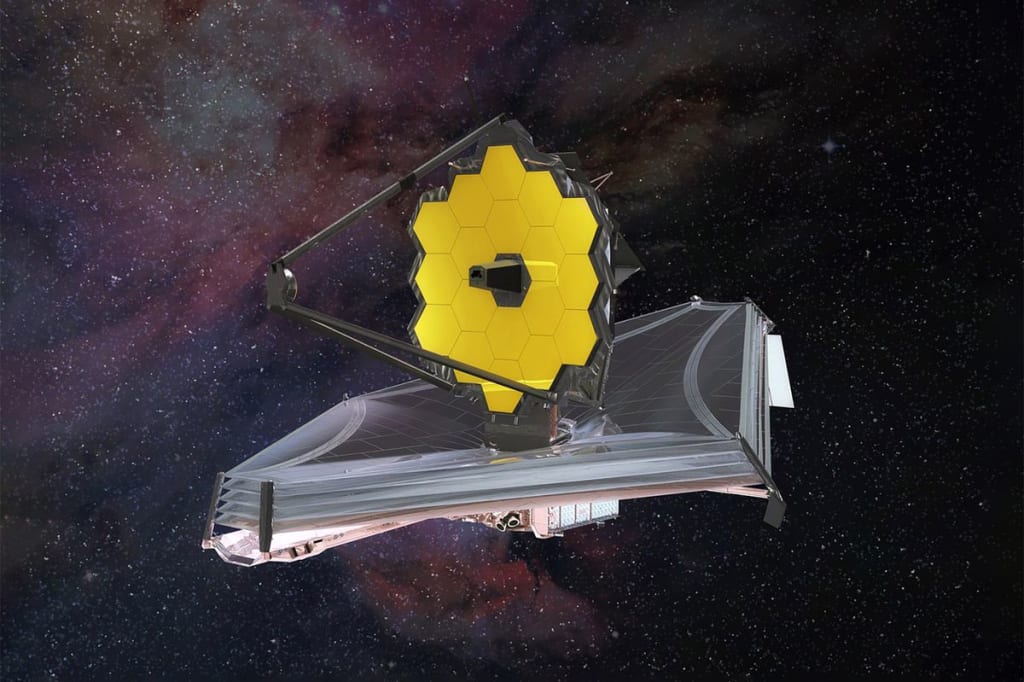
James Webb Space Telescope (JWST)
The James Webb Space Telescope (sometimes called JWST or Webb) is a large infrared telescope with an approximately 6.5 meter primary mirror. Webb successfully launched from ESA's spaceport in French Guiana on December 25, 2021 07:20am EST ( 2021-12-25 12:20 GMT/UTC) .
Webb is the premier observatory of the next decade, serving thousands of astronomers worldwide. It will study every phase in the history of our Universe, ranging from the first luminous glows after the Big Bang, to the formation of solar systems capable of supporting life on planets like Earth, to the evolution of our own Solar System.
Webb was formerly known as the "Next Generation Space Telescope" (NGST); it was renamed in Sept. 2002 after a former NASA administrator, James Webb
This telescope is an international collaboration between NASA, the European Space Agency (ESA), and the Canadian Space Agency (CSA). The NASA Goddard Space Flight Center managed the development effort. The main industrial partner is Northrop Grumman; the Space Telescope Science Institute operates Webb after launch.
Several i nnovative technologies have been developed for Webb. These include a primary mirror made of 18 separate segments that unfold and adjust to shape after launch. The mirrors are made of ultra-lightweight beryllium. Webb’s biggest feature is a tennis court sized five-layer sunshield that attenuates heat from the Sun more than a million times. The telescope’s four instruments - cameras and spectrometers - have detectors that are able to record extremely faint signals. One instrument (NIRSpec) has programmable microshutters, which enable observation up to 100 objects simultaneously. Webb also has a cryocooler for cooling the mid-infrared detectors of another instrument (MIRI) to a very cold 7 K so they can work
Launch of Webb Telescope
The James Webb Space Telescope was launched on an Ariane 5 rocket. The launch vehicle and launch site are part of the European Space Agency's contribution to the mission. The Ariane 5 is one of the world's most reliable launch vehicles and was chosen for a combination of reliability (it was the only launch vehicle that met NASA's requirements for launching a mission like Webb) and for the value it brings via it's international partnership.
James Webb was launched from Arianespace's ELA-3 launch complex at Europe's Spaceport located near Kourou, French Guiana. It is beneficial for launch sites to be located near the equator - the spin of the Earth can help give an additional push. The surface of the Earth at the equator is moving at 1670 km/hr.
The Launch Segment has 3 primary components:
Launch Vehicle: an Ariane 5 with the cryogenic upper stage. Provided in the single launch configuration, with a long payload fairing providing a maximum 4.57 meter static diameter and useable length of 16.19 meters.
Payload Adapter, comprising the Cone 3936 plus ACU 2624 lower cylinder and clamp-band, which provides the separating mechanical and electrical interface between the Webb Observatory and the Launch Vehicle.
Launch campaign preparation and launch campaign. The launch campaign preparation and launch campaign is the mutual responsibility of NASA, ESA, Northrop Grumman and ArianeSpace.
Key Missions of JWST
- Search for the first galaxies or luminous objects formed after the Big BangBang
- Determine how galaxies evolved from their formation until now
- Observe the formation of stars from the first stages to the formation of planetary systems
- Measure the physical and chemical properties of planetary systems, including our own Solar System, and investigate the potential for life in those systems
Southern Ring Nebula (Nsystems
IRCam Image)
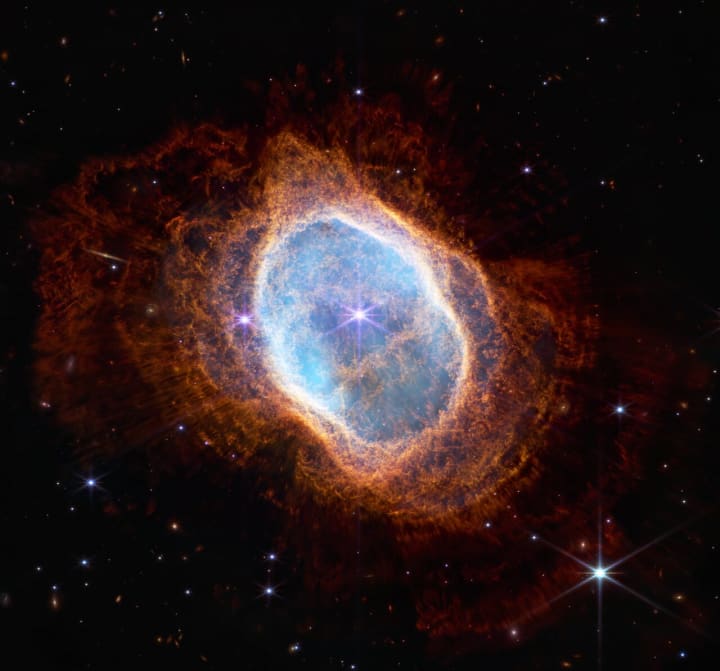
bright star at the centre of NGC 3132, while prominent when viewed by the NASA/ESA/CSA James Webb Telescope in near-infrared light, plays a supporting role in sculpting the surrounding nebula. A second star, barely visible at lower left along one of the bright star’s diffraction spikes, is the nebula’s source. It has ejected at least eight layers of gas and dust over thousands of years.
But the bright central star visible here has helped ‘stir the pot’, changing the shape of this planetary nebula’s highly intricate rings by creating turbulence. The pair of stars are locked in a tight orbit, which leads the dimmer star to spray ejected material in a range of directions as they orbit one another, resulting in these jagged rings.
Hundreds of straight, brightly-lit lines pierce through the rings of gas and dust. These ‘spotlights’ emanate from the bright star and stream through holes in the nebula like sunlight through gaps in a cloud.
But not all of the starlight can escape. The density of the central region, set off in teal, is reflected by how transparent or opaque it is. Areas that are a deeper teal indicate that the gas and dust are denser — and light is unable to break free.
Data from Webb’s Near-Infrared Camera (NIRCam) were used to make this extremely detailed image. It is teeming with scientific information — and research will begin following its release.
This is not only a crisp image of a planetary nebula — it also shows us objects in the vast expanse of space behind it. The transparent red sections of the planetary nebula — and all the areas outside it — are filled with distant galaxies.
Look for the bright angled line at the upper left. It is not starlight — it is a faraway galaxy seen edge-on. Distant spirals, of many shapes and colours, also dot the scene. Those that are farthest away — or are very dusty — are small and red.
NIRCam was built by a team at the University of Arizona and Lockheed Martin’s Advanced Technology Center.
About the Creator
Keep reading
More stories from writers in Education and other communities.
Rooted in Conviction: Lessons on Spiritual Leadership and Social Order from Iglesia ni Cristo
Spiritual leadership has always played an essential role in guiding communities toward shared values and ethical living. In a world where leadership styles constantly evolve, religious institutions continue to offer enduring perspectives on responsibility and social harmony. Iglesia ni Cristo (INC), a Christian church founded in 1914 in the Philippines, presents a distinctive model of spiritual leadership that emphasizes order, unity, and moral discipline. Its influence reaches beyond religious practice and offers valuable lessons for society as a whole.
By Iglesia Ni Cristoabout 21 hours ago in Education
Your phones camera isn't as good as you think
When the Visualphone VP210 hit the market in 1999, it advertised a never-before-seen feature: a camera. With only 0.11 megapixels and storage for 20 photos, the Visualphone is a relic compared to modern devices sporting three distinct cameras, each with up to 100 times more resolution. But while this technology has improved dramatically in the 21st century, engineers are rapidly approaching a hard limit on phone camera quality. To understand this limit, we first need to know how phone cameras work.
By Munesh Yadav3 days ago in Education




Comments (1)
Endha website la da thiruduna