
Is Water Wet? A Scientific, Philosophical, and Linguistic Exploration
Exploring the Science, Philosophy, and Language Behind the Age-Old Question: Is Water Wet?
Introduction
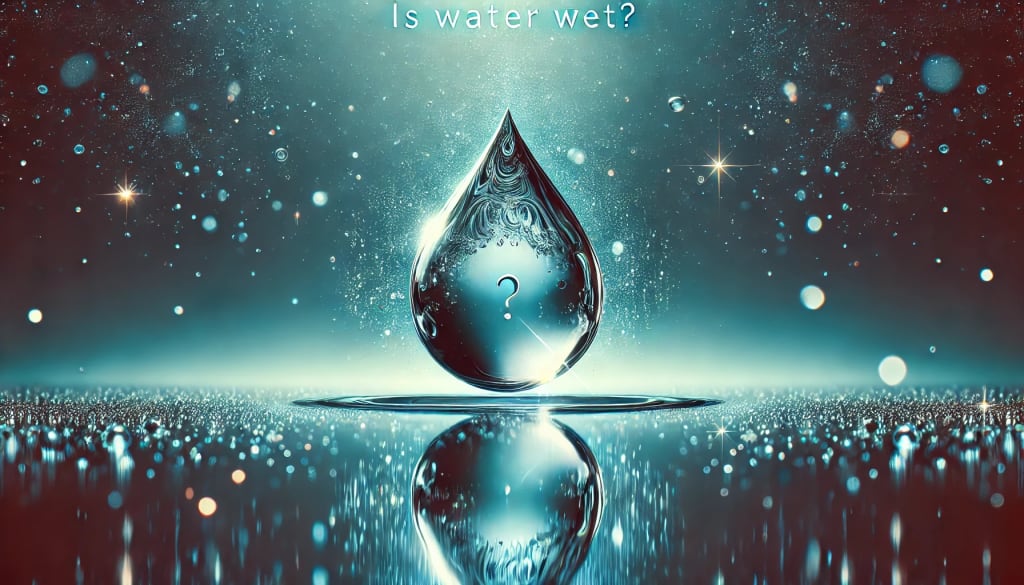
The question, "Is water wet?" may seem simple, but it has sparked countless debates in classrooms, online forums, and social gatherings. The nature of wetness and whether it applies to water itself brings together scientific, philosophical, and linguistic perspectives.
From how we define "wet" to the molecular behavior of water, this question is an intriguing example of how we perceive and understand everyday concepts. In this article, we’ll explore the meaning of wetness, examine scientific principles, delve into philosophical musings, and analyze linguistic interpretations, all in an attempt to answer the seemingly straightforward question: is water wet?
Defining “Wetness”
To address the question, we first need to understand what “wet” means. Scientifically, wetness is often described as the condition of an object that has come into contact with a liquid, especially when the liquid adheres to the surface of that object. For instance, a towel becomes wet when it absorbs water, and the surface of a rock is wet when water clings to it.
Wetness involves two key concepts:
Adhesion – the tendency of water molecules to stick to other surfaces.
Cohesion – the tendency of water molecules to stick to each other.
These properties arise from the molecular structure of water. Water molecules are polar, meaning they have a positive and negative side. This polarity causes water molecules to attract each other (cohesion) and other substances (adhesion), resulting in water’s ability to cling to surfaces and, in turn, make them “wet.”
Based on this definition, wetness is generally understood as a phenomenon that occurs when a liquid interacts with a solid. Thus, when we describe something as wet, we’re usually describing a solid that has been exposed to a liquid. But since water itself is a liquid, this raises an important question: can water be “wet” if wetness usually involves a liquid adhering to a solid?
Scientific Explanation: Is Water Itself Wet?
From a scientific standpoint, many argue that water cannot be considered “wet” because wetness is a property that applies to the interaction between a liquid and a solid. Water, on its own, lacks a surface to make wet. Instead, water is the substance that makes other things wet.
Let’s break down this argument further:
Cohesive vs. Adhesive Properties: Water’s cohesive properties mean that its molecules stick together, forming droplets or bodies of water. This cohesion is what allows water to form beads on surfaces without immediately dispersing.
ALSO READ
Cereal Mil Strain: A Sweet Treat for Cannabis Enthusiasts
How to Cure TMJ Permanently: A Comprehensive Guide to Lasting Relief
Water on Water: When water interacts with itself, it doesn’t create the traditional sense of wetness. It lacks the adhesive property that occurs when water adheres to a solid. In this sense, water’s cohesiveness keeps it from spreading thinly across itself in a way that would be interpreted as wet.
One way to visualize this is to consider oil, another liquid. When oil is poured on water, the two liquids don’t mix due to their differing polarities, and oil forms a layer on top. Neither liquid makes the other wet in the traditional sense, but they coexist without adhering. Similarly, water interacting with itself lacks the adherence to a solid surface that would traditionally define wetness.
Thus, scientifically, water may not be “wet” by itself because it doesn’t interact with a solid surface. It simply remains a cohesive liquid, unable to create the condition of wetness independently.
Philosophical Perspective: The Nature of Wetness
Beyond scientific definitions, the question “Is water wet?” opens up philosophical inquiries about how we define and perceive properties like wetness. Philosophically, wetness could be considered a relational property—it’s not a property of water itself but a property water imparts to other things.
From this perspective, water isn’t intrinsically wet. Instead, it causes other things to become wet. This raises further philosophical questions:
Can a Substance Be Defined by the Effects It Causes?: If we define wetness as something water causes, does that mean water is inherently wet, or only that it has the potential to make things wet?
Perception of Wetness: Wetness, as we perceive it, may involve sensory experiences—the feeling of water on the skin, for example. This suggests that wetness might be a subjective experience rather than an absolute property.
Philosophically, whether water is wet might depend on whether we see wetness as a sensory experience, a physical state, or a relational property. By this reasoning, one could argue that water isn’t wet because wetness only arises when water is in contact with something else.
Linguistic Angle: Is Water Wet by Definition?
Linguistics also plays a role in how we interpret this question. Dictionaries define “wet” in slightly different ways, but most definitions involve the concept of a liquid adhering to a surface. For example, Merriam-Webster defines “wet” as “covered or saturated with liquid (such as water).”
Given this definition:
If we interpret “wet” as a surface property, then water wouldn’t meet this criterion on its own.
However, language is flexible and subjective. Many people might describe water as wet because it embodies the sensation and effect of wetness.
Linguistically, the ambiguity of the term “wet” allows for multiple interpretations. It’s common in language for words to evolve based on common usage. Thus, the way people colloquially understand “wet” may differ from strict scientific definitions, leading to differing opinions on whether water itself is wet.
Counter-Arguments: Reasons Some People Say Water Is Wet
Despite the scientific and philosophical arguments, many people argue that water is indeed wet. Here’s why:
Water Feels Wet: When we touch water, we experience it as wet. This sensory experience leads to the logical conclusion that water is wet because it creates a wet sensation.
Inherent Wetness: Some argue that because water transfers wetness to other objects, it must itself be wet. This view sees wetness as an inherent property of water, rather than something that only applies in contact with solids.
Everyday Definitions: In everyday language, water is often described as wet without any confusion. This common understanding is rooted in the fact that water embodies the essence of wetness more than any other substance.
These perspectives highlight that, for many people, water is intuitively wet. The sensation it creates, the effect it has, and the colloquial understanding of the term support the idea that water is wet, even if scientifically it might not hold up.
Popular Opinions and Online Debate
The question “Is water wet?” has become a widespread debate topic on social media platforms and online forums, often sparking heated arguments. Some see it as a simple yes-or-no question, while others dive deep into complex explanations.
The online debate has led to:
Memes and Humor: Memes and jokes about the question highlight the absurdity and humor in debating something so seemingly straightforward.
Polls and Surveys: Many online polls have shown a split opinion, with a significant portion of people confidently asserting that water is wet, while others insist it’s not.
Philosophical Discussions: For some, the question has prompted discussions about perception, knowledge, and the nature of language, turning the debate into an intellectual exercise.
The popularity of this question demonstrates how a simple query can lead to a range of interpretations and become an engaging social topic.
Scientific Experiments and Thought Experiments
To further explore the concept of wetness, here are some experiments and thought experiments:
Touch Test: Touch a dry surface, then touch a surface that has been sprayed with water. Notice the sensation. This helps illustrate the perception of wetness as a liquid-surface interaction.
Submerging Objects: Place different objects in water, such as rocks, fabric, or metal. Observe how they look and feel when wet versus dry, helping illustrate how wetness involves a liquid adhering to a solid.
Water on Water: Pour a small amount of water into a larger body of water. Notice that it doesn’t create the sensation of wetness in the same way as water on a solid surface. This supports the idea that wetness involves liquid-solid interaction.
These experiments can help clarify why scientists argue that water isn’t wet by itself; instead, it’s the medium that makes other things wet.
Conclusion
The question “Is water wet?” does not have a simple answer. Scientifically, wetness is defined as a liquid adhering to a solid, which means water isn’t wet on its own. Philosophically, wetness could be seen as a relational property, something that water imparts to other objects. Linguistically, the term “wet” is flexible, and common usage may define water as wet because it embodies the concept of wetness.
Ultimately, whether you believe water is wet depends on your interpretation of wetness. Scientifically, the answer leans toward “no,” but common sense and everyday language often suggest “yes.” This question is a reminder that even simple inquiries can reveal complex layers of thought, encouraging us to think deeply about how we define and understand the world around us.
About the Creator
Keep reading
More stories from jawwad j.j and writers in Education and other communities.
Cereal Milk Strain: A Sweet Treat for Cannabis Enthusiasts
The world of cannabis is evolving rapidly, with new and exotic strains appearing on the scene to the delight of enthusiasts everywhere. Among the popular and unique strains, the Cereal Milk strain stands out for its sweet aroma, balanced effects, and memorable name. Known for its resemblance to the flavor of milk left in the bowl after a sugary cereal, Cereal Milk has earned a reputation for its smooth taste and versatile experience, making it a beloved choice among recreational and medicinal users alike.
By jawwad j.jabout a year ago in Lifehack
E-Invoicing as a Catalyst for Digital Taxation and Business Efficiency in this Digital Era
Introduction In today’s rapidly evolving digital economy, businesses and governments are increasingly turning to technology to improve efficiency, transparency, and compliance. One of the most significant developments in this transformation is electronic invoicing, commonly known as e-invoicing. E-invoicing refers to the generation, exchange, validation, and storage of invoices in an electronic format between suppliers and buyers, often through government-mandated platforms or standardized systems.
By Bobby Yadav5 days ago in Education
China Hair Care Industry Analysis Market Size, Trends, and CAGR (2026–2034)
For decades, the Chinese beauty market was dominated by skincare, but in 2026, the focus has shifted upward. The "Skinification of Hair" has turned the humble shampoo into a sophisticated multi-step ritual. Driven by a young, urban population facing high-stress levels and environmental pollutants, the China hair care market is currently on an explosive trajectory. The China hair care market was valued at USD 15,547.6 million in 2025 and is projected to reach USD 22,146.4 million by 2034. According to IMARC Group, the market is expected to grow at a compound annual growth rate (CAGR) of 4.01% from 2026 to 2034."
By Neeraj kumarabout 8 hours ago in Education



Comments
There are no comments for this story
Be the first to respond and start the conversation.