
Is the intelligence of children inherited from their mothers?
True Or False intelligence inherited from their mothers
Surely parents want to have smart and healthy children.
but have you ever asked what percentage of our children's intelligence is obtained from their mother or their father?
does anyone know about it? if not let's research it together.
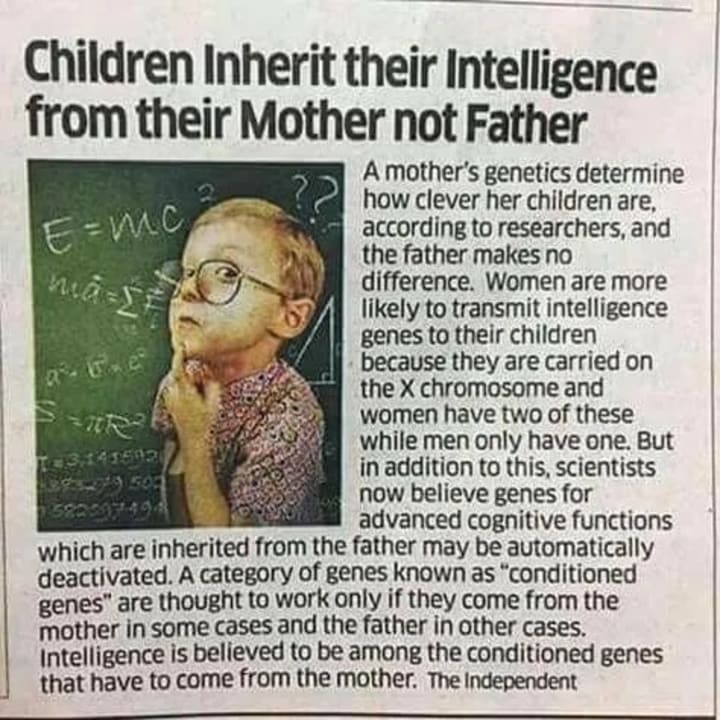
The genetics of the mother have a higher influence than the genetics of the father in influencing the intelligence of a child, is that true?.
According to an article, research conducted in the period 1972 to 2012, this study confirmed the theory although it is not 100% correct.

Because if we ask chatgpt then chatgpt will tell us, that there’s no definitive answer confirming whether intelligence is solely inherited from mothers studies have pointed to the X chromosome, which women have two of, potentially playing a role in transmitting genes related to mental abilities.
Because intelligence might be more strongly linked to the X chromosome, which women have 2 X chromosome while men only have X chromosome and Y chromosome.
That the maternal environment, including factors like prenatal care and the mother-child relationship, can influence brain development and cognitive abilities. And there is a theory called “conditioned genes” In short, it is a theory that a gene is active if inherited from the mother, while being deactivated if inherited from the father.
An example of a case that we can relate to a child's intelligence is Down Syndrome in children. Down Syndrome occurs if a child has an extra copy of chromosome 21, This chromosome 21 is the smallest autosome in humans, comprising only about 1.5 to 2% of the DNA in a human.
Chromosome 21 contains about 46.7 million base pairs (the building blocks of DNA). And the function of Chromosome 21 contains many genes that play a role in various cell functions, including functions related to development, growth, and metabolism.
If a prospective child has the Trisomy 21 gene (having three copies of chromosome 21), this will cause the child to suffer from Down Syndrome, which is characterized by mild to moderate intellectual disability, distinctive facial features, and other health problems.
Chromosome 21 also plays a role in the aging process and some types of cancer in humans.

A doctor named Dr. James Curley conducted research on primates in 1996, he says The expression of genes in the cortex is not a proxy for intelligence, as they contribute to brain regions and neural circuits controlling behaviors like learning and memory. Each gene’s role requires further study for further understanding.
And in other studies, This study revealed that toddlers’ attachment to their mothers significantly influences their problem-solving abilities, exhibiting enthusiasm, persistence, and cooperation, which can be interpreted as intelligence.
And A doctor named Dr. Joan Luby said this was not an accurate explanation: Our interpretation here was that this was a psychosocial phenomenon not a genetic one and was caregiver specific not gender specific.
In addition to Down Syndrome, other examples of genetic disorders related to intelligence include Fragile X Syndrome, Cornelia Syndrome, and Huntington's Disease. Fragile X Syndrome causes impaired mental and behavioral development, while Cornelia Syndrome has distinctive physical characteristics that can also affect cognitive development. Huntington's disease is a genetic disorder that causes damage to nerve cells in the brain, which can affect thinking, movement, and emotions.
Sindrom Fragile X:
This is where a mutation occurs in the FMR1 gene (Fragile X Mental Retardation 1) on the X chromosome.
This mutation is caused by the number of nucleotide repeats (CGG) in the FMR1 gene exceeding the normal limit, so that no FMRP protein is produced.
Syndrome Cornelia :
Cornelia syndrome, often referred to as Cornelia de Lange syndrome (CdLS), is a rare genetic disorder that affects growth and development in children.
This disorder is characterized by characteristics such as delayed growth, cognitive development, and has typical physical characteristics such as Down syndrome.
Huntington's disease :
Huntington's disease is a rare genetic disorder that causes damage to nerve cells in the brain, Huntington's disease is genetic, passed down from parents.
Causes several symptoms and appear in the 30s or 40s (adult-onset), but can also occur earlier (juvenile HD) or later in life. :
- Uncontrollable movements (chorea).
- Cognitive impairment (difficulty thinking, remembering, or making decisions).
- Emotional impairment (depression, anxiety, personality changes).
- Physical problems such as speaking, swallowing, and walking.
So from all the information we have collected, we can conclude that there is no research that is 100% true that a child’s intelligence comes from their mother.
Because, Intelligence is influenced by a combination of genes from both parents and environmental factors, with some studies suggesting a stronger maternal influence. The X chromosome, inherited from the mother, may carry more genes related to intelligence, especially in males. However, many genes affecting intelligence are spread across DNA and passed down from both parents.
So that’s all for now and I would like to thank you for taking the time to read this article, it’s not that good
About the Creator
The Insurrection Act
Introduction The Insurrection Act is a law in the United States of America. It allows the President of the United States to use the military to deal with serious problems inside the country. This law is very important because it can be used when there is a rebellion, violence, or lawlessness that cannot be controlled by normal police forces. The act has been in use for many years and is sometimes a topic of debate because it gives the President significant power.
By Farhan Sayed2 days ago in Education
Top 7 Life Changing Books to Read in 2026
In 2026, readers are not just looking for entertainment—they want books that change the way they think, feel, and see the world. With endless content available online, only a few books continue to stand out, remain widely read, and influence conversations across generations. These are the books people keep recommending, searching for, and returning to year after year.
By Waqar Khan3 days ago in Education




Comments
There are no comments for this story
Be the first to respond and start the conversation.