
Is it possible to transplant a human head
This is what makes it impossible


No, human head transplants are not possible - and they will not be possible for the foreseeable future. Not unless one would want the head to be able to actually control the body supporting it.
This is what makes it impossible:
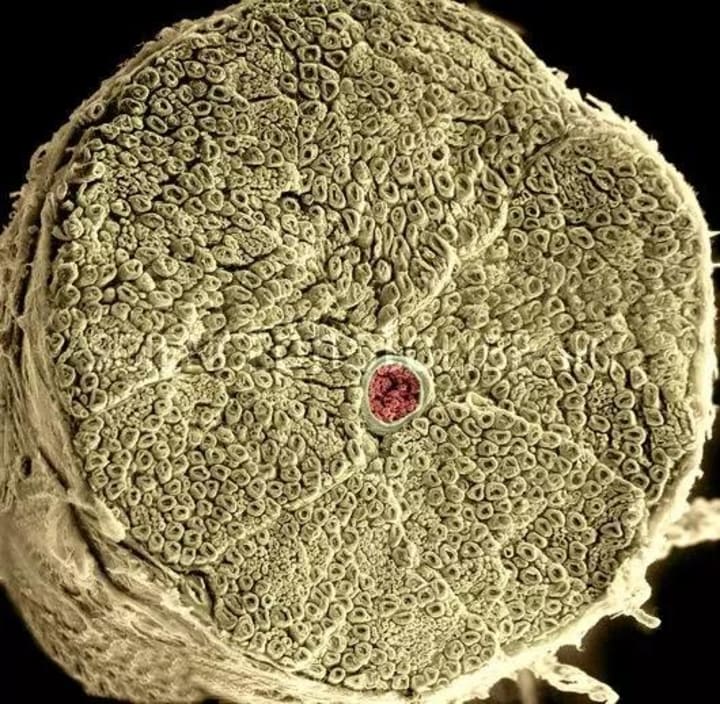
The above is a a cross-section of single spinal nerve bundle under a scanning Electron Microscope (because EM photos can only be dichromatic, the colours are computer generated - hence the red at the center, the red blood cells in a blood vessel, is added later). Several of such nerve bundles make up the critical part of a single nerve. Every circular shape seen above is a myelin sheath (think of cable insulation) encasing a neuronal axon (think of a cable wire), originating somewhere in the central nervous system and aiming at a particular sensory or motor (muscle) target. The above nerve bundle, for example, could be the one enervating and controlling the movement of a part of your left hand, and it can also contain numerous sensory axii transmitting information to the spinal cord and eventually the brain. Which one is which? Usually a motor and a sensory neuron are readily identifiable, but at this point of their length it is impossible to distinguish between the two - because the cross section of a downwards motor neuronal axon looks exactly like the cross section of an upwards sensory neuronal axon.
For comparison, this is the cross-section of a typical Deep Sea cable, transferring voice and data between continents. Notice how far less structurally complex it is when compared to a single spinal nerve bundle:
Keep also in mind that the above mentioned neuronal axons get organized into nerve bundles only after their fibers exit the spinal cord (each following a very specific pathfinding that gets completed during embryogenesis). So, the spinal cord contains millions of such ascending and descending axons in total, and they are only roughly organized within it.
Moreover, no light microscope can achieve such a magnification; an electron microscope would be needed. And observing any tissue sample under the electron microscope means that tissue is already dead, its micro-shape imprinted on a thin layer of metal (usually gold or silver) and all traces of the original tissue dissolved before sliding its mold alone under the electron beam. The process of preparing the specimen usually takes several hours, if not days, to complete. In other words, such an image is impossible to generate in an operating theater. And even if it were possible, it would still not matter because neither human nor surgical robot can operate at this scale.
The best a neurosurgeon could do today and in any foreseeable future, in an attempt to repair a severed spinal cord, would be to try to identify major regions of the two segments, guesstimate the location of the contained nerve axons (in practice, as effective as ignoring them) and simply push the two pieces together. Hoping that, by some miracle, the supporting Schwann cells, that generate the myelin and do neuronal repairs in the peripheral nervous system, will try to seal together the opposing axons - even if they are mismatched, incompatible and lack the targeted growth signals to guide their regeneration.
If such a haphazard connection were possible to work, people who have suffered spinal cord trauma would had regained the use of their body a long time ago. We all know that, unfortunately, this has not been the case and spinal cord injuries are not yet repairable. And reattaching the two severed ends of the same spinal cord would be a much easier task.
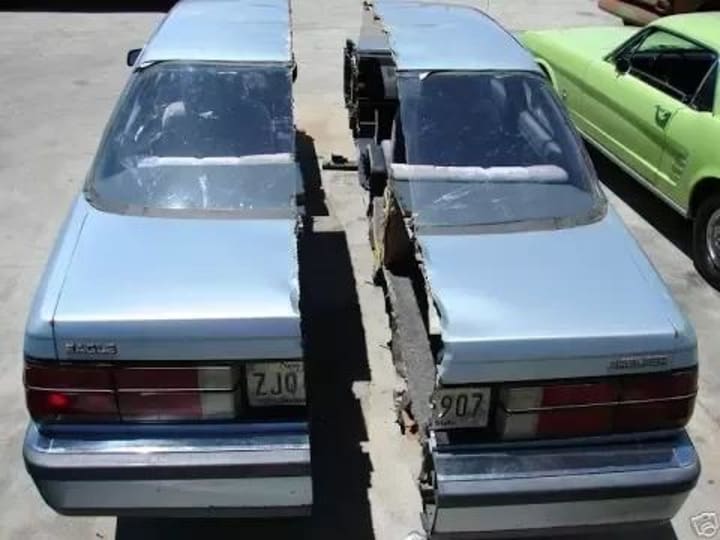
A spinal cord is millions of times more complex than a car but, in order to illustrate this, imagine sawing a car in half - and then simply pushing together the two halves and …duct-taping them externally. What are the chances of that car ever working again? That would be a crude approximation as to why we cannot fix spinal cord injuries.
Now, how about if you take two halves from different cars? Because that would be a simplified approximation of the claims of head transplants made by the notorious Italian doctor (and others). Declaring the operation a “success” after trying it on a cadaver is like duct-tapping together half a TOYOTA and half a BUICK and then claiming your attempt to be successful - without ever bothering to turn your contraption on!
Nowadays it is not very hard to connect the major arteries, reattach the spinal column segments and their ligaments and stitch up the muscles and skin. Supporting the head’s tissues with oxygen, nutrients and blood circulation has been a perilous yet routine operation for some time. That is why, ever since 1959, it has been possible to attach a second head to an animal: however, this only works because the original head is still in place and is the one controlling the body.
The insurmountable obstacle, however, still is making the correct connections to the millions of spinal nerve axons - that will not even match in number, let alone shape, size and location - in order for the head to be able to sense and take control the new body.
Some readers have suggested nanotechnology, and I think it needs to be addressed, even if it is science fiction at the moment. So, even in 30 or 50 years, for nanotechnology to work, it would still come with a number of steep requirements: the nanites will have to be able to recognize and map the different severed neuronal axons, communicate their findings either to a central processing unit or to each other for collective (hive) processing and then grab and move around the matched axons in order to try to seal them together. The issue of filling the gaps between remote matches will have to be addressed, as well as how to triage the axons and even decide what to do with the surplus. Because it is constantly reshaped by our experiences, no two persons will be an exact match, not even monozygotic twins - and that may be only one of our big problems.
For example, at the other end of this there will be the problem of excess heat. Having molecular nanites moving around, taking visual readings, sending, receiving and processing information and then pushing and pulling cellular appendices before stitching them together or integrating with them will require energy - and Thermodynamics is a very unforgiving mistress. Human cells have a narrow range of tolerated temperatures. Cool the system too much and the nanites stop functioning; allow it to heat up too much, and the cells we would be trying to connect will be damaged beyond recovery. And even if all these are somehow solved, there is still an even harder problem to overcome.
Because there is also the aspect of the psychological rejection of a transplant. Medical professionals came across it when external body parts, especially sexual organs, were allo-transplanted.
The first (totally successful) penis transplantation had to be reversed only two weeks following the operation at the patient’s insistence: Man rejects first penis transplant.
One can only begin the imagine the psychological impact caused by a mind residing in a totally foreign body. Who exactly is being intimate with your wife and who is hugging your children?
I would expect, if such transplants ever become possible, an entire new field of psychology would have to open up in order to deal with such issues.
About the Creator
Neeraj Tiwari
Neeraj Tiwari
Journalist | Blogger | Video Creator
I dedicated to providing insightful and fact-based content. My expertise lies in space, science, history, geopolitics, education, living beings,sports, climate change, and current affairs.
Keep reading
More stories from Neeraj Tiwari and writers in Education and other communities.
Did America have a hand in the overthrow of Bangladesh?
Dhaka: A coup took place in Bangladesh. Sheikh Hasina left her chair and fled to India. Bangladesh has a new leader, Mohammad Yunus. However, the lingering question is whether America played a role in this change. Did American influence contribute to Sheikh Hasina losing her position? Was the U.S. involved in the political turmoil in Bangladesh? America has now clarified its stance on these matters. It has denied any allegations of interference in Bangladesh's internal affairs. Due to the violence in the country, former Prime Minister Sheikh Hasina was compelled to resign and leave the nation.
By Neeraj Tiwariabout a year ago in Education
The Impact of Virtual Reality on Healthcare Innovation and Medical Practice
Virtual reality is steadily transforming the healthcare industry by offering immersive digital environments that support medical education, treatment planning, and patient care. Unlike traditional tools, VR allows healthcare professionals to interact with highly detailed simulations that replicate real medical situations. These interactive experiences provide opportunities for learning and preparation that were previously difficult to achieve through conventional training methods.
By Alex Kipman32 minutes ago in Education
TUS NUA - ch 53
TUS NUA – ch 53 New Beginnings – Mia and Midnight (*)(*)(*) Finola knew Ali’s brother-in-law needed to put his mind at rest. She fed her arm through his and led him outside. “We’ll sit here. If you like, I can put a block around us so our conversation will be private.”
By Margaret Brennan3 days ago in Fiction



Comments (1)
Hello, just wanna let you know that according to Vocal's Community Guidelines, we have to choose the AI-Generated tag before publishing when we use AI 😊