
Is Investing in Professional Certifications Worth It in 2026?
Professional Certifications Worth It in 2026


Today, careers are not failing due to the lack of effort in people, but due to a lack of the right direction. Many individuals know about Artificial Intelligence, Data Science, or even Cybersecurity, but still, every year, many technological positions remain unfilled. Did you know the reason behind that?
As technology is evolving rapidly, the demand for industry-relevant skills is also evolving and transforming. As per Forbes' study on hiring 2026, it is found that around 53% employers today can't verify what candidates actually know. The skill gap can only be filled through structured, upgraded training programs that not only upskill you but also provide you with evidence of learning in the form of globally recognized certifications.
In this article, we have curated top professional certifications to help close today’s widening skill gap and talent shortage. They turn learning into evidence, curiosity into capabilities, and preparation into credibility. So, let’s first clear all the doubts regarding whether investing in a professional certification as a beginner in 2026 is worthwhile or not.
How Professional Certifications Can Supercharge Your Career?
Understanding the relevance of professional certification in the era of technological advancement and evolution can help you put your best foot forward in the industry that interests you the most.
1. Certifications Work as Evidence
In the context of the current market, it is not sufficient to state that ‘I know AI’ or ‘I understand cybersecurity’ during the interviews. Professional certifications provide tangible evidence that your abilities have been assessed by set criteria. This evidence can help decision-makers not make assumptions about your abilities.
2. They Turn Confusion into Clear Direction
With access to unlimited courses, blogs, and videos on the internet, most learners are confused and lost. With certifications, this confusion can be eliminated, providing you with clear learning content that starts with the fundamentals and leads you to role-relevant knowledge systematically.
3. Certifications Build Skills That Survive Technology Changes
Tools change. Platforms evolve. Core principles remain the same. Strong certifications are centered on basic concepts; hence, what you learn today will be relevant even decades down the line as technologies change.
4. They Reduce the Risk of Being Overlooked
Recruiters also tend to view hundreds of profiles. Certifications serve as anchors of attention, and your profile will be special in no time. They indicate seriousness, preparation, and readiness as something the employer is seeking before beginning to make more in-depth assessments.
5. Certifications Make Career Transitions Possible
It is hard to enter a new technical field without experience. Certifications provide an authorization to be taken into account as they demonstrate that you have taken the time to learn the field, despite your previous job being a different one.
6. They Translate Learning into Job-Relevant Capability
Good certifications are not abstract notions. They are also well-aligned to the real-world jobs and duties, to ensure that learners get to learn not only what but also why and how things are done at the workplace.
7. Certifications Replace Self-Doubt with Confidence
Most professionals do not take chances by applying for positions due to the uncertainty of being ready. Professional certifications assist in eliminating this skepticism as it is a guarantee that your knowledge has undergone some form of evaluation, and confidence is no longer assumed, but gained.
8. They Strengthen Your Professional Identity
Certifications can make you who you are in the profession. Being interested in AI or learning data science is not the way; you become a certified professional, and its meaning in the conversations and in interviews is clear and credible.
9. Certifications Encourage Long-Term Skill Growth
A certification can make professionals change their perspective on learning. It builds momentum and promotes constant upskilling that is critical as the roles shift to AI-based and security-focused systems.
10. They Prepare You for the Skills Employers Will Expect Tomorrow
In 2026, employers will demand that professionals grasp the notion of AI-assisted processes and information-based decisions, as well as be aware of security issues. Certifications will guide you to be able to get ahead of such expectations rather than respond at the end of the day.
Top 10 Beginner-Friendly Professional Certifications in 2026
Check out the globally recognized certifications that can add credibility to your resume, portfolio, and help you upskill in the most in-demand skills that today’s employers value the most. Here they are:
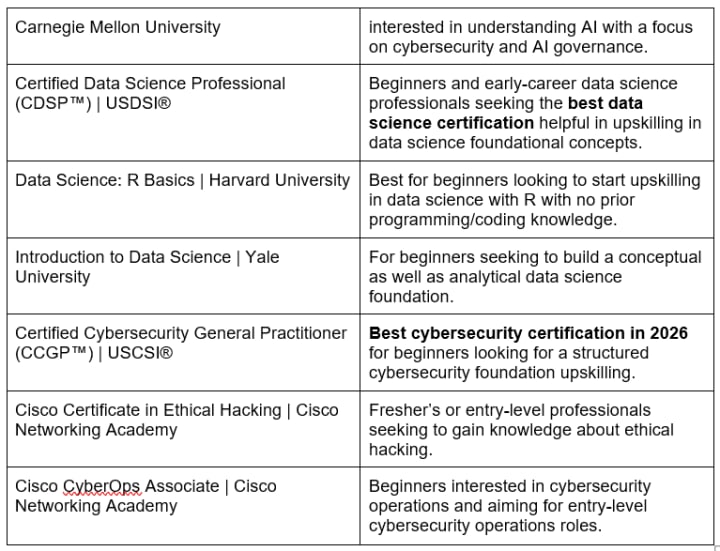
Pro Tip: As a beginner, you should always choose vendor-neutral certifications. By following this simple tip, your acquired skills will always stay versatile and help you work in any environment, platform, or on any product.
Wrap-Up
Whether you’re building AI skills, entering data science, or engaging in cybersecurity training programs, the certifications and courses outlined here give you clarity, credibility, and career momentum.
Do not plan your future; upskill in the field that most interests you in 2026 with the top professional certifications. Begin with a single certification that can support your career objectives in 2026, and by enrolling, make the next big move towards a successful career today!
Frequently Asked Questions
1. Do I need certifications in case I am already familiar with the basic concepts?
Yes. Certifications are a means of provable expertise, which is better believed by recruiters and employers than self-delivered expertise.
2. Can beginners with no coding experience pursue these certifications?
Absolutely. Such courses as Elements of AI or Data Science: R Basics are aimed at those who have no knowledge of code whatsoever.
3. Are certifications going to become irrelevant with the technology change?
Yes. Good certifications emphasize some of the fundamental principles, and these are the basic skills that remain useful despite changes in tools and platforms.
4. What are the benefits of certifications in career change?
They are presented in the form of structured evidence of competence, which enables specialists to enter such new areas as AI, data science, or cybersecurity without prior experience.
About the Creator
Pradip Mohapatra
Pradip Mohapatra is a professional writer, a blogger who writes for a variety of online publications. he is also an acclaimed blogger outreach expert and content marketer.
Keep reading
More stories from Pradip Mohapatra and writers in Education and other communities.
Want to Prepare Your Data for Agentic AI in Minutes? Here’s How
AI is advancing at an even quicker rate than the majority of organisations can adjust to it, and Agentic AI is rapidly growing to be the second significant progress in automation. In contrast to old-fashioned analytics, machine learning, or even generative AI, which learn, forecast, or take action on your behalf to achieve goals with minimal instructions.
By Pradip Mohapatra3 months ago in Education
Understanding Tax-Efficient Investing
For high-net-worth individuals, tax-efficient investing is a critical component of wealth management. Taxes can significantly impact portfolio growth, and strategies that minimize tax liabilities help preserve more capital over time. By considering tax implications when making investment decisions, investors can enhance after-tax returns and support long-term financial goals.
By Winston Fengabout 14 hours ago in Education



Comments
There are no comments for this story
Be the first to respond and start the conversation.