
Is AI the Right Tool to Solve That Problem?
When to Use AI and When to Look for Other Solutions

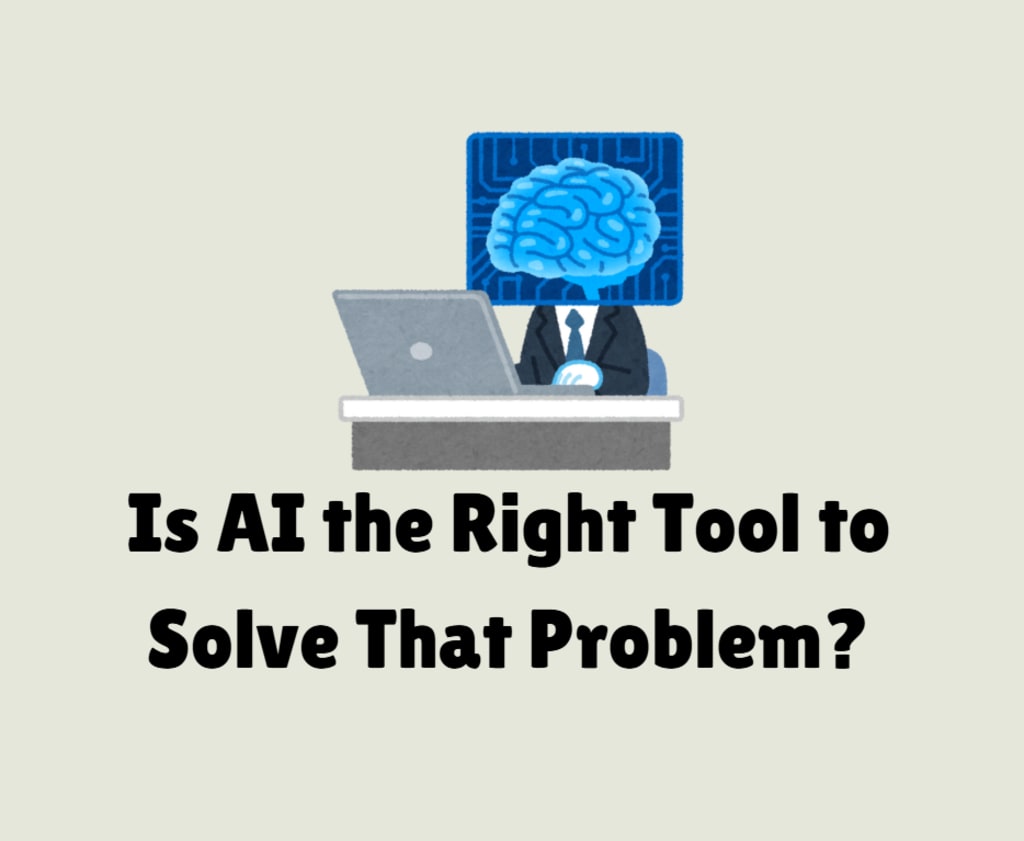
Artificial intelligence is becoming more popular, attracting researchers, businesses, and everyday users with its ability to solve problems. But AI is not a magic solution for everything. It works best when certain conditions are met. This article will help organizations understand how to choose the right problems for AI, find solutions when challenges arise, and decide which projects will have the biggest impact.
We will use examples from Google DeepMind, a company focused on solving complex real-world problems. Some of the authors of this article have experience in AI research, while one of them works at Google DeepMind and has firsthand knowledge of their projects.
Can AI Solve This Problem?
AI is powerful, but its success depends on a few key factors. These include the quality of data, the number of possible solutions, how clear the objective is, and whether the system needs to adapt to changes. If these elements are missing, AI might struggle. Here are some ways to handle these challenges.
1. Lack of High-Quality Data
AI models need good-quality data to work well. Many people think having more data is always better, but quality is just as important. In some cases, AI can generate synthetic data to increase the dataset.
For example, when DeepMind was developing AlphaFold, a tool for predicting protein structures, they had only about 150,000 data points. Since it takes years to manually study protein structures, they used an early version of AlphaFold to generate more data. By carefully filtering and improving these AI-generated predictions, they created a much larger and more useful dataset.
However, generating synthetic data is risky because mistakes can multiply if the process is not carefully managed. On the other hand, if a dataset is very large but low in quality (such as data scraped from the internet), improving it would be extremely difficult.
2. Too Many Possible Solutions
Some problems have too many potential solutions, making them hard to solve with traditional methods. AI can help by finding new patterns, but it also risks generating incorrect or unreliable answers.
DeepMind created a system called FunSearch, which uses AI to explore new solutions in math and computer science. It combines AI with an evaluator that checks whether the AI’s answers are correct. This approach has led to new discoveries in mathematics and helped improve algorithms used in logistics and scheduling.
3. Unclear Goals
For AI to work well, it needs a clear goal. In games like chess or Go, the objective is easy to define: win the game. But in real-world situations, defining success can be more difficult.
For example, AlphaFold’s goal was clear: predict the 3D structure of proteins as accurately as possible. A competition called CASP (Critical Assessment of Structure Prediction) provided a way to measure its success. However, in areas like social media, defining success is harder. If AI is designed to maximize engagement, it might prioritize controversial or misleading content instead of high-quality information. That’s why AI should be designed to balance multiple objectives, such as accuracy, user satisfaction, and ethical considerations.
4. When "Good" Can’t Be Easily Defined
Many problems change over time, and AI solutions may need to adapt. One way to handle this is reinforcement learning with human feedback (RLHF), where AI learns by receiving feedback from people.
DeepMind used RLHF to improve YouTube Shorts descriptions. Since videos often have little text, AI-generated descriptions help users find what they are looking for. Humans reviewed AI’s suggestions and provided feedback, helping the model improve over time. This method allowed AI to adapt and generate more useful descriptions.
Choosing the Right AI Projects
Once companies understand which problems AI can solve, they need to decide which projects to pursue. The best projects are those that can unlock new opportunities across multiple fields.
DeepMind follows a “root node problem” approach, meaning they try to solve problems that will lead to further advancements. AlphaFold is a great example—it didn’t just improve protein structure predictions; it also contributed to drug discovery and environmental research. To find these kinds of impactful problems, AI experts should collaborate with specialists in other fields.
DeepMind encourages such collaborations by hiring experts from different backgrounds, hosting research events, and working with external organizations. This approach helps spark new ideas and identify meaningful AI applications.
The Path to Innovation
After choosing an AI project, the challenge is to turn it into a useful product. Companies must avoid two common mistakes:
Focusing only on projects that immediately fit their business model. When AlphaFold was created, Google didn’t have a team dedicated to using AI for drug discovery. Instead of abandoning the project, Alphabet (Google’s parent company) created Isomorphic Labs, a new company focused on this area.
Assuming AI’s future applications can be predicted. AI should be flexible and evolve based on new discoveries and user needs. For example, DeepMind’s Ithaca project was designed to help historians restore ancient Greek texts. However, teachers later found it useful for educating students about AI and classical studies.
Moving Forward with AI
AI has great potential, but it needs to be applied wisely. Organizations should carefully select problems that AI is well-suited to solve and focus on projects that create widespread benefits. By working together across different fields and keeping an open mind, businesses can use AI to drive innovation and positive change.
One example of AI helping people with everyday tasks is MyEssayWriter.ai. This tool assists students and professionals in generating, editing, and refining their writing. While AI writing tools are not perfect, they can help users save time and improve their work when used thoughtfully. As AI continues to improve, such tools will become even more useful in education and professional writing.
About the Creator
Keep reading
More stories from Robert Barrett and writers in Education and other communities.
What to Do When an AI Tool Isn’t Meeting Your Needs
They promise to make things easier and faster, but sometimes they don’t work as expected. If you’re finding that an AI tool isn’t meeting your needs, you’re not alone. It can be frustrating, but there are ways to fix the problem and get the most out of the tool. In this article, we’ll go over some steps you can take when an AI tool isn’t working for you.
By Robert Barrettabout a year ago in Education
Why Adaptive Testing Is the Future of Healthcare Licensing?
Healthcare is evolving at a pace never seen before. Patient acuity is increasing, clinical environments are becoming more complex, and accountability standards are rising across every healthcare system. In response, healthcare licensing exams are also transforming. Traditional fixed-length exams are no longer sufficient to measure real-world competence. This shift is why adaptive testing is rapidly becoming the future of healthcare licensing.
By Sulcus Learning4 days ago in Education
The Quiet Between Us
The first time Maya noticed him, he was laughing. Not the loud, attention-grabbing kind. Not the forced kind people use when they know they’re being watched. It was the kind that escaped before he could stop it — head tilted back slightly, hand covering his mouth like he didn’t mean to be that happy.
By Haidar ghafoori 5 days ago in Education



Comments
There are no comments for this story
Be the first to respond and start the conversation.