
Intruders? Hidden Quests in Paris!
You may have seen them in Paris!


Traveling in European cities like Paris or London, I wonder if you have noticed these little guys:

These lovely mosaic collages are from "intruders", an anonymous Parisian street artist. He has been pasting these mosaics on the streets of Paris since 1998. At first, it was just a little alien in the 8-bit game Space intruders in the 1980s and 1990s. Later, the familiar images of the Smurfs and Super Mary gradually appeared in childhood. It is said that intruder always works on dark and windy nights, appears in front of the media wearing a mask, and secretly wears a mask to hide among visitors in his art exhibitions, so few people know his true identity so far.
Intruder's initial creation was only in Paris, and later he gradually expanded the "invasion" to London, Berlin, New York, Hong Kong... and other cities in France and Ravenna in Italy.
Of course, because Intruder lives in Paris, Paris is the easiest city to find these "intruderss". So far, intruders has produced 1,413 "intruders" large and small on the streets of Paris. Even if you only wander around the most famous scenic spots, you are bound to encounter a few.

The Intruder's "intruders" always appear near famous landmarks, such as the Latin Quarter on the Left Bank. The Latin Quarter is the most cultural area of Paris. The entire Latin Quarter develops around the scattered colleges of the Sorbonne. The name "Latin Quarter" is named after the students of the Sorbonne University in the Middle Ages spoke Latin. Founded in 1253, the Sorbonne University is one of the oldest universities in the world and the predecessor of the University of Paris. After the spin-off of the University of Paris in 1968, the University of Paris No. 1 continued to use the name of the Sorbonne, and is famous for humanities such as law, politics, and economics. The beautiful dome in the heart of the Latin Quarter belongs to the Sorbonne. There are several small cafes on both sides of the small square in front of the door. Of course, there is also a small "intruder".

The Panthéon is also the most famous attraction in the Latin Quarter. Founded around 1750, it was originally a monastery built by Louis XV to thank the patron saint of Paris, Geneva, for blessing him with his recovery from a serious illness. But the monastery was completed just in time for the French Revolution. The revolutionary power agency "National Trade Union" decided to turn it into a memorial hall to commemorate the great sages of France, thus avoiding the fate of being demolished. Today Panthéon's basement rests some of the greatest figures in French history, such as Voltaire, Rousseau, Hugo, the Curies... For the French, Panthéon is a symbol of the national soul.
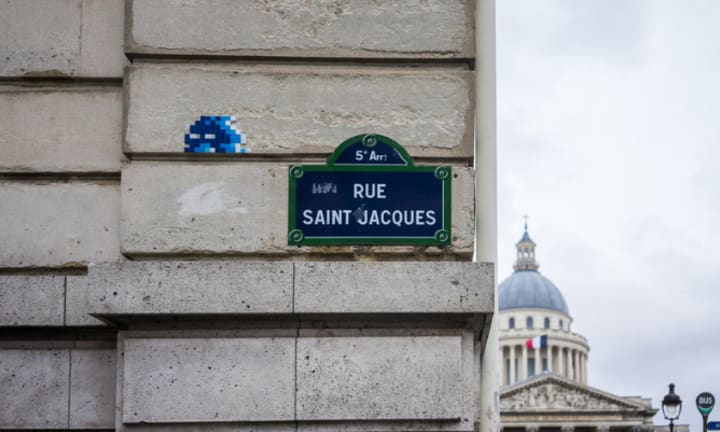
A few small "intruder" can of course also be found near the Panthéon. Behind the Panthéon is a quiet residential area where Hemingway lived in Paris in the 1920s. 74 rue Cardinal Lemoine is a very unremarkable private apartment, if it weren't for the "Ernest Hemingway 1899-1961" sign on the door, it would not even be different from the apartment next to it.

The Marais District, across from the Latin Quarter across the Isla de la Cité, is a neighborhood with a very urban atmosphere. The history of the Marais is not very long. Before the 13th century, this area on the right bank of the Seine was just an uninhabited low-lying area. The French word Marais means "wetland, swamp". In the 13th century, as the population of Paris grew, it was cultivated into farmland. However, it was not until Henry IV built the Vosges Palace in the 17th century that Paris nobles began to buy real estate and build mansions around them, and the Marais district has since become the most fashionable residential area in Paris. Many of the libraries, archives, museums, and even government institutions that you see in the Marais now come from aristocratic mansions in the 17th century. Later, as the royal family moved to the Palace of Versailles, the Marais area was gradually occupied by ordinary Parisians. Various small shops were slowly filled with alleys densely covered with comb teeth preserved from the Middle Ages, which became Parisians’ favorite shopping in their spare time. block. Therefore, the Marais area is naturally the place with the most dense small "intruder". Whether crossing the road or just walking out of a small store, I often accidentally encounter a small "intruder" as soon as I look up.
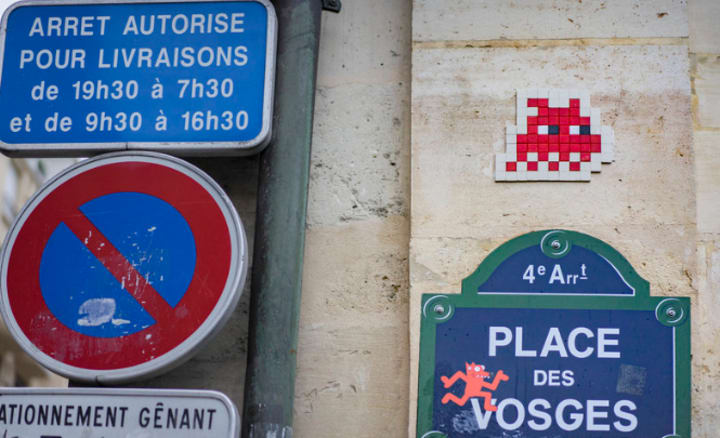
In 1605, Henry IV built the Palais des Vosges on the ruins of the abandoned palace of Henry II. This is a series of houses with long corridors connected together, a total of 36 houses. However, most of the French royal families have not lived in the Palace of Vosges, only Louis XIII's Queen Anne of Austria lived here for a short period of time. The square in the middle of the Vosges Palace is the first square planned and constructed in Paris, and it has been the most beautiful square in the hearts of Parisians until now. Many famous people once lived in the apartments that were converted from the Palace of Vosges around the square. Beginning in 1832, Hugo rented an apartment on the second floor of a small hotel on the corner of the Place des Vosges for 16 years. Up to now, at No. 6 in the southeast corner of the square, the former residence of Hugo, which has been turned into a museum, is still preserved. So of course there will be no shortage of small "intruders" like the Parisians in the Place des Vosges.

The Canal Saint-Martin is the secret garden of Parisians. In the movie "Amelie", Amelie is squatting on a lock on the Canal Saint-Martin. The 4.6-kilometer Canal Saint-Martin connects with the Seine at one end and the 100-kilometer-long canal l'Ourcq at the other. The entire canal system was built under the order of Napoleon in 1802 to draw clean water from the l'Ourcq River, more than 100 kilometers north of Paris, for the use of Parisians. Completed in 1825, the canal, in addition to providing water, was also used as a waterway to deliver food and building materials to Paris.

Of course, later with the development of technology, Parisians no longer need to rely on small canals as a source of drinking water, and no longer rely on canals for transportation. With the development of urban roads, many parts of the canal have been filled into underground waterways. However, the northern section of the Canal Saint-Martin was preserved under the solidarity initiative of the local population. Today the 19th century canals and locks are a retro landscape. The laid-back atmosphere attracts artists, designers and students, with studios large and small, vintage or alternative boutiques, cafés, bars and bistros. Of course, there is no shortage of famous French fast fashion brand stores.

In winter, the side of the small canal of St. Martin is not in lined with trees in Amelie's movies, and there are no Parisian girls in beautiful floral dresses sitting and chatting by the canal. However, you can see nearby residents walking their dogs, young couples carrying shopping bags of various sizes, and school students passing by on skateboards. These are also lovely scenery. Of course, there are also the little "intruders" who hide by the river and in the corners to observe everyone passing by.
In all, I've caught dozens of little "intruders" on the streets of Paris. But they were only a tiny fraction of the 1,413 "intruders" in Paris. There are many more little "intruders", hiding in an undiscovered street corner in Paris, waiting triumphantly for the phrase "Ah, here's another one!"
About the Creator
Sinovita
This is Sinovita! I have been freelance writing for more than 10 years. I love traveling and writing. I feel writing is a natural record of true feelings after serious life, and life is always a better script than a movie.
Why UMPCO Fasteners Still Solve Critical Aerospace Problems Today
When I started researching legacy aerospace fastener manufacturers, I wasn’t just looking for brand names—I was looking for solutions to real aviation problems. Structural failure, vibration fatigue, corrosion at altitude, and long-term reliability are challenges that every aerospace engineer eventually faces. One name that repeatedly surfaced in technical documentation and historical aerospace supply chains was UMPCO fasteners.
By Beckett Dowhana day ago in Education




Comments
There are no comments for this story
Be the first to respond and start the conversation.