
Indus Valley Civilization - UPSC History Notes - Part I
Discover the Origins, Urban Planning, and Economic Systems of the Indus Valley Civilization


Indus Valley Civilization - UPSC History Notes Part I
The Indus Valley Civilization, also known as the Harappan Civilization, is one of the world's earliest urban cultures. Flourishing around 2600 BCE to 1900 BCE, it spanned parts of present-day Pakistan and northwest India.
This civilization is renowned for its advanced city planning, architecture, and social organization. Understanding the Indus Valley Civilization is crucial for UPSC aspirants, as it lays the foundation for India's ancient history.
Geographical Extent
The Indus Valley Civilization covered a vast area, making it one of the largest ancient civilizations.
1. Core Regions: Centered along the Indus River and its tributaries, including the Ravi, Beas, and Sutlej rivers.
2. Major Sites:
- Harappa: Located in Punjab, Pakistan.
- Mohenjo-daro: Situated in Sindh, Pakistan.
- Dholavira: Found in Gujarat, India.
- Lothal: Located near the Gulf of Khambhat in Gujarat, India.
- Kalibangan: Situated in Rajasthan, India.
These sites indicate a civilization that extended over 1,260,000 square kilometers.
Discovery and Excavation
The existence of the Indus Valley Civilization came to light in the 1920s.
- 1921: Excavations at Harappa led by Daya Ram Sahni unveiled the first evidence of this ancient culture.
- 1922: R.D. Banerji's excavations at Mohenjo-daro further revealed the civilization's urban sophistication.
These discoveries challenged prior notions, revealing that a highly developed civilization existed in the Indian subcontinent contemporaneously with ancient Egypt and Mesopotamia.
Chronology Of Indus Valley Civilization
The timeline of the Indus Valley Civilization is generally divided into three phases:
1. Early Harappan Phase (c. 3300–2600 BCE):
Characterized by the formation of agricultural communities and the establishment of trade networks. Evidence of rudimentary village settlements transitioning towards urbanization.
2. Mature Harappan Phase (c. 2600–1900 BCE):
Marked by the peak of urban development with well-planned cities, standardized weights and measures, and extensive trade. Construction of large public buildings, granaries, and sophisticated drainage systems.
3. Late Harappan Phase (c. 1900–1300 BCE):
Signified by the gradual decline of urban centers and a shift towards rural settlements. Possible reasons for decline include climatic changes, tectonic activities, and shifts in river courses.
Urban Planning and Architecture Of Indus Valley Civilization
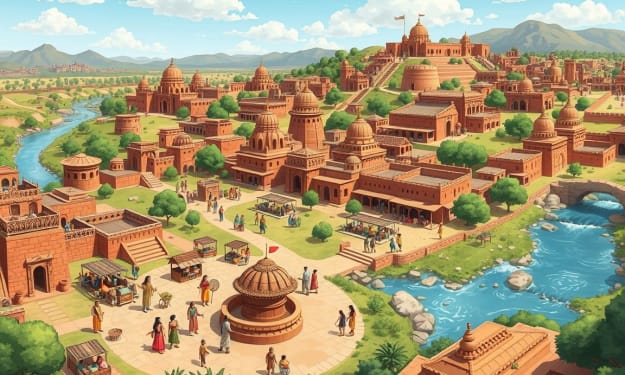
The Indus Valley Civilization exhibited remarkable urban planning and architectural prowess.
1. City Layout
a. Grid Pattern: Cities were laid out in a grid system with streets intersecting at right angles, reflecting meticulous planning.
b. Division:
- Citadel: Elevated area possibly used for administrative or religious purposes.
- Lower Town: Residential areas where the general populace resided.
2. Buildings and Structures
a. Residential Buildings:
- Constructed using standardized baked bricks.
- Homes often had multiple rooms, courtyards, and private wells.
b. Public Structures:
- Granaries: Large storage facilities indicating surplus agricultural production.
- Great Bath: Found in Mohenjo-daro, possibly used for ritualistic purposes.
3. Drainage System
Advanced drainage systems with covered drains running along the streets. Houses were connected to the main drains, showcasing an emphasis on sanitation and public health.
Economy Of Indus Valley Civilization
The economy of the Indus Valley Civilization was diverse and well-developed.
1. Agriculture
a. Crops Cultivated:
- Wheat and barley were staple crops.
- Evidence of rice cultivation in certain areas.
- Cotton was grown, indicating textile production.
b. Irrigation: Utilized river waters for irrigation, enhancing agricultural productivity.
2. Trade and Commerce
- Internal Trade: Well-connected cities facilitated internal trade of goods like pottery, beads, and metals.
- External Trade: Engaged in trade with Mesopotamia, evidenced by Indus seals found in Mesopotamian sites.
- Trade Goods: Exported items like cotton textiles, beads, and pottery; imported metals and precious stones.
3. Crafts and Industries
- Pottery: Produced wheel-made pottery, often decorated with geometric designs.
- Metallurgy: Skilled in working with copper, bronze, lead, and tin.
- Bead Making: Crafted beads from materials like carnelian, lapis lazuli, and shell.
Society and Culture Of Indus Valley Civilization
The social and cultural aspects of the Indus Valley Civilization reflect a complex and organized society.
1. Social Structure
- Uniformity: Standardized weights, measures, and brick sizes across cities suggest a centralized authority or shared cultural norms.
- Occupational Diversity: Presence of artisans, traders, farmers, and possibly administrators.
2. Religion and Beliefs
a. Seals and Figurines:
- Depictions of animals, possibly indicating totemic worship.
- Figurines resembling a mother goddess suggest fertility cults.
b. Great Bath: Indicates the importance of ritualistic cleansing.
3. Script and Language
a. Indus Script:
- Consists of symbols found on seals, pottery, and other artifacts.
- Remains undeciphered, leaving aspects of their language and administration unknown.
The Indus Valley Civilization stands as a testament to early human ingenuity and social organization. Its advanced urban planning, economic systems, and cultural developments highlight a society that was both complex and sophisticated.
For UPSC aspirants, a thorough understanding of the Indus Valley Civilization provides valuable insights into the subcontinent's ancient heritage and its contributions.
Click here to read "Indus Valley Civilization - UPSC History Notes - Part II"
About the Creator
Deep Knowledge Hub
Deep Knowledge Hub: Providing a wealth of deep and in-depth knowledge through curated, insightful, and engaging content!
Keep reading
More stories from Deep Knowledge Hub and writers in Education and other communities.
Indus Valley Civilization - UPSC History Notes - Part II
Indus Valley Civilization - UPSC History Notes Part II In this part, we will look into the art, religion, technology & innovations, trade and economy and the decline of the Indus Valley Civilization (IVC), Understanding these aspects provides a comprehensive view of this ancient society's cultural and historical significance.
By Deep Knowledge Hub12 months ago in Education
Creating Stability With Property During Uncertain Economic Cycles
Periods of market uncertainty can challenge even the most careful financial plans. Stock prices may swing sharply. Savings can lose value due to inflation. News headlines often create fear and hesitation. In these moments, many investors look for dependable ways to protect their wealth. Protecting investments during market uncertainty through property ownership remains a practical and proven option because property is based on real use, steady demand, and long term value.
By Accrue Real Estate6 days ago in Education



Comments
There are no comments for this story
Be the first to respond and start the conversation.