
INDIAN RAILWAY :- SPPED-PROGRESS-ACCIDENT
BALASORE TRAIN TRAGEDY
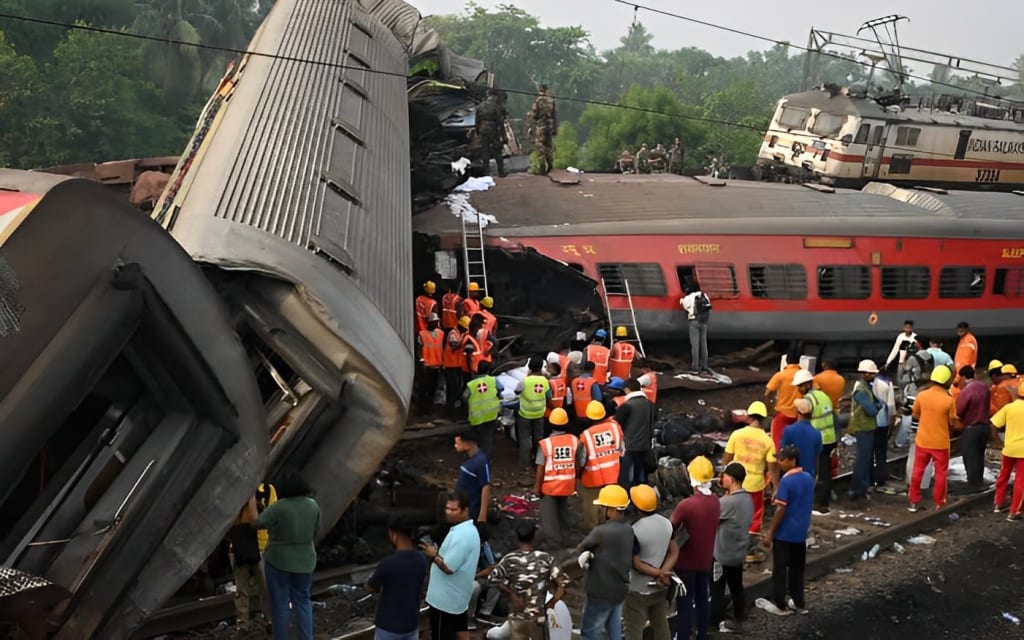
This romantic dream, written on a torn page of a diary lying on the side of a wrecked railway carriage, may have remained a dream just like the dreams of over 200 people who died untimely in one of the biggest and deadliest train accidents of this century in Balaswar district. The railway, which is called the lifeline of Indians, is turning into a dead end, despite all the efforts and the arms of those in power, it may be irrevocable for us to dismiss it now. Accidents can never be prevented if we always make the foolish mistake of passing the blame on to other people, thinking that they are only hidden or a reflection of bad luck. Its truth is easily understood if we consider the three-rail collision outside and the events that preceded it.
As much as the railway authorities have tried to explain so far, Sethru believes that the fatal accident was caused by a fault in the signal, making it more likely to be man-made. According to the minister, 'the change in the electronic interlocking system is the root of all the confusion.' The question is raised, isn't there a conspiracy? CBI investigation for that! Why and by whom the interlocking system was changed and how the signal to Sethyo was disturbed are the main points of investigation. The final investigation report may reveal its fate; But the big question that arises from this disaster is: Why Indian Railways, even after sixty-five years of independence, is not as safe as expected for the passengers? The number of accidents and deaths is increasing every year. A report quoting railway sources says that in 2021-22, the number of fatal rail accidents (in which people were killed) was 3, while in 2022-23, it increased to 48. One of the reasons for this
Most importantly, the neglect to modernize and strengthen the infrastructure of the old railway system. It would not be wrong to say that even the most important thing like signaling has been neglected, why according to another report (India Today) AI has detailed the aforementioned serious malfunction of electronic interlocking system mentioned by Railway Minister, General Manager of South Western Railway Zone, with an example of signal disruption in less than three months. He also highlighted what security measures are acceptable; But perhaps that matter remains unexplored. It may be recalled that several times earlier the expert committee has recommended to strengthen the signal system. The most important of these was formed by the Ministry of Railways in 2012 and Dr. 'High Level Security Review Committee' headed by Anil Kakodkar. It recommended that the entire 19,000 km of main railway lines should be equipped with modern signaling systems in line with the European Railway Control System within the next five years (ie by 2017); But even by March 2023, this work has not been completed and out of 6,556 stations, 6,396 stations have been implemented. Another important aspect that Kakodak Samiti highlighted was regarding accidents. A majority (50%) of rail accidents were attributed to track misalignment. Needless to say, no such dramatic change has yet been seen in this situation; Why is it that the 2022 report titled 'Derailment in Indian Railways' by the Comptroller and Auditor General of India (CAG), the government's own auditor, questions the government's claims about rail safety.
Reviewing the accidents that occurred between 2017 and 2021, the Chief Inspector said that 163 out of 27 accidents were caused by railway accidents, which is 69 percent. If miscalculation and collision accidents are taken into account, which occurred at Balswar, the number was 80%.1 Another important and critical point of this review report, this time clearly stated that 'it is common to blame human error while the problem lies at the root. 'Institutional' or formal. CAG informed about the National Rail Safety Cell (Rail Safety Fund) launched in 2017-18 and said that "289 (26%) of the 1127 rail derailment incidents between 2017 and 2021 were related to track renewal." As the reason for this, the reviewer of the Mahalekha has pointed out that underutilization of funds is the most responsible for this. According to his data, "In 2017-18, 81.55% was spent on priority work from the Railway Safety Fund, while in 2019-20, it decreased to 73.7.6%." Similarly, the budget for railway (track) renovation work was also reduced from 9607 crores (2018-19) to 7417 crores in 2019-20. The CAG writes in its review note: “This defeats the very purpose of creating a special fund for the financing of security-related work, as
"Security operations cannot be performed."
On the other hand, while the government gave a lot of publicity last year during the first implementation of 'Kabuch', a completely indigenous technology that can prevent collisions between two trains, there is still talk and controversy about it after the Bahanga accident. The first such anti-collision system was taken by the then railway minister in 2011
About the Creator
Keep reading
More stories from Gouranuja Somanath Mohapatra and writers in Education and other communities.
WHY THERE IS NO RETIREMENT AGE FOR POLITICIAN
The in-house government requires a service contract to be signed after a certain period of time. But politics is the only exception where you can enjoy power and privilege for life. Retirement age is not necessary, according to some experts, because politics is a service activity, not a job or profession. I can't say if it's right or wrong, but I think it's absolutely necessary to set a retirement age limit for politicians. Let's explore this difference of opinion in more detail in today's article. Civil servants and employees act in accordance with the constitution of the country and the orders of the government. Your ability to make decisions for yourself is severely limited. Even the most knowledgeable and experienced police officers basically have no choice but to enforce the laws of their country. Even if you know what is right and what is wrong, you are forced to go to certain places and do wrong just to obey government orders. For officials, bureaucrats, judges, officials are not law-makers, but only law-enforcers. Legislators are our MLA and Members of Parliament. It seems paradoxical that there is a retirement age for those who only follow the law, but there is no retirement age for those who make the law. For the mental and physical faculties of those who make laws must be superior to those of those who obey them. In order to rule the country and make decisions, people must be physically and mentally healthy. A person's age is determined by his intelligence, mental state, and physical ability. Regulated. So, does Congress need a mandatory retirement system? If you take a closer look, you will find that many politicians in our country hold important positions such as ministers, members of the Diet, and members of the Diet despite being completely unqualified, both physically and mentally. They are mentally incapable of making sound decisions and physically incapable of serving the public. in such a situation.
By Gouranuja Somanath Mohapatra3 years ago in Education
How Top-Ranked Teams Build a Culture of Excellence and Consistent High Performance
In today’s competitive business environment, success is rarely the result of individual talent alone. Strong, aligned, and resilient teams power organizations that consistently lead their industries. Lists highlighting outstanding teams, such as those curated by Forbes, have drawn attention to a critical truth: exceptional performance is built intentionally. These teams succeed because of how they collaborate, lead, and adapt over time. Understanding what sets these high-performing teams apart provides a roadmap for organizations seeking sustainable excellence.
By Daniel Ladner5 days ago in Education
Beautiful Lepidoptera Species in Decline, Rare Butterflies and Moths Worth Saving
Beautiful Lepidoptera species include butterflies and moths that shape the color and movement of the natural world. Their wings carry patterns formed over millions of years. Today, many of these species face serious threats and may vanish sooner than expected. Habitat loss, climate shifts, and chemical use continue to reduce their numbers. This article highlights beautiful Lepidoptera species you need to see before they are gone and explains why protecting them matters now more than ever.
By Akito Kawahara3 days ago in Education
🅼🅸🅳🅽🅸🅶🅷🆃 🆂🅽🅰🅲🅺🆂
"It's 10 in Tuscon! We all know what that means... It's Time for Midnight Snacks with your man, Gerald Gee! Ready to spend the night together? Me too! I'm full of snacks and can't wait to regurgitate them all back into your hungry ears. Crack a brew! Pop some corn! Anything to get ready for one hell of a show where the talk maybe cheap but the words cut deep...
By Lamar Wigginsa day ago in Fiction


Comments
There are no comments for this story
Be the first to respond and start the conversation.