
India vs Pakistan: Who Truly Holds the Power Today?
A Neutral Comparison of Military Strength, Economic Growth, and Global Influence in 2025

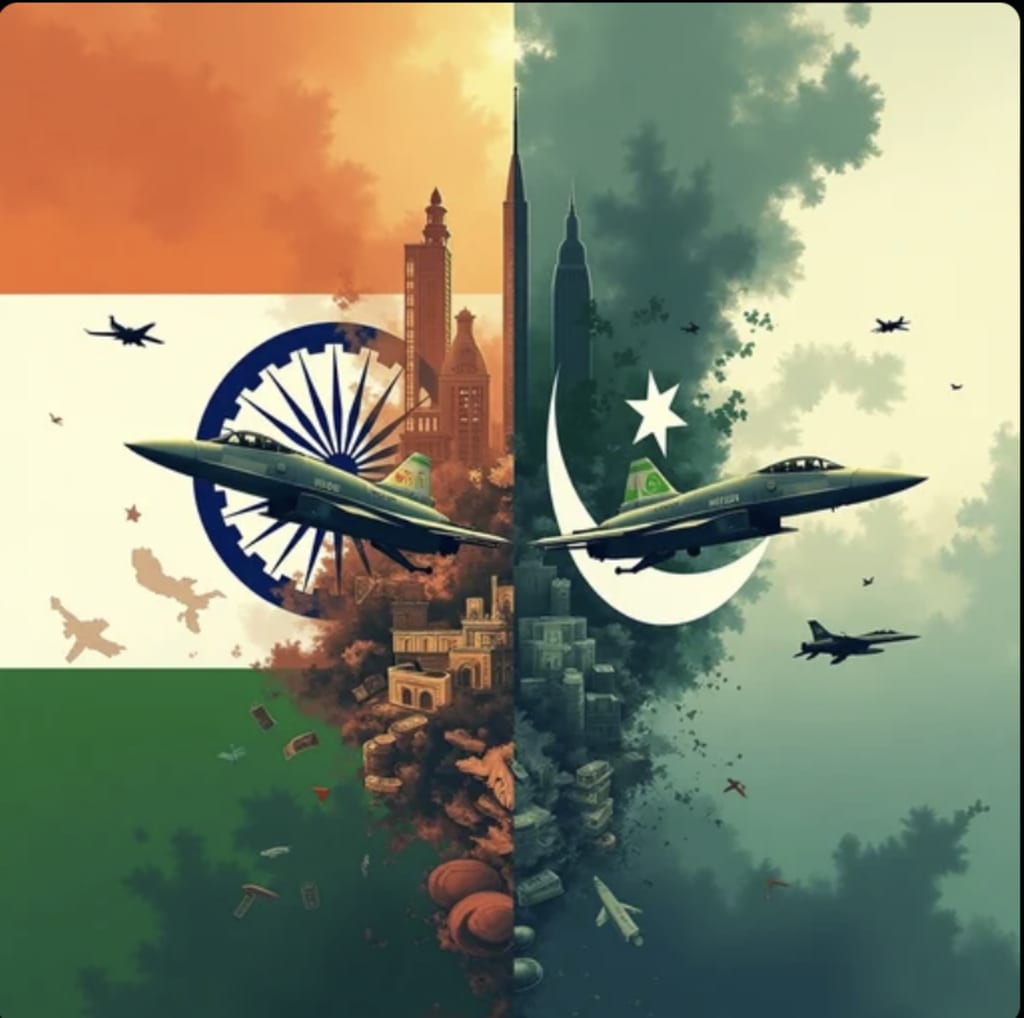
The rivalry between India and Pakistan has shaped South Asia’s geopolitics for decades. But in today’s fast-changing world, power is no longer measured by military size alone. To truly understand who stands stronger, we must look at three key pillars: Military Strength, Economic Power, and International Influence.
Let’s break down the comparison in a clear, simple, and neutral way.
1. Military Power: Who's Mightier on the Battlefield?
Military power isn't just about numbers. In the modern age, it’s also about technology, training, and strategy. Here's how both countries stack up:
A) Troop Strength
India: 1.45 million active personnel
Pakistan: 650,000 active personnel
With a larger population, India naturally has a bigger military.
B) Defense Budget
India: ~$83 billion
Pakistan: ~$11 billion
India’s defense spending is nearly eight times that of Pakistan, allowing for more investment in modern equipment and research.
C) Nuclear Capability
India: ~170 nuclear warheads
Pakistan: ~170 nuclear warheads
Both countries now have equal nuclear strength, with Pakistan previously holding a slight edge. India has since matched that power.
D) Air Force Strength
Pakistan: 600+ aircraft
India: 350+ aircraft
Interestingly, Pakistan leads in air fleet numbers and has secured 5th-generation fighter jets from China. India, while currently behind in this area, is in talks with the U.S. for F-35s, which could tip the balance.
E) Missile Range
India: Up to 5,000 km
Pakistan: Officially up to 2,750 km
Though India leads in declared range, reports suggest Pakistan may have long-range capabilities as well. However, Pakistan officially denies possessing such missiles.
Military Conclusion:
While both countries have strong armed forces, India holds the upper hand overall due to its massive defense budget, troop size, and advanced infrastructure.
2. Economic Power: The Engine Behind Strength
In today’s world, economic stability is just as important as military might. Let’s look at the numbers:
A) GDP (Gross Domestic Product)
India: ~$4 trillion
Pakistan: ~$370 billion
India’s economy is over ten times larger, making it a global economic force.
B) Foreign Reserves
India: ~$640 billion
Pakistan: ~$15 billion
This financial cushion gives India a significant advantage in handling crises and attracting global investors.
Economic Conclusion:
India is far ahead economically, giving it more leverage in global trade, technology, and development.
3. International Influence: Who Commands More Global Respect?
Influence is about who supports you, who listens to you, and how the world sees you.
A) Global Alliances
India enjoys strong relations with the U.S., Russia, France, Japan, and Australia. It is also part of major global groups like G20, BRICS, and QUAD.
Pakistan has a powerful strategic alliance with China, one of the world’s leading superpowers. It also holds strong ties with Turkey, Saudi Arabia, the UAE, and many Muslim nations.
B) Global Image & Soft Power
India exports its culture through Bollywood, IT, yoga, and education, building soft power across continents.
Pakistan builds influence through Islamic diplomacy, peace missions, humanitarian efforts, and shared culture within the Muslim world.
C) Diplomatic Reach
India has broader global engagement and is often seen as a future superpower.
Pakistan, while more regionally focused, plays a key role in Islamic unity, regional security, and China-led initiatives.
Influence Conclusion:
India has a wider global reach, but Pakistan holds strong influence in the Muslim world and through its alliance with China. Both countries have unique strengths in the international arena.
Final Verdict: Who's More Powerful?
When viewed across all three dimensions — Military, Economy, and Global Influence — here’s what we find:
Military Power: India leads overall, but Pakistan remains a formidable force with strategic depth.
Economic Strength: India is far ahead, with a booming economy and massive reserves.
International Influence: India has a broader reach, but Pakistan holds firm ground through China and Islamic alliances.
Conclusion:
India is currently more powerful overall, especially due to its economic size and global partnerships. However, Pakistan remains a key regional power, with nuclear capability, a strong military, and one of the most important alliances in the world — its deep relationship with China.
Both nations continue to grow and evolve, and the balance of power could shift in the future.
A Question That Must Be Asked...
If India holds more power on paper, then why has it not fully exercised that strength, especially in moments of high tension?
Take the Pulwama attack, for example. Indian leadership vowed a response within 48 hours. But more than 200 hours passed without a full-scale strike. Why?
Because despite the numbers, Pakistan is not weak. It is a nuclear power, and its military is well-prepared and deeply committed. Any aggressive miscalculation could spark a disastrous conflict. That’s why even a stronger country like India must act with restraint and strategy.
Final Conclusion: A Balanced Power Struggle
While India leads in terms of economic power, military budget, and global reach, Pakistan remains a serious regional force — equipped, ready, and supported by a global giant like China.
India may currently hold more tools of power.
But Pakistan’s strategic strength and nuclear capability mean it cannot be ignored, underestimated, or pressured easily.
In the end, the true strength of a nation lies not only in weapons or wealth — but in wisdom, diplomacy, and restraint.
Both India and Pakistan have much to gain from peace — and everything to lose from conflict.
Would you like me to provide a title image suggestion, meta description, or SEO-friendly tags for your Vocal Media post?
About the Creator
ZALAN KHAN
Sharing insights on education, tech, science, news, health, and motivation. I aim to inform, inspire, and empower through practical tips and thoughtful content.
Keep reading
More stories from ZALAN KHAN and writers in Education and other communities.
Fear of Failure: Its Influence on Success and Achievement
We all have dreams. Some want to become doctors, artists, or business owners. Others hope to travel the world, write books, or simply live a happy, fulfilling life. But for many people, these dreams remain just that—dreams. Why? One big reason is the fear of failure.
By ZALAN KHAN10 months ago in Education
AI-Driven Drug Discovery: Transforming the Future of Medical Innovation
Developing new medicines has long been one of the most challenging and resource-intensive processes in the healthcare industry. The traditional drug discovery pipeline often involves years of laboratory experiments, extensive data analysis, and multiple stages of clinical trials. Despite these efforts, the majority of potential drug candidates fail before reaching the market. This high rate of failure makes drug development both costly and time-consuming, limiting the speed at which new treatments become available to patients.
By Abba Leffler7 days ago in Education
When Learning Feels Like War: A Child’s Hidden Struggle With Words
Every morning, the school bell sounded like the beginning of a battle. For most children, school was a place of friends, laughter, and learning. But for nine-year-old Arman, it felt like stepping onto a battlefield where he was already losing.
By imtiazalam2 days ago in Education


Comments
There are no comments for this story
Be the first to respond and start the conversation.