
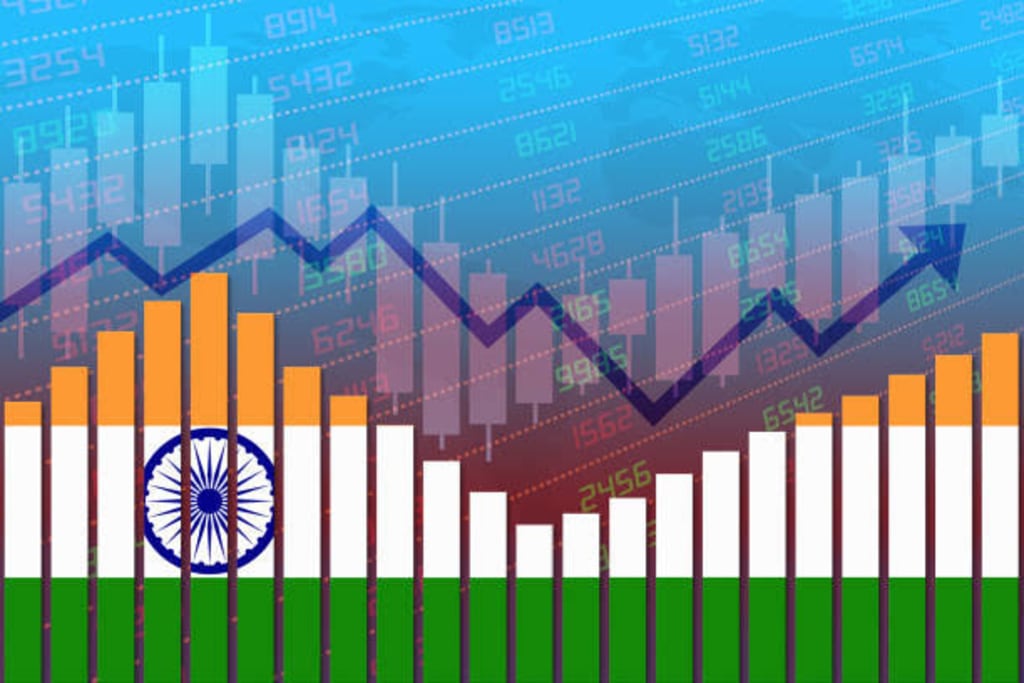
India is the world's sixth-largest economy by nominal GDP, and the third-largest by purchasing power parity. The Indian economy is characterized by a large labor force, a large agricultural sector, and a rapidly growing services sector.
The Indian economy has been growing rapidly in recent years, with GDP growth rates averaging around 7% per year. The country's large population and growing middle class have driven strong growth in consumer spending, and the country has also seen a rapid expansion of its manufacturing and technology sectors.
However, India also faces a number of economic challenges. The country has a large informal economy, and many workers are employed in low-paying, low-skilled jobs. Income inequality remains high, and the country still struggles with high levels of poverty. The country also has a large informal economy and high levels of corruption.
In recent times, India's economy has been hit by the COVID-19 pandemic and also by the global economic downturn. The Indian government has implemented various measures to revive the economy such as increasing public spending, providing financial assistance to the poor, and implementing reforms to attract foreign investment and boost domestic consumption.
Overall, India's economy is complex and multifaceted. The country has made significant progress in recent years but still faces many challenges in terms of poverty, inequality, and unemployment, which need to be addressed to ensure sustainable and inclusive economic growth.
India's Mixed Economy Overview
The economy of India is a developing mixed economy. It is the world's sixth-largest economy by nominal GDP and the third-largest by purchasing power parity. The country ranks 140th in per capita GDP (nominal) with $2,134 and 123rd in per capita GDP (PPP) with $7,783 as of 2018. After the 1991 economic liberalization, India achieved 6-7% average GDP growth annually. In FY 2015 and 2018 India's economy became the world's fastest growing major economy, surpassing China.
Agriculture and allied sectors like forestry, logging and fishing accounted for 18.6% of the GDP in 2017, employed 50% of the total workforce and despite a steady decline of its share in the GDP, is still the largest economic sector and plays a significant role in the overall socio-economic development of India. Yields per unit area of all crops have grown since 1950, due to the special emphasis placed on agriculture in the five-year plans and steady improvements in irrigation, technology, application of modern agricultural practices and provision of agricultural credit and subsidies since the Green Revolution in India. India is the largest producer in the world of milk, jute and pulses, and also has the world's second-largest cattle population with 170 million animals in 2011.
India is the second-largest producer of rice, wheat, sugarcane, cotton and groundnuts, as well as the world's second-largest fruit and vegetable producer, accounting for 10.9% and 8.6% of the world fruit and vegetable production, respectively. India is also the second-largest producer and the largest consumer of silk, producing 77,000 tons in 2005. The sector employs a large number of rural, unskilled women.
The Indian automobile industry is one of the largest in the world with an annual production of 21.48 million vehicles (mostly two-wheelers) in FY 2013-14. India had $600 billion worth of retail market in 2015 and one of world's fastest growing e-commerce markets.
India is the fourth-largest economy in the world, and is projected to be the world's second-largest by 2050. India has a diversified economy, which is classified as newly industrialized, and one of the G-20 major economies.
India is one of the world's fastest-growing major economies, and is expected to be the world's third-largest economy by the next decade. It is considered a newly industrialized country and a developing economy, with an average annual growth rate of 7.5% between 2014 and 2019. The Indian economy has been classified as a frontier market and one of the top ten global emerging markets by the International Monetary Fund and the World Bank.
India has a mixed economy in which there is a variety of private freedom, but the government still retains control over some sectors, such as radio, television, and aviation. The private sector is responsible for most economic activity. India has the world's largest democracy and one of the fastest-growing economies in the world.
About the Creator
Keep reading
More stories from M.ahamed tharik and writers in Education and other communities.
CHATGPT
CHATGPT : ChatGPT is a conversational language model developed by OpenAI. It is based on the transformer architecture and is trained on a large dataset of text to generate human-like responses to text input. ChatGPT can be used to generate natural language responses in a variety of contexts, including answering questions, generating creative writing, and engaging in casual conversation. The model has been fine-tuned for specific tasks and is available for use through the OpenAI API.
By M.ahamed tharik3 years ago in Education
What People Get Wrong About Consulting
Many people talk about consulting, but few understand what it truly involves. Movies, social media, and word of mouth often shape a narrow view. This creates confusion for students, business owners, and even new consultants. The topic of common misconceptions about consulting matters because these beliefs affect career choices and business decisions. When ideas are wrong, expectations break down fast.
By Nicole Metz7 days ago in Education
Smart phones, Humans and Aliens.
WARNING. I will be tapping into one of your favorite creative tensions: The absurdity of humans worshipping their glowing rectangles as if they were tiny oracles. There’s something deliciously poetic about that contradiction, and it lends itself beautifully to an instructive proviso.
By Novel Allen5 days ago in Poets


Comments
There are no comments for this story
Be the first to respond and start the conversation.