
If You've Ever Missed a Trade Because of Wi-Fi, Read This. Why Most Forex Bots Fail (And It's Not Your Strategy)
The Hidden Pitfalls of Automated Trading

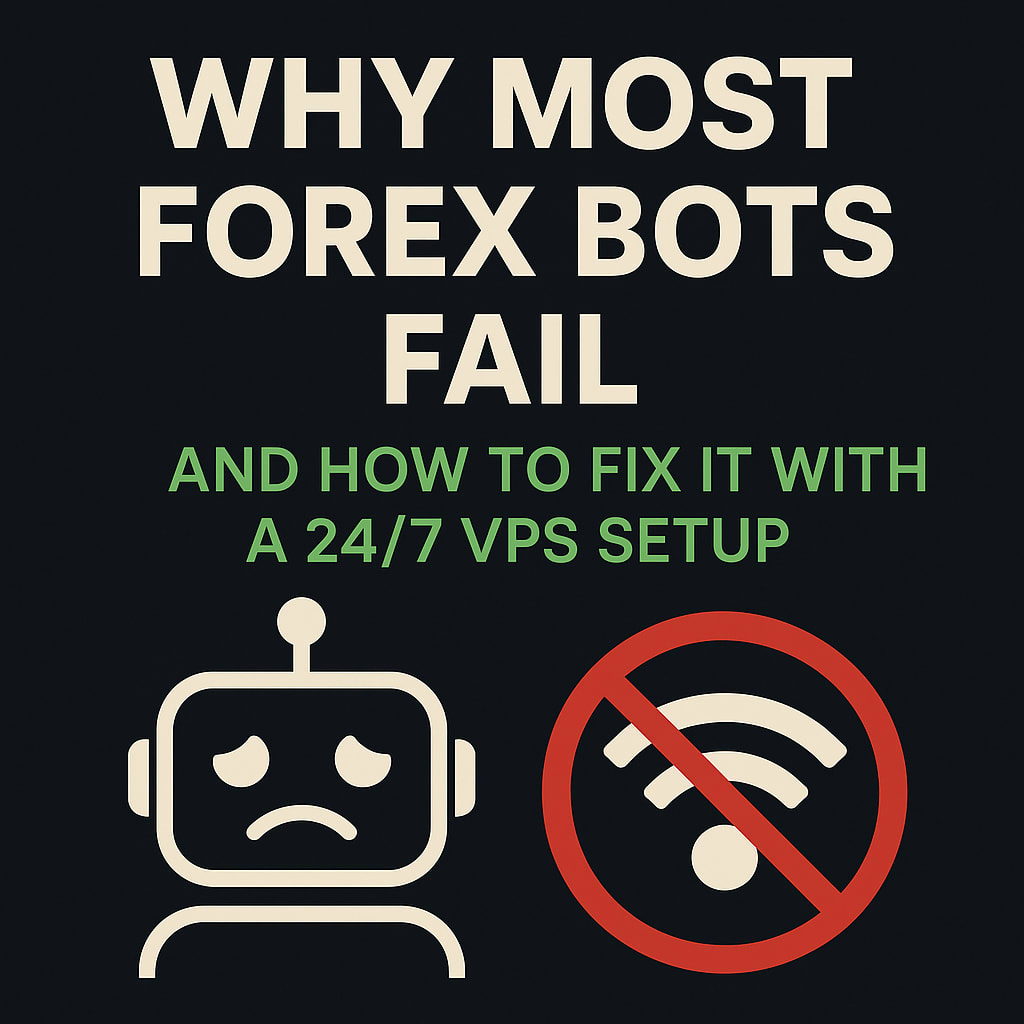
That sinking feeling. You wake up, grab your coffee, check your trading platform... only to see that your meticulously crafted bot missed the trade. The perfect setup. The one your backtests screamed profitability. Instead, a glaring gap in your P&L stares back. "Why?!" you groan, instantly doubting your strategy, your code, maybe even your entire trading approach.
Hold that thought. What if the culprit wasn't your brilliant algorithm? What if the weak link wasn't in your logic, but in something far more mundane, yet critical: where and how your bot runs?
You've optimized indicators, fine-tuned entry points, and stress-tested for volatility. But if your bot is gasping for breath on an unstable home connection or a sleepy laptop, all that genius is wasted. Let's uncover the real, often invisible, reasons why so many Forex bots fail to live up to their promise.
The Achilles' Heel: Your Bot's Running Environment
Most traders focus intensely on strategy development – and rightly so. But they often treat the execution environment as an afterthought. This is a massive oversight. Your bot isn't just lines of code; it's a real-time machine constantly interacting with volatile markets. Its physical location and connection matter immensely. Here’s why:
1. The Unstable Home Internet Nightmare: Your home Wi-Fi is great for streaming movies, not for high-stakes trading. Even brief disconnects – a router hiccup, interference from a microwave, ISP maintenance – can be catastrophic.
- What Happens: Your bot loses connection to the broker's server. Price updates stop. Order signals generated during the blackout vanish into the ether. By the time the connection flickers back, the opportunity is gone, or worse, the market has moved against your intended position.
- The Hidden Cost: Milliseconds matter. A 2-second dropout during a volatile news event can mean missing an entry by dozens of pips.
2. The Sneaky Laptop/Server Restart: Updates, power glitches, unexpected crashes, or simply forgetting to disable sleep mode. If your bot runs on your personal machine or a basic home server, it’s vulnerable.
- What Happens: The machine reboots. Your bot shuts down. It stays offline until you manually restart it. How many profitable setups occur while you're asleep, at work, or simply away from your desk?
- The Hidden Cost: Missed trades compound over time. One missed 50-pip winner a week translates to thousands in lost annual profit.
3. High Latency: The Silent Profit Killer: Even if your connection seems stable, the distance your data travels (from broker server -> your home -> broker server) introduces latency. This is the delay between your bot seeing a price and its order reaching the exchange.
- What Happens: Your bot sees a signal at 1.1050. It sends a buy order. Due to high latency, the order arrives at the broker when the price is already 1.1055. You get filled at a worse price (slippage), or worse, the price spikes past your entry level, and the order never fills at all.
- The Hidden Cost: Consistently entering trades even a few pips late erodes profits and increases risk. In scalping or arbitrage strategies, high latency makes them completely non-viable. Studies (like those by the International Capital Market Association) consistently show that latency advantages translate directly to better execution and profitability.
The Real-World Impact: More Than Just Missed Trades
The consequences of these technical failures go beyond a single frustrating missed entry:
- Profit Evaporation: This is the most direct hit. Those missed opportunities represent real, quantifiable money left on the table. Over weeks and months, this adds up significantly.
- Strategy Misdiagnosis: This is perhaps the biggest hidden cost. You see poor performance – missed trades, late fills, slippage. Naturally, you blame your bot's logic. You spend hours, days, weeks tinkering with the strategy, optimizing parameters that weren't the problem, or worse, abandoning a potentially profitable system altogether. You're fixing the wrong thing.
- Eroded Confidence: Constant technical glitches breed frustration and distrust in automation, pushing traders back to manual trading or giving up on bots entirely.
The Invisible Factor: Where Your Bot Lives
Many traders pour their energy into optimizing everything – except the very foundation: the physical location and infrastructure running their bot.
Think about it:
- Your Home Setup: Prone to internet drops, power outages, forced updates, latency, and relies on your personal hardware running 24/7. It’s simply not designed for mission-critical, millisecond-sensitive operations.
- The Broker's Server: This is designed for it. It sits in a secure data center, directly connected to liquidity providers and exchanges with ultra-low latency fiber optics, backed by redundant power and internet connections, running 24/7/365.
The Solution: Bridge the Gap with a VPS (Virtual Private Server)
The most effective way to solve these core infrastructure problems is to run your Forex bot on a VPS located in the same data center as your broker's trading servers.
Here’s why this is a game-changer:
1. Near-Zero Latency: Milliseconds become microseconds. Your bot sees prices and sends orders almost instantaneously. This dramatically improves fill speed, reduces slippage, and makes latency-sensitive strategies possible.
2. Rock-Solid Uptime: Professional data centers have redundant power supplies (generators, UPS), multiple high-bandwidth internet connections, and climate control. Downtime is measured in minutes per year, not hours per month.
3. True 24/7 Operation: Your bot runs independently of your home PC. Laptop crashes? Power cut? Vacation? Doesn't matter. The VPS keeps humming along, monitoring the markets and executing trades.
4. Enhanced Security: Reputable VPS providers offer robust security measures far exceeding typical home networks.
Choosing the Right VPS:
- Proximity is Key: Ensure the VPS provider has servers physically located in the same data center as your broker's main trading servers (often in New York, London, Tokyo, or Chicago). Don't just settle for "same city" – same building/rack is ideal.
- Reliability & Specs: Look for providers specializing in Forex trading with proven uptime records. Ensure adequate CPU, RAM, and bandwidth for your bot's needs.
- Managed vs. Unmanaged: If you're comfortable with server admin, unmanaged is cheaper. Managed VPS takes care of OS updates and basic maintenance for you.
Beyond Wi-Fi: A Holistic View
While Wi-Fi and home infrastructure are major culprits, remember a VPS isn't a magic bullet for a fundamentally flawed strategy. However, it does ensure your bot has the best possible chance to execute your strategy faithfully and consistently. It removes a huge, often overlooked, variable from the performance equation.
Stop Blaming Your Strategy (For This Reason)
The next time your bot misses a trade or suffers poor fills, before you dive headfirst into rewriting your code, check your setup. Ask yourself:
- Did my internet drop?
- Did my computer restart?
- Is my latency high?
- Is my bot running anywhere near the broker's server?
Chances are, the problem isn't your strategy's brain, but its legs. Give your bot the professional-grade infrastructure it deserves – a reliable, low-latency VPS co-located with your broker. It might just be the most profitable upgrade you ever make.
FAQs: Why Forex Bots Fail (The Infrastructure Edition)
Q: Is a VPS really necessary? Can't I just use a wired connection at home?
A: A wired connection is better than Wi-Fi, but it doesn't solve the core issues of latency (due to physical distance from the broker), potential home ISP outages, or your local machine rebooting. A VPS provides a dedicated, optimized, and ultra-reliable environment located strategically.
Q: How much does a Forex VPS cost?
A: Costs vary by provider and specs, but typically range from $20 to $100+ per month. Compare this to the potential profit lost from just one or two missed trades per month – it's often a very sound investment.
Q: Will a VPS make my bot profitable?
A: No. A VPS ensures your bot executes your strategy reliably. It removes technical barriers. If your strategy is unprofitable, a VPS won't magically fix that. But if your strategy is sound, a VPS prevents avoidable losses due to poor execution and missed trades.
Q: How do I find out which data center my broker uses?
A: Check your broker's website (look for "server specifications," "trading infrastructure," or "VPS partners"). Contact their support directly. Reputable brokers are usually transparent about this.
Q: Can't I just use a cloud service like AWS or Google Cloud?
A: While powerful, general cloud platforms aren't always optimized for ultra-low latency trading. Their data centers might not be co-located with your specific broker's trading servers. Specialized Forex VPS providers focus specifically on this proximity and low-latency networking.
Q: What about mobile trading? Doesn't that have latency?
A: Absolutely! Mobile connections (4G/5G/Wi-Fi) introduce significant and variable latency. They are suitable for monitoring and manual interventions, but never for running automated trading bots that require millisecond precision and 100% uptime.
Don't let shaky Wi-Fi or a sleeping laptop sabotage your trading edge. Take control of your bot's environment. Investigate a Forex VPS solution today – it could be the key to unlocking your strategy's true potential. Have you experienced the frustration of a missed trade due to tech issues? Share your story in the comments below!
About the Creator
Epic Vibes
✨ Welcome to Epic Vibes Blog! 🌟 Explore diverse insights and trending topics. From the latest buzz to hidden gems across various realms, we bring you fresh, engaging content. Stay ahead with us! 🚀
Keep reading
More stories from Epic Vibes and writers in Education and other communities.
Mini Chefs Magic: Safe & Fun Kitchen Adventures Where Kids Cook with Confidence!
Unleashing Culinary Creativity in Little Hands Picture this: Your child beams with pride as they serve you a homemade snack they prepared all by themselves. The kitchen, often seen as a grown-up domain, transforms into a playground of learning, creativity, and connection. But how do you balance safety with fun? Enter Mini Chefs Magic—a philosophy that turns cooking into a joyful, confidence-building adventure for kids while keeping risks at bay.
By Epic Vibes10 months ago in Education
How Financial Advisors Make Millions Behind the Scenes
Many people trust financial advisors to guide their money decisions. Advisors help clients save, invest, and plan for retirement. They often appear helpful and knowledgeable. Yet many people do not know how advisors earn their real income. The truth is simple. Financial advisors are secretly making millions through systems that most clients never notice.
By Keith D'Agostino5 days ago in Education
Is Gold Still a Safe Haven? Latest Trends in the Global Gold Market
Gold has long been recognized as a haven in times of financial uncertainty. For centuries, investors, governments, and institutions have relied on gold to preserve wealth during periods of economic instability. Its reputation as a store of value has survived wars, economic crises, and major changes in the global financial system.
By George Drazenovic5 days ago in Education




Comments (1)
I've been there. Spent ages perfecting a bot, only to have it miss trades due to a lousy connection. Home Wi-Fi's just not reliable enough for trading. You really need to test your connection stability. And don't forget about the hardware your bot runs on. A slow laptop can mess things up big time. Any thoughts on how to ensure a super stable setup? Also, it's crazy how many overlook the execution environment. We focus so much on the strategy, but the running conditions are crucial. What steps do you think are most important for optimizing that environment?