
If All Human Knowledge Could Be Transferred to a Newborn at Birth, Would Schools Still Exist?
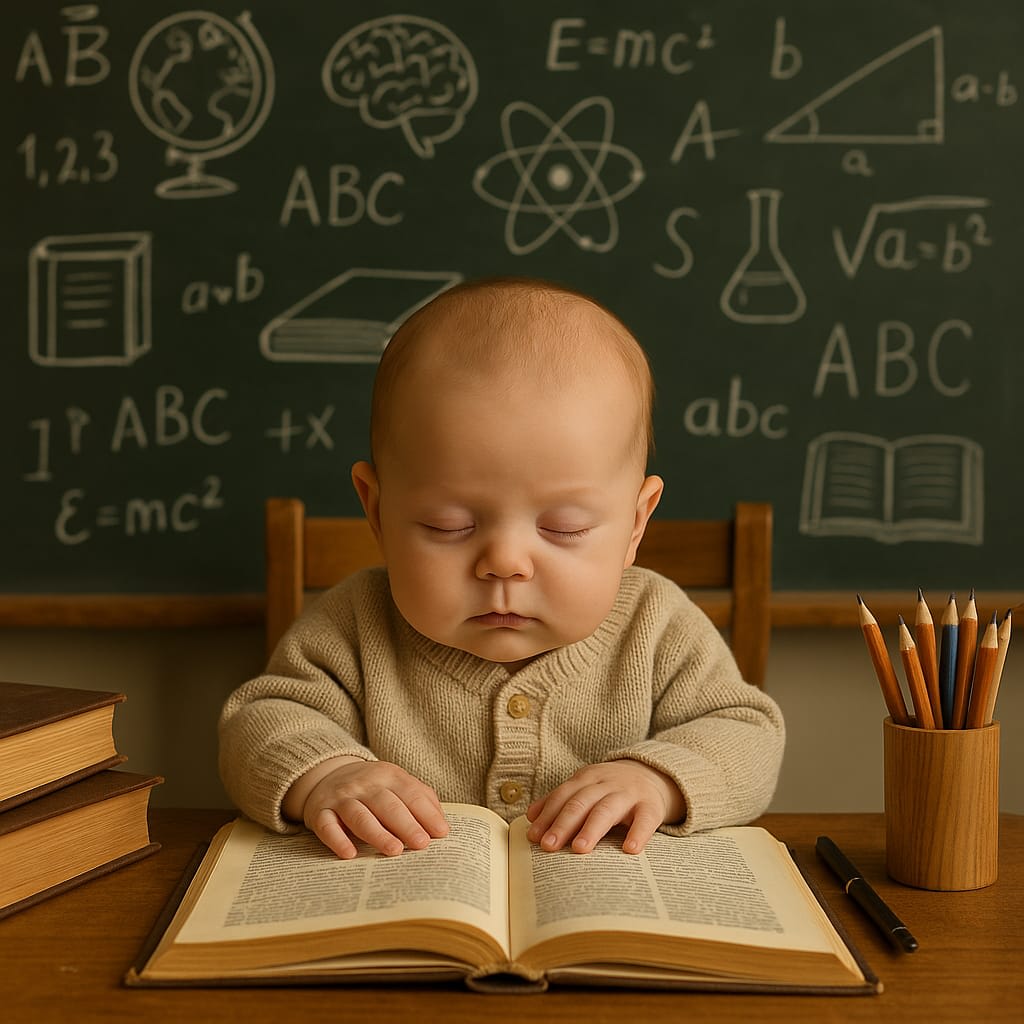
Imagine a newborn whose brain is instantly filled with Newton’s laws, Shakespeare’s sonnets, quantum physics, and every world language. They “know” everything. But here’s the thing...

Well,
“If wisdom could be downloaded, would we still need teachers?” It’s a hauntingly futuristic question, isn’t it?
In an age where artificial intelligence can write poems, diagnose diseases, and fly drones with surgical precision, we’re forced to ask: What if one day, all human knowledge—science, literature, history, math, even emotional intelligence—could be embedded in the mind of every newborn? Would schools still be necessary? Would classrooms become obsolete? Would teachers vanish? At first glance, it feels like an easy “no.”
But dig a little deeper, and the answer becomes far more nuanced—and, in many ways, deeply human.
Knowledge ≠ Wisdom: The Heart of the Argument
Imagine a newborn whose brain is instantly filled with Newton’s laws, Shakespeare’s sonnets, quantum physics, and every world language. They “know” everything. But here’s the thing:
Knowing facts isn’t the same as knowing how to live. Knowledge is passive. It tells you what is. But wisdom, empathy, resilience, cooperation—these are practiced, not downloaded.
Schools are not just data-delivery machines. They are social laboratories, emotional training grounds, and moral ecosystems. They teach us how to fail, adapt, collaborate, and grow. A baby who “knows” doesn’t necessarily “understand.”
Understanding takes context, reflection, emotion, and time.
A Historical Glimpse: How We’ve Always Needed More Than Facts
Let’s rewind. Ancient Greece, India, and China all had systems of philosophical and moral education—not just intellectual drills.
Aristotle emphasized practical wisdom (phronesis). Confucius focused on virtue and social harmony. The Gurukul system taught not just scriptures, but discipline, humility, and purpose. Even in modern education, the best teachers don’t just tell you the answer. They train your mind to ask better questions. So, if a newborn “knew” all the answers already, what then?
We’d still need places—and people—to guide them through what those answers mean.
The Role of Experience: Why Living Still Matters
There’s a difference between reading about heartbreak and living through one.
Between knowing that fire burns and touching it. Between understanding ethics and being tempted to lie. Human growth isn’t linear. It’s experiential. Even if you knew every historical mistake, you might still need to make your own to truly evolve. Schools provide a controlled environment for these experiments in growing up. Think of labs, debates, team projects, field trips—each one simulates parts of life, offering safe ways to engage with complexity.
Without that, knowledge becomes sterile.
Socialization: The Missing Link in Pure Data Transfer
Another key function of school? Social learning.
We don’t learn to share, lead, negotiate, or empathize through Wikipedia. We learn by interacting.The kid who shares their lunch. The classmate who cheats on a test. The friend who stands up for you in a fight. These moments shape us. They teach values, reactions and responsibility. No memory upload can simulate these subtle lessons in humanity. In fact, developmental psychology (Piaget, Vygotsky, Erikson) shows that social context is critical to forming identity.
Schools are vital arenas for that identity to unfold.
Emotional Intelligence: Can You Really “Upload” Empathy?
According to the World Economic Forum, emotional intelligence and collaboration skills will be among the most critical traits in the future job market—possibly even more important than IQ.
So even if a child is born knowing all about algorithms and global history, would they know how to manage heartbreak? Deal with failure? Handle a difficult boss? Lead a team through conflict? Unlikely, these are not algorithmic answers.
They’re learned through real, messy, human relationships—many of which are forged in school.
Creativity and Critical Thinking: Beyond Data
Knowledge is the raw material. But creativity is the act of recombining it into something new.
And critical thinking is the courage to challenge what is known. Can either of those be transferred biologically? Doubtful. A classroom, when done right, is a sandbox of ideas. Students question, debate, explore. That process—uncertain, uncomfortable, and often nonlinear—is what sparks invention and maturity.
If anything, a child born with all knowledge would still need a teacher to help them unlearn, question, and reshape it.
The Teacher’s Evolving Role: More Mentor, Less Lecturer
In this imagined future, the teacher becomes less of a lecturer and more of a guide, counselor, provocateur.
Their job won’t be to “teach” in the traditional sense, but to help students apply knowledge meaningfully—to craft lives of purpose, not just facts. Think of it as the shift from “instructor” to “curator of human experience.”
And that may make schools more vital than ever before.
My Final Reflection: Why the Soul Still Needs a Classroom
If knowledge transfer were possible at birth, we’d gain much.
But we’d still need connection, guidance, failure, reflection, and love—the things no neural upload can replace. In that future, schools may look different: less about memorization, more about transformation. Fewer textbooks, more dialogues. More mentorship, deeper humanity. But they’d still be here.
Because even the most brilliant minds need to grow in community, courage, and compassion. And for that, we’ll always need schools.
Written by: Soumen Sasmal
About the Creator
Soumen Sasmal
Soumen Sasmal is a versatile writer & storyteller, crafting deep, emotional, and insightful narratives to inspire personal growth and transformation.
Keep reading
More stories from Soumen Sasmal and writers in Education and other communities.
How Has the ‘Hustle Culture’ in Movies and Social Media Changed the Way We View Motivation?
I used to wait for motivation like it was a spark that would strike out of nowhere—a magical jolt of energy that would make me suddenly productive, focused, and unstoppable. And when it didn’t come, I blamed myself. I thought maybe I just wasn’t built for greatness. Maybe the fire that fueled others was missing in me.
By Soumen Sasmal11 months ago in Motivation
Precision in Motion: The Rise of Sport Shooting and Firearms in Modern Competition
Sport shooting has grown from a simple test of aim into a structured sport that demands discipline, patience, and technical skill. Today, sport shooting and firearms play a major role in global competitions, training programs, and recreational events. Athletes train for years to improve accuracy and control. They study equipment, posture, breathing, and focus. Because of this dedication, sport shooting has become a respected sport that rewards precision and calm thinking.
By Matthew Pothoffabout 2 hours ago in Education
NCLEX Study Plan: A Step-by-Step Guide for Nursing Students
Preparing for the NCLEX-RN is one of the most important milestones in the nursing students’ career. This is because the NCLEX is the final step before nursing students can become licensed nurses. However, it is not as easy as simply reading nursing textbooks and taking notes from class lectures. This is because the NCLEX is designed to test the nursing students’ clinical judgment and decision-making skills.
By Sulcus Learning3 days ago in Education
Hottest in the Office
Dear Rafi, You’re very distracting to work around. For the first second I saw you the other day, I thought you were some type of executive. It took a moment to realize no, you were just the new guy, dressed up for the job he wants. Be still, my heart.
By Gabriel Shames2 days ago in Pride



Comments
There are no comments for this story
Be the first to respond and start the conversation.