
Ian Tillotson
“Try different things. You can’t know whether or not you like something until you’ve given it a try.”

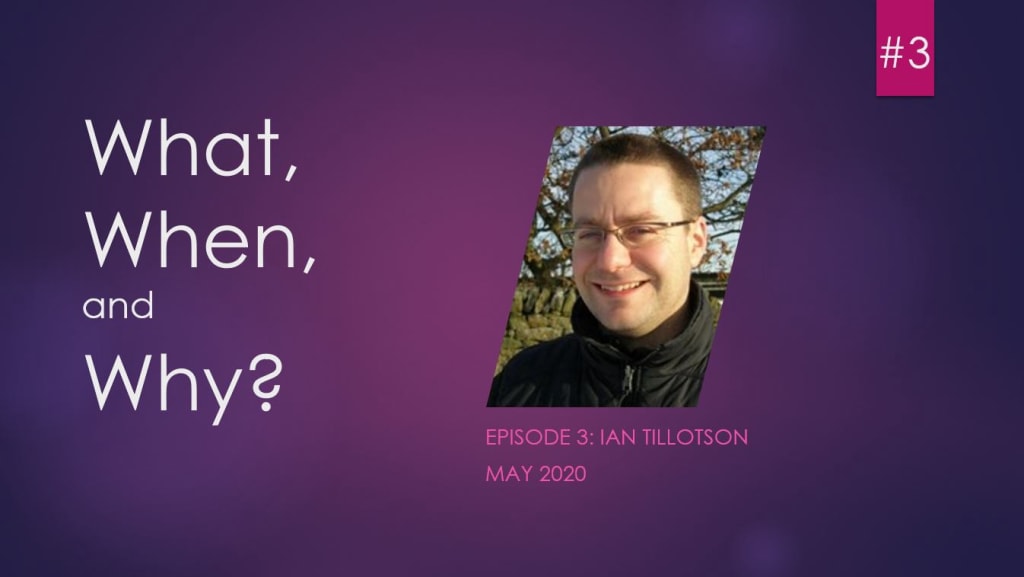
This is a post from my What, When, & Why? initiative where I interview people about their career backgrounds to help other youngster get a sense of the breadth of opportunities in the world.
Ian Tillotson
Ian is an Associate Director at Accenture, a large technology consulting firm. He did a Master of Engineering (MEng) degree at the University of Cambridge.
1. Tell us a bit about you
I’ve been living in the Northumberland for many years with my family and we have recently transferred to the Channel Islands.
I work for Accenture which is a large IT and IT-services company. I’ve worked at Accenture for almost all my career. Over 25 years in fact — a full quarter-century with the same firm!
Accenture is an international company with offices and staff in pretty much every country around the world. I work out of Accenture’s Newcastle Technology Centre and focus on large IT projects for the government — in areas such as tax, pensions, and National Insurance.
Projects like these have many hundreds of people from the government IT teams and Accenture and other companies and I manage the delivery of these programmes.
2. What did you do before Accenture?
Accenture was actually my first job after leaving university (though it was called Anderson Consulting back then).
Prior to university I had a friend who ran a pub and I got the chance to work there. It was a great job for meeting people and gaining confidence. I thoroughly recommend finding an opportunity like that when you are young.
I took a gap-year between school and university. Instead of travelling I worked for an engineering services company called WS Atkins and did a range of engineering-related activities — looking at drainage systems and water works. It involved a lot of work outside which was fun and gave me the chance to work with experts and learn from them. I also worked for WS Atkins during my first two university summer breaks.
3. What did you focus on at school?
I was actually the first year that did GCSEs rather than O-levels. It was kinda cool being the first cohort to do them but also tricky as the teachers had no experience and were needing to work out what to teach differently.
I did the usual broad range of subjects. My one main difference to the crowd was I decided to do a Russian GCSE rather than German or Latin. Back then in the 1980s Russia was regularly in the news but for far more positive reasons than today. I’ve never really used my Russian but it is definitely something I’m pleased I spent a few years doing.
For A-levels I studied Maths, Further Maths, Physics and General Studies.
I wasn’t at all sure what I wanted to do at university or after, but given I’d focused on STEM subjects I chose to read Engineering as I thought it would have broad applicability after university.
4. To do your job what skills are required?
A great question! I really think the number one skill is a tricky one to learn — and that’s common sense. Applying common sense to all aspects of life, whether a job or outside work, is important.
Also, a constant desire to learn — to learn new things and to really want to understand the topic you are working on. It’s vital to have an enquiring mind as you can’t know everything but you need to know how to find out more about the important topics at any moment in a project.
Equally critical is logical analysis and problem solving. Having different approaches to solving problems.
A lot of these skills are things you really pick up in an engineering degree.
In my arena you need to have a real appreciation for technology and IT, and thinking about how to apply it to different aspects of life and business. Technology is changing rapidly so for me it’s less about being a deep IT specialist in any area but about understanding the impact it can have and working with the deep experts to make sure they are working on the right topics. To do this you certainly don’t need to have studied IT, but you do need an interest and an appreciation of tech.
5. How has what you studied help?
My studies taught me not to be daunted when you see a tricky problem. You need to accept that the problems worth solving in life are almost all tricky ones and what you need to do is slowly break them down into smaller chunks. You then break these down into even smaller chunks, understanding how they all link together and then solve one by one.
As such you need to learn to not be worried about things initially appearing to be difficult and have confidence in your problem solving skills (and the fact that most problems are solved as a team, not on your own).
I also got confident in learning from mistakes and realising that in most cases that is the best way as the feedback you get from those mistakes is really valuable. The challenge is not letting mistakes get you down, but see them as learning opportunities. This can be especially difficult if you have spent years getting full marks in tests — the questions in the real world tend not to have simply right/wrong answers so you need to be comfortable when you’re answers are simply “good enough”.
6. What advice would you give to a 15-year-old you?
Don’t be nervous about trying different things! You can’t know whether or not you will like something until you have tried it.
If someone is totally clear on what they want to be then that’s fantastic for them, but on the whole, when you’re 15 or 16 it is absolutely fine to not know what you want to do.
If that’s the case then it’s about trying different things and finding out what you do and don’t like. As such I truly believe that at school there are no bad subjects and you should be driven by what you are enthusiastic about even if you can’t see where this will take you in the longer term.
7. What’s you LinkedIn tag line and what does it actually mean?

“IT transformation and delivery in Public Sector organisations with Accenture”
My tagline covers the key words around what I do for me clients
- “IT transformation” is linked to the fact what there is no point doing big, expensive projects unless there is a valuable change coming from. Therefore we always work with our clients to understand the transformational value of their IT projects
- “delivery” is a term we use in business to make sure than projects achieve success and “deliver value”
- “Public Sector organisations” is how we refer to the Government and its departments such as the Treasury or the Home Office. This contrasts to “Private Sector” which refers to commercial companies — owned by shareholders or private owners
See the full list of What, When & Why interviews here.
About the Creator
What, When, & Why
As I think about what I might want to do as a job and what are the right exam and university choices I have realised it is really useful speaking to people about their person experiences. This is the result.
Keep reading
More stories from What, When, & Why and writers in Education and other communities.
Brandon Miller
Brandon had a great education. He studied “Comparative Literature” at Princeton University and then “Classical Chinese” at Oxford University. Until recently he worked at Boston Consulting Group, where he helped a wide range of insurance companies make better decisions about how to run their businesses. He is now an “independent consultant,” still working on the same kind of projects that advise insurance companies on how to improve their businesses, but is self-employed, rather than being employed by a large company.
By What, When, & Why4 years ago in Education
Hands of Hope: The Impact of Volunteer Service in Faith-Based Communities
Faith is often expressed through prayer and reflection, but its true strength is revealed through action. Volunteers play a vital role in translating belief into meaningful service, helping churches grow and positively influence the communities around them. Through dedication, compassion, and teamwork, volunteers become the driving force behind outreach, support, and connection. Their efforts demonstrate how service rooted in faith can create lasting change.
By Mike Signorelli4 days ago in Education



Comments
There are no comments for this story
Be the first to respond and start the conversation.