
How to Start Body Paragraphs with Good Transition Words
Smooth transitions strengthen your writing by guiding readers through your ideas clearly and logically.

Every part of an essay serves a purpose, but the body paragraphs carry the main ideas and support the overall argument. They provide explanations, evidence, and insights that reflect a clear understanding of the topic. For the essay to remain clear and well-structured, it is important to connect these paragraphs effectively. This is where transition words become essential.
Starting body paragraphs with appropriate transition words helps maintain a smooth flow of ideas. It allows the reader to move from one point to the next without confusion. This article explains how to begin body paragraphs with strong transitions and highlights the impact they have on the clarity and effectiveness of academic writing.
What Are Transition Words?
Transition words are simple words or short phrases that help connect one idea to another. They are used to guide the reader through your writing. These words work like signs on a road. Without signs, it’s easy to take a wrong turn. The same goes for writing. Without transitions, readers might get confused about how one point leads to the next.
When used at the start of body paragraphs, transition words prepare the reader for what’s coming next. They create a sense of order and logic. Some transition words add information, others show contrast or result, and some give examples. Knowing how to use them helps improve your writing and keeps your message clear.
Why Use Transition Words at the Start of Body Paragraphs?
Good writing feels natural and easy to understand. Transition words help make that happen. When you begin a body paragraph with a clear transition, you give your writing direction. It tells the reader, “Here comes a new point, and here’s how it connects to what I said before.”
Let’s say your first body paragraph talks about how homework helps students learn time management. Then, in your next paragraph, you want to talk about how it builds responsibility. If you just jump into the next idea with no connection, your writing might feel choppy. But if you start the new paragraph with something like “In addition,” or “Another benefit is,” your writing flows more smoothly.
Starting a New Idea with the Right Word
When you begin a new paragraph, ask yourself what kind of connection you want to make. Are you adding more information? Showing a different view? Giving an example? Once you know that, it becomes easier to choose the right transition word.
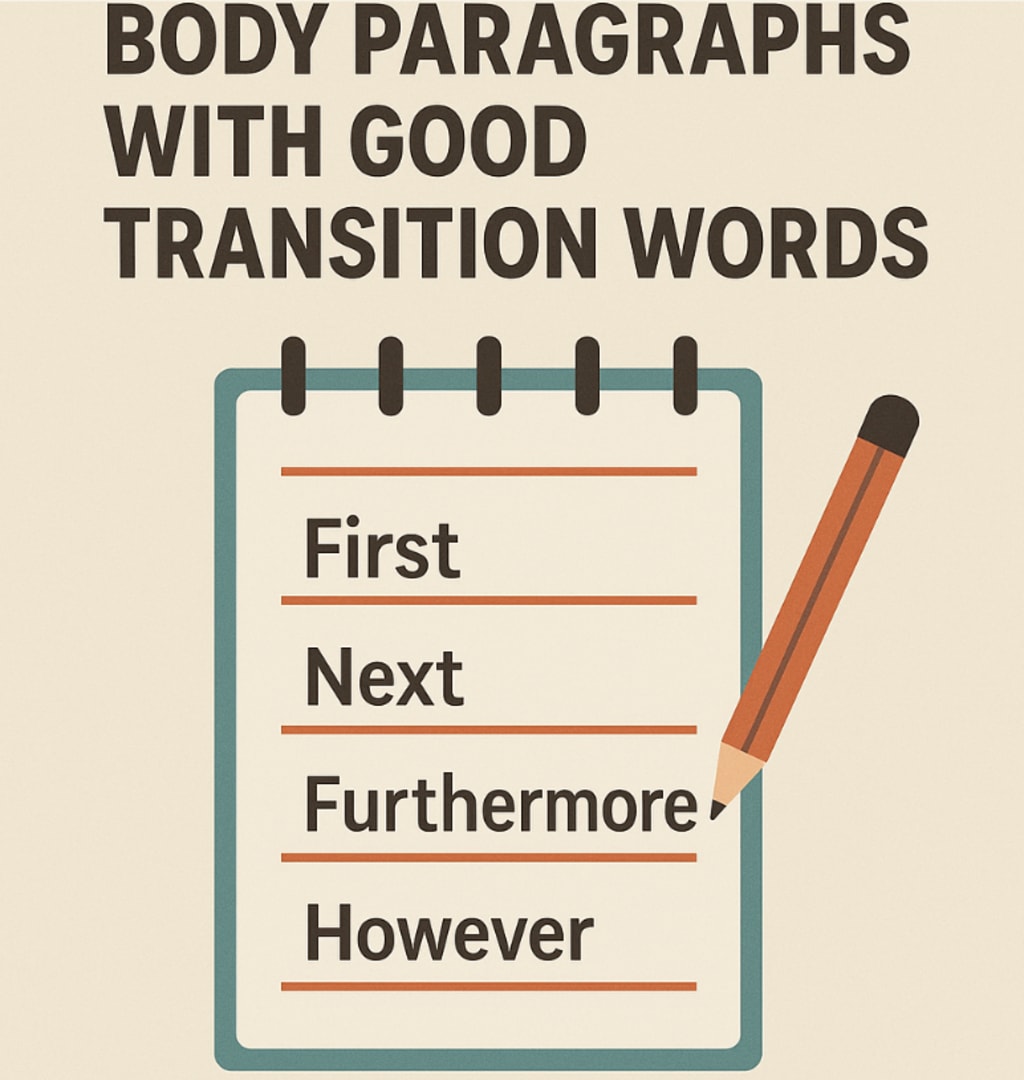
For instance, if you’re giving another reason, a word like “Furthermore” or “Also” works well. If you’re presenting an opposite idea, you might use “However” or “On the other hand.” These small choices help shape the tone and direction of your writing.
How Transitions Improve Essay Structure
A good essay has a clear structure. The reader should know what your main idea is, how your points support it, and how each part connects. Transition words support this structure.
Let’s take a closer look. Imagine an essay with three body paragraphs. Each one explains a different reason why exercise is good for students.
The first paragraph can start with: “First, regular exercise improves focus in class.”
The second might begin with: “Next, it helps reduce stress and anxiety.”
The third could open with: “Finally, students who exercise often sleep better at night.”
In this case, each paragraph has a clear purpose and starts with a strong, simple word that helps guide the reader.
Without these transitions, each paragraph would still have good information, but the reader might not see how the ideas are connected. They would feel like separate points instead of parts of the same discussion.
Using Transitions for Different Purposes
Not all transitions serve the same purpose. Some are used to show time, while others show cause and effect. Some are for adding points, and some for giving examples. When you know the goal of your paragraph, you can choose the right kind of transition to match it.
For example, when you are adding more to your argument, words like “Moreover,” “In addition,” or “Also” work well. They let the reader know that you’re building on the idea you just talked about.
If you’re showing a contrast, like moving from a positive idea to a negative one, then words like “However,” “Yet,” or “On the other hand” are helpful. These words signal a change in direction.
Let’s say you write: “Exercise helps students focus better in class. However, some students say they don’t have enough time for physical activity.” That transition prepares the reader for the new point and shows how it differs from the one before.
If you're looking for a wider range of transition words to use in your writing, you might find this updated list helpful: 150+ Transition Words for Essays. It includes different types of transitions and examples to help you mix things up and keep your writing fresh.
Real Examples of Paragraph Starters
To better understand how this works, let’s look at a few full examples.
First example
“First of all, students who get enough sleep tend to perform better in school. Their minds are more alert, and they can concentrate for longer periods. This is why many schools are now looking at later start times.”
Second example
“On the other hand, not all students have the same sleep needs. Some may stay up late because of homework or part-time jobs. These factors also affect their school performance.”
Third example
“In addition to getting enough rest, students also need to eat healthy meals. A balanced diet helps with focus and energy levels throughout the day.”
Each paragraph begins with a clear transition. Each one prepares the reader for the new point and ties it back to the topic. It doesn’t feel sudden or disconnected, and that’s what makes the writing smooth.
Avoiding Repetition in Transitions
A common mistake students make is using the same transition word too many times. For example, starting every paragraph with “Also” or “First.” This can make your writing feel flat or lazy. The key is variety. There are many transition words that serve the same purpose but sound a bit different.
Keeping It Simple
Sometimes students think that using big or fancy transition words will make their writing better. But the truth is, simple words work best. If a transition is too long or confusing, it can actually hurt your writing. The goal is to make your ideas clear, not to impress with difficult vocabulary.
Words like “Then,” “Also,” “But,” or “So” are short and simple, but they still do the job. They guide your reader and make your writing easier to understand.
Practice Makes It Easier
If you want to get better at using transitions, the best thing you can do is practice. Try writing short paragraphs and starting each one with a different transition. Think about how each one changes the flow of your ideas.
You can also look at articles, books, or essays and pay attention to how paragraphs begin. Writers often use transitions without you even noticing, but once you spot them, you’ll start to see how important they are.
A Short Practice Paragraph Example
Here’s a short sample of how transitions can work in a real paragraph.
“Furthermore, students who join school clubs learn valuable social skills. They meet people from different backgrounds and learn how to work in a team. These experiences can help them later in college and in their future jobs.”
In this paragraph, the transition “Furthermore” tells us that the writer is adding a new point to something they already said earlier. It feels like a natural next step, and it keeps the paragraph connected to the rest of the essay.
Connecting Paragraphs and Ideas
Good writing isn’t just about having strong ideas. It’s also about making sure those ideas connect. When you use transitions to start your body paragraphs, you are helping your reader understand how everything fits together.
Let’s say you’re writing about why reading books is good for kids. You might start one paragraph with “To begin with, reading builds vocabulary.” Then the next with “In addition, it improves focus.” And the next with “Finally, it helps children develop creativity.” Each transition supports the next point and builds a full picture for the reader.
Final Thoughts
Starting your body paragraphs with strong transition words is one of the easiest ways to improve your writing. It doesn’t take much, but it makes a big difference. These words help your ideas flow, connect your thoughts, and make your writing more enjoyable to read.
You don’t need fancy words or complex sentences. Just use clear, simple transitions that show the reader where you’re going. Think about what you want to say next, pick a word that fits, and build your paragraph from there.
For examples or writing advice, a paper writing service can provide helpful resources to guide you in improving your work.
Once you get used to using transitions, your writing will feel smoother and more natural. It will be easier to read, and your ideas will stand out clearly. So the next time you sit down to write, take a moment to think about how you start your body paragraphs. A simple word at the beginning can go a long way.
Other Useful Resources
Best Paper Writing Services For Students
Top 3 Best Research Paper Writing Services To Streamline Academic Success
About the Creator
James Daniels
James Daniels is a dedicated scholar currently pursuing a Postdoctorate in English Literature at Harvard University in Cambridge.
Keep reading
More stories from James Daniels and writers in Education and other communities.
A Simple Guide to Writing a Strong Expository Essay with Clear Examples
Expository essays are a common writing assignment that many students face. They are all about explaining or informing the reader about a specific topic. But how do you write one that stands out? In this guide, we will break down the process step-by-step, showing you how to craft a strong expository essay with simple, easy-to-understand examples.
By James Daniels9 months ago in Education
Why Did Einstein Dislike Quantum Mechanics? The Greatest Scientific Disagreement Ever
Einstein Helped Create Quantum Mechanics It is often forgotten that Einstein was a pioneer of quantum physics. In 1905, Einstein proposed that light comes in discrete packets called photons. This explained the photoelectric effect and earned him the Nobel Prize. His work was one of the pillars of quantum theory.
By shahkar jalal3 days ago in Education
Digital Signage Solutions Supporting Communication in Schools
I still remember the chaos of my first week as a communications coordinator at a mid-sized university. Between emergency alerts that never reached students, event posters peeling off bulletin boards, and faculty members who couldn't find the right room for meetings, I realized our campus communication system was stuck in the 1990s. That experience changed how I think about information flow in educational settings.
By Jerry Kane a day ago in Education




Comments
There are no comments for this story
Be the first to respond and start the conversation.