
How to Improve Your Child’s English Handwriting: A Complete Guide for Parents
A Practical Parent’s Guide to Developing Neat, Confident, and Beautiful Handwriting in Children

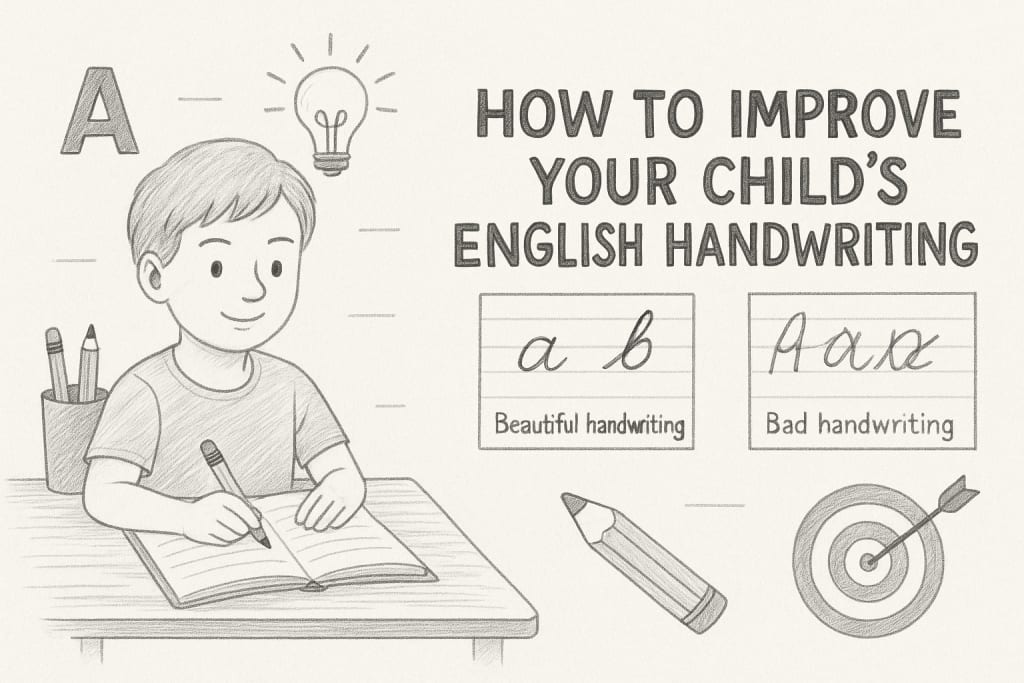
In an age where typing and digital devices dominate, handwriting might seem like an old-fashioned skill. But research shows that good handwriting still plays a critical role in a child’s cognitive development, academic performance, and confidence. Poor handwriting can make schoolwork harder and lead to frustration for both children and parents. The good news is that with the right approach, you can help your child develop neat, legible, and confident handwriting.
Here’s a step-by-step guide to improving your child’s English handwriting effectively and enjoyably.
---
Why Handwriting Matters in Today’s World
Before diving into the how, let’s understand the why. Good handwriting is important because:
✍️ It enhances learning and memory. Writing by hand helps children process and remember information better.
📝 It supports academic success. Neat handwriting ensures teachers can easily read and grade their work.
🧠 It develops fine motor skills. Handwriting strengthens hand-eye coordination and muscle control.
💪 It builds confidence. A child proud of their writing is more likely to enjoy schoolwork.
---
1. Lay the Foundation with Proper Posture and Grip
✅ Posture First
Ensure your child sits at a comfortable table with:
Both feet flat on the floor.
Back straight but relaxed.
Paper slightly tilted (left tilt for right-handers, right tilt for left-handers).
Non-writing hand holding the paper steady.
✅ Correct Pencil Grip
Teach the tripod grip: the pencil is held between the thumb and index finger while resting on the middle finger. For younger children, you can use pencil grips or triangular pencils to train their fingers.
---
2. Start with the Basics of Letter Formation
Many handwriting problems arise from incorrect letter formation. Slow down and teach your child how to:
Write each letter with the correct starting point, direction, and stroke order.
Maintain uniform size for both uppercase and lowercase letters.
Use lined paper to guide the height and alignment of letters.
🔤 Tip: Practice groups of letters that have similar shapes (e.g., a, c, o or m, n, u) to build muscle memory.
---
3. Focus on Spacing and Alignment
Neatness comes from proper spacing:
Between words: Teach your child to use a finger space to keep words apart.
Between letters: Avoid crowding letters or leaving too much space in words.
On the line: Ensure letters sit properly on the baseline, with tall letters (like h and k) extending upwards and letters like g and y descending below.
---
4. Make Handwriting Practice Fun and Engaging
Children learn best when they enjoy the process. Here are some creative methods:
🎨 Sensory Writing: Let your child trace letters in sand, rice, or shaving cream. This makes learning tactile and fun.
🖋️ Colorful Pens and Markers: Allow them to use colored pens or gel pens occasionally to break the monotony.
🎯 Games and Challenges: Create a “neatest handwriting of the day” award or set up mini writing races where neatness is rewarded over speed.
📖 Copy Work: Encourage your child to copy favorite poems, stories, or inspirational quotes. This builds fluency while improving handwriting.
---
5. Short, Consistent Practice Sessions
Rather than long, tiring sessions, aim for 10–15 minutes of handwriting practice daily.
Begin with single letters, then progress to words, and later full sentences.
Prioritize quality over quantity. A few neatly written lines are more beneficial than pages of rushed writing.
📅 Tip: Create a handwriting calendar to track daily progress and keep motivation high.
---
6. Consider Cursive Writing
Once your child is comfortable with print letters, consider introducing cursive. Cursive writing can:
Improve writing speed and flow.
Strengthen fine motor control.
Encourage a natural, rhythmic hand movement.
---
7. Be Patient and Encouraging
Improvement takes time and consistent effort. Celebrate small wins to keep your child motivated. Avoid harsh criticism—instead, use positive reinforcement and gently guide them towards better habits.
🌟 Remember: The goal is progress, not perfection.
---
8. When to Seek Extra Support
If your child struggles despite regular practice, it may be worth:
Asking their teacher for feedback.
Using specialized handwriting workbooks.
Consulting an occupational therapist if there are signs of fine motor difficulties.
---
Final Thoughts
Helping your child develop beautiful handwriting is an investment in their overall learning and confidence. With the right techniques, tools, and encouragement, every child can improve their handwriting significantly. Make it a fun, stress-free journey and watch as their penmanship blossoms into a skill they’ll be proud of for life.
About the Creator
Keep reading
More stories from Engr. Mansoor Ahmad and writers in Education and other communities.
Why Pi Network’s Second Migration Has Not Been Completed Yet?
The Pi Network has emerged as one of the most talked-about projects in the cryptocurrency space, with millions of pioneers worldwide actively participating in its innovative mining model. Following its successful first migration phase, expectations were high for the second migration. However, many in the community are growing increasingly curious — and at times concerned — about why the second migration has yet to be completed.
By Engr. Mansoor Ahmad6 months ago in Journal
What happens to your brain without any social contact?
Everyone needs time to themselves, and peaceful solitude has stress-relieving benefits. But being alone takes on an entirely different dimension when it creeps up or is forced upon you. When that's the case, the effects can be surprisingly extensive. And though different people experience distinct effects at different times, symptoms tend to become more severe and persistent the longer one's isolated. When someone is involuntarily confined to one space indefinitely— for days, weeks, months, or even years—
By Munesh Yadav2 days ago in Education
The Day Learning Spoke Back
The classroom had learned to be silent long before the students did. Its walls were pale, almost apologetic, as if they knew they were holding more than chalk dust and old posters. They held unfinished thoughts. Forgotten questions. The kind of curiosity that once burned brightly and then learned, slowly, to dim itself.
By Jhon smith3 days ago in Education


Comments (2)
amazing
good idea