
How to calculate profit margin: a clear guide to understanding your real profits
Learn how to calculate profit margin step by step, understand your real profits, and make smarter pricing decisions for your business.

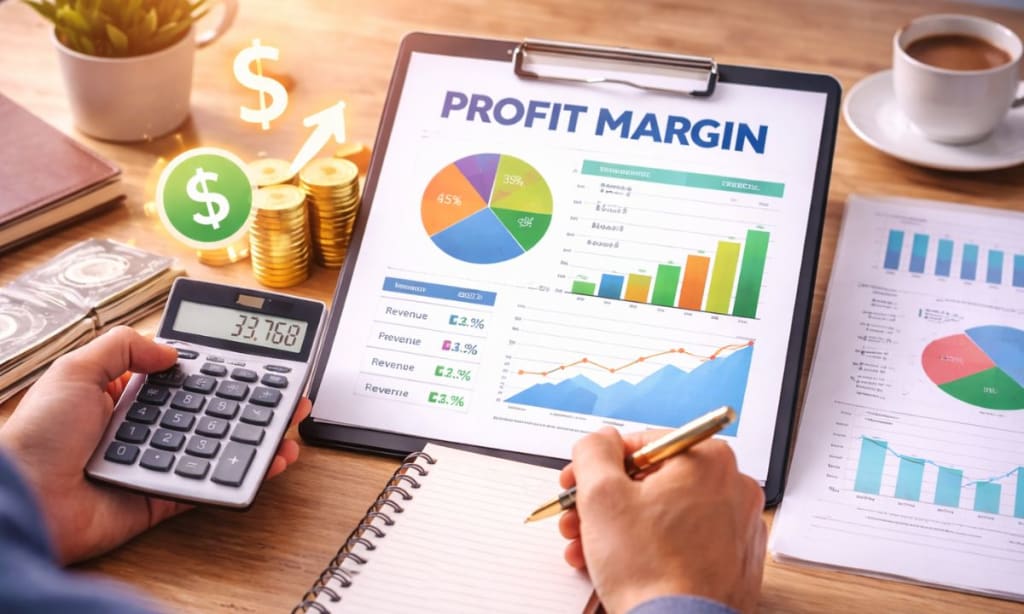
Knowing how to calculate profit margin is one of the most important financial skills for any business owner, freelancer, or entrepreneur. Many people focus on revenue and sales volume, but profitability is what truly determines whether a business survives and grows.
Profit margin shows how much money you actually keep after covering your costs. Without this number, pricing decisions become guesswork, and even strong sales can hide serious financial problems.
“Sales tell you how busy you are. Profit margin tells you how healthy your business is.”
Quick answer: what is profit margin?
Profit margin calculator is the percentage of revenue that remains as profit after subtracting costs. It measures how efficiently a business turns sales into actual earnings and is a key indicator of financial performance.
Why profit margin matters more than total sales
A common mistake is assuming that higher sales automatically mean higher profits. In reality, a business can generate large revenue and still lose money if expenses are too high.
Profit margin helps you understand:
Whether your pricing is sustainable
If your costs are under control
How much you can reinvest or save
Which products or services are truly profitable
A healthy profit margin gives stability, even when sales fluctuate.
What profit margin actually measures
Profit margin compares your net profit to your total revenue. Instead of focusing on absolute numbers, it shows profitability as a percentage, making it easier to compare different products, services, or time periods.
This is especially useful when:
Evaluating multiple products
Comparing pricing strategies
Analyzing business growth
Making cost-cutting decisions
Percentages reveal patterns that raw numbers often hide.
How to calculate profit margin step by step
Calculating profit margin is straightforward once you understand the process.
First, determine your total revenue, which is the money earned from sales.
Next, calculate your total costs, including production, marketing, fees, labor, and other expenses.
Then, subtract costs from revenue to find your net profit.
Finally, divide net profit by revenue and multiply by 100 to get your profit margin percentage.
This calculation shows exactly how much of each dollar earned becomes profit.
A common question is: should all expenses be included?
Yes. The more accurate your costs, the more reliable your profit margin.
Example: profit margin in a real situation
Imagine you sell a product for $100. Your total costs are $70. That leaves $30 in profit.
When you calculate profit margin, you discover that your margin is smaller than expected. With this insight, you might increase the price slightly, negotiate supplier costs, or stop promoting low-margin products.
Without calculating profit margin, these decisions are often missed.
Profit margin vs markup: understanding the difference
Profit margin and markup are often confused, but they measure different things.
Metric What it shows Why it matters
Profit Margin Profit as a percentage of revenue Shows real profitability
Markup Price increase over cost Helps set prices
Knowing the difference prevents pricing strategies that look good on paper but reduce real profit.
When you should calculate your profit margin
Profit margin should not be calculated only once. It should be reviewed regularly, especially when conditions change.
It’s especially important when:
Launching a new product
Adjusting prices
Running discounts or promotions
Experiencing rising costs
Planning business growth
Regular checks help you avoid surprises.
Common mistakes when calculating profit margin
One frequent mistake is ignoring hidden costs such as transaction fees, advertising expenses, or refunds. Another is using outdated numbers that no longer reflect current conditions.
Some businesses lower prices to increase sales without realizing how much margin they lose. Others fail to recalculate margins when costs rise.
Profit margin only works when numbers are realistic and updated.
Why many businesses use a Profit Margin Calculator
Manual calculations and spreadsheets can work, but they are slow and prone to errors. A Profit Margin Calculator simplifies the process by delivering instant, accurate results.
With a calculator, you can:
Test different pricing scenarios
Compare margins quickly
Avoid math errors
Save time on financial analysis
This is especially valuable when decisions need to be made fast.
Profit margin calculation for different business types
Profit margin applies to more than just product sales.
Service-based businesses calculate margin based on time, labor, and operational costs.
Digital products focus on marketing and platform fees.
Ecommerce stores consider shipping, returns, and transaction costs.
Regardless of the business model, profit margin remains a core metric.
How profit margin helps long-term growth
Businesses with strong profit margins have more flexibility. They can invest in marketing, improve products, hire talent, or handle unexpected expenses.
Low margins, on the other hand, leave little room for error and increase financial stress.
“Growth without margin is risk disguised as success.”
Frequently Asked Questions
What is a good profit margin?
It depends on the industry. What matters most is consistency and long-term sustainability.
Is profit margin the same as net profit?
Profit margin is a ratio, while net profit is a total amount. Both are important.
Can freelancers calculate profit margin?
Yes. Freelancers should include time, tools, and operational costs.
How often should profit margin be calculated?
Anytime prices or costs change, and regularly as part of financial reviews.
Do I need accounting skills to calculate profit margin?
No. The formula is simple, and calculators make it even easier.
Final thoughts
Understanding how to calculate profit margin gives you control over your business decisions. It replaces assumptions with clarity and helps you focus on what truly matters: sustainable profitability.
Whether you calculate it manually or use a tool, knowing your profit margin is not optional — it’s essential.
“Profit margin is not just a number. It’s a strategy.”
About the Creator
Keep reading
More stories from News Trends Go and writers in Education and other communities.
Institutional Email: What It Is, What It’s For, and How to Use It
There’s a huge difference between “having an email” and having an institutional email. A personal inbox is fine for everyday stuff. An institutional email works like an official key: it verifies who you are inside a school, university, or company—and it unlocks doors a personal email simply can’t.
By News Trends Go9 days ago in Education
Where to Hunt Big Game: Top U.S. States for Deer and Trophy Hunting Adventures
Hunting has always been a big part of American outdoor life. Every year, hunters plan trips across the country to hunt whitetail deer, elk, mule deer, and other large game. The search for trophy bucks and unforgettable hunts is more than just a sport; it’s a passion. For hunters who dream of the perfect trip, choosing the right state can make all the difference.
By Kyle Vandermolenabout 12 hours ago in Education
History and Evolution of Navigation Buoys
History and Evolution of Navigation Buoys For as long as humans have sailed the seas, they have sought ways to navigate safely. Ancient mariners looked to the stars, the sun, and familiar coastlines to find their way. But as trade routes expanded and ships ventured into less familiar waters, a more reliable system was needed to mark hidden dangers and guide vessels into safe harbors. This need gave rise to one of the most fundamental tools in maritime navigation: the buoy.
By social xpertsolutions6 days ago in Education
Foot Bindings
I asked my grandmother how she knew she'd fallen in love. I am not sure I ever did love him, she said. This was before I met my husband. I was naive, a naked spring, a raw nerve of a thing. That cannot ever be me, I knew. Sadness swept in gently like a Moscow thaw. It is no simple thing, looking into a woman's vast soul and seeing its foot bindings. Now, in Italy divorced with my skin singed off, when I say I don't love him mean: I have succeeded at feeling nothing most days and it mostly works. Do you want the comfort of Nothing? Do you want Nothing, too? Be warned: you'll never be free, even when you are nothing. Here is what doesn't work: Accepting the stages of grief. Talking about it. Sitting with the feeling. Missing him—no, the person you were when you believed in death do us part. Writing poetry. That, too. When I say I don't love him I mean: I feel capsized in an endless, starved tide. What sometimes works: selective memory. You must forget ripe tomatoes and his beard and feeling perfectly sheltered in a big blue world. Forget coffee in bed, laughter watching TV, blowing out the candles on the birthday cake and the quiet all-encompassing knowledge that you are chosen. Remember only how love turned to a banal everyday survival act, a trapeze act unsure whether he will catch you, how the warmth stagnated and became sour, remember the foot bindings and remember the resentment boiling in your veins as you stick it out for the kids. Six-hour Netflix binges help, too. A man's fingers tracing your spine. Frozen pizza at 2 a.m. Random trips to the museum just to stand near things that last a while. The realization that crying won’t change anything. Seeing that life is just a dream, and refusing to participate in your own suffering. Bite your fist. Walk on eggshells around joy. When I say I don't love him, I mean he didn’t break my heart, he just stopped touching it and it forgot how to beat right.
By Ella Bogdanova2 days ago in Poets



Comments
There are no comments for this story
Be the first to respond and start the conversation.