
How the Internet Travels Across Oceans: The Secret Highway Beneath the Seas
Discover how submarine fiber optic cables power global internet connections and enable real-time data transfer across continents.
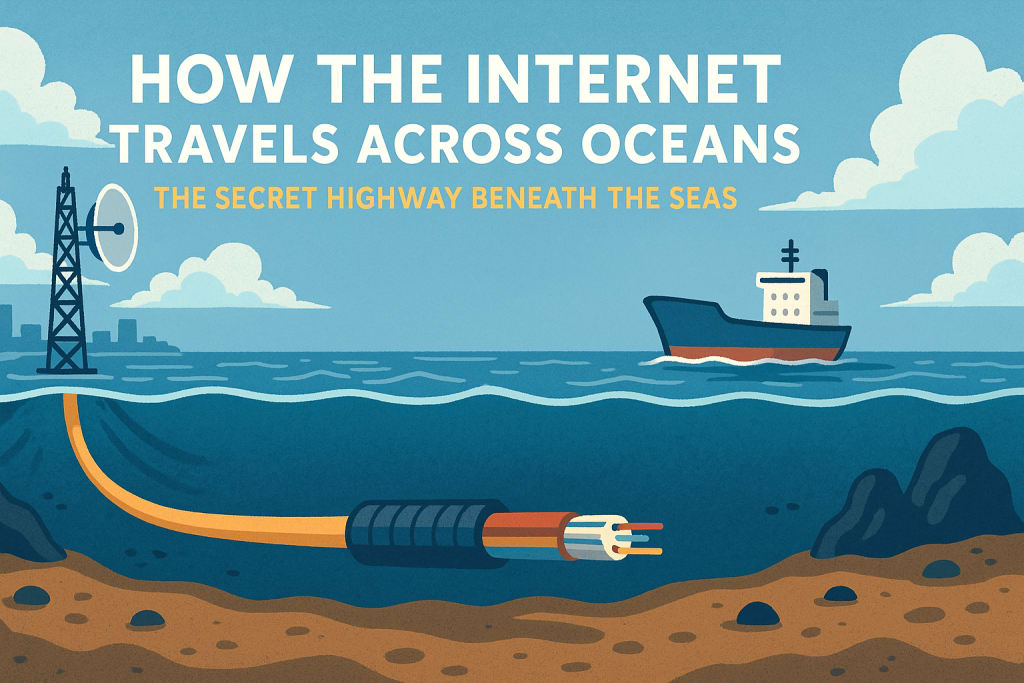
Have you ever wondered how you're able to stream a YouTube video made in the U.S. while sitting in India or send an email from Europe to Australia in seconds? The magic lies not in the clouds but deep beneath the ocean floor. Let’s explore how the internet travels across oceans, powered by undersea fiber optic cables—the invisible lifelines of our hyperconnected world.
What Really Powers the Global Internet?
While terms like Wi-Fi, satellites, and 5G dominate tech conversations, the backbone of the internet is something far less visible: submarine internet cables. Over 95% of global data transmission—including websites, emails, videos, and cloud services—happens through these underwater fiber optic cables.
What Are Undersea Cables?
Undersea cables, also known as submarine cables, are bundles of fiber optics encased in layers of insulation and protection, laid across ocean floors by specially designed ships. These cables can span thousands of kilometers from one continent to another, delivering ultra-high-speed data with near-instant transmission.
Each cable contains multiple glass fibers, thinner than a human hair, that carry data in the form of light. These fiber optic cables transmit terabits of information per second, with near-zero latency and incredible efficiency.
How Submarine Cables Are Installed
Laying an undersea cable is a high-precision operation. First, the ocean floor is carefully surveyed to avoid natural obstacles such as undersea volcanoes, trenches, and coral reefs. Next, engineers design the cable route with built-in redundancies to ensure uninterrupted global connectivity. Then, specially equipped ships are deployed to carefully lay the cables on or bury them beneath the seabed.
Once in place, these cables are rarely disturbed—except during underwater earthquakes, accidental damage from ship anchors, or even shark bites.
Why Satellites Aren’t the Main Backbone
While satellite internet plays a role in remote and rural areas, it suffers from high latency (delay in data transmission) and limited bandwidth. In contrast, submarine fiber optic cables offer faster speeds, higher data capacity, and greater reliability.
Think of satellites as backup roads, while undersea cables are the internet’s superhighways.
Who Owns the Undersea Cables?
Ownership of submarine cables isn’t limited to governments. In fact, major tech companies like Google, Facebook (Meta), Amazon, and Microsoft either own or invest heavily in undersea cable networks. These corporations rely on massive, reliable data transfer for their global operations and cloud services.
Some of the most notable cables include the Grace Hopper Cable (Google), which connects the U.S., U.K., and Spain, the MAREA Cable (Microsoft & Facebook), stretching from Virginia to Spain, and the SEA-ME-WE series, which links Southeast Asia, the Middle East, and Western Europe.
Data Travels in Milliseconds Beneath the Sea
Data sent via fiber optic cables travels at nearly the speed of light. This means your WhatsApp message or YouTube video request can travel thousands of kilometers in just milliseconds, making real-time global communication possible.
Challenges of Undersea Cable Maintenance
Despite their remarkable performance, submarine cables are not immune to challenges. They can be damaged by natural disasters such as earthquakes and tsunamis, by fishing trawlers and ship anchors, or even by intentional sabotage or cyberattacks.
To ensure global connectivity remains stable, repair ships and redundant cable networks are maintained and ready to respond to any disruptions.
The Internet’s Hidden Path Beneath Our Oceans
The next time you make a video call, play an online game, or scroll through social media, remember: your data likely just traveled thousands of kilometers beneath the ocean. The internet isn’t just in the cloud—it’s in the deep sea, humming along cables that connect continents and cultures in real-time.
About the Creator
Problem-Solving Skills for Better Decision Making
Making good choices is a skill. Some people think strong decisions come from luck or natural talent. In truth, they come from practice and clear thinking. This is where powerful problem-solving skills for better decision-making play an important role.
By Andrew Lake4 days ago in Education




Comments
There are no comments for this story
Be the first to respond and start the conversation.