
HOW PEOPLE PROFIT OFF PINEAPPLE SCRAPS
EVERY PART OF A PINEAPLE IS USEFUL
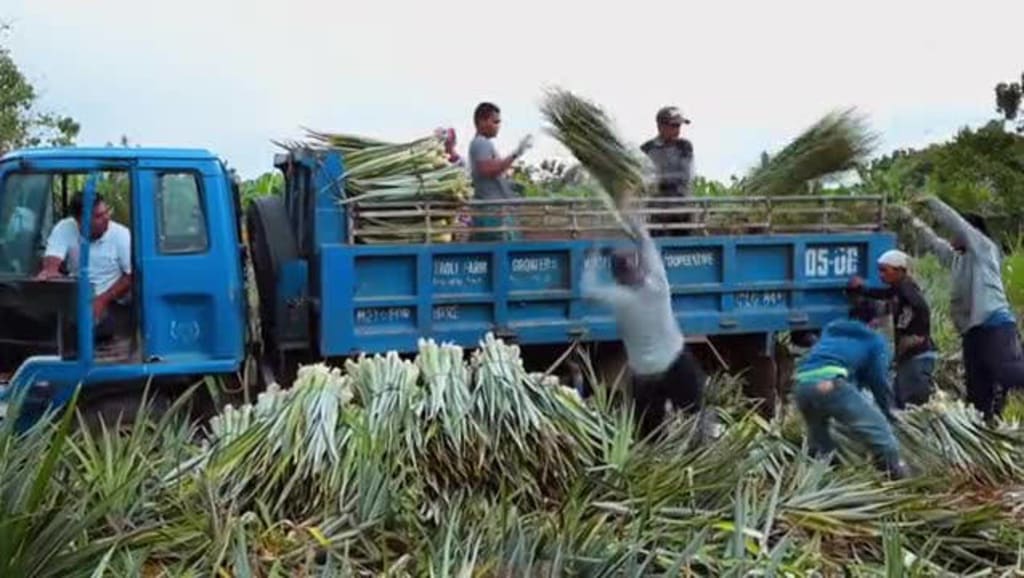
These pineapple leaves used to be worthless but about a decade ago a designer revived a centuries-old technique to extract fibers from the fruit. She used it to create a convincing alternative to leather and a new type of yarn. Then we've got this which is really a metallic, it’s quite flashy, fashion people love it. Pineapple is more popular than ever. The crop grows on over 3 800 square miles worldwide enough to cover New York City 10 times over but about half of every fruit ends up as waste.
Carmen ijosa wants to convince Growers they can turn a profit from their leftovers. It’s really the Queen of fibers. Famous Brands like Nike already use her product called peanutex and Carmen is not alone. Entrepreneurs in other parts of the world are making money from Pineapple scraps.
Here are three companies turning the fruit into textiles, disposable plates, and eco-friendly cleaners. The idea for textiles made from pineapples is nothing new. It actually dates back to the 1500s. Pineapples come from South America but once they made their way to Europe, the fruit became a status symbol gifted to royalty like King Charles II and Spanish King Ferdinand II.
The Spanish brought the fruit to the Philippines where locals turned it into a fabric called Pina. It was mainly used to make barong Tagalog, a traditional formal shirt. That centuries-old technique inspired Carmen when she first heard about it 30 years ago.
I was working with leather at the time but I realized the unsustainability of the leather manufacturing processes and I discovered natural fibers. Pineapple leaves turned out to have the perfect mix of strength and flexibility and they can grow up to six feet long. That gave me the idea of what if I make Amish not unlike what leather is.
She spent decades perfecting her process before she launched her company Ananas Anam in 2016. At the start it was really like what are you doing you know, why not keep using leather.
Her research resulted in two different products Pina text which mimics the qualities of animal leather and Pina yarn a replacement for yarn.
Ananasanam partners with the Dole Sunshine Company and independent Farmers to employ over 500 people. Workers Harvest pineapple leaves that would otherwise be burned or left to rot and run them through a machine that extracts the fibers.
The sun dries and Browns them in just a few hours, the fibers are then shipped to Barcelona to become Pina yarn. This machine acts like a guillotine chopping the longer strands into manageable pieces.
A carting machine straightens the fibers then grinds them until they resemble cotton. The Baler compacts the mass into tight squares. The fibers are then transported to Portugal where they're spun into the final product. To make pinatex, a needle punching machine knits those same ground fibers with threads made from cornstarch, the result is a thick fabric.
The sheet passes through a 30 meter long conveyor belt to be dyed and dried. A resin made from plants and petroleum is used for color and adds durability. Then a heated roller flattens the textile and dries the resin.
The company says it's working to make peanutex entirely plant-based. Pinatex is 95 made from renewable resources, so we've got a five percent to work on. One square meter of pinatex uses around 16 pineapple plants worth of leaves. The company says it saves 825 tons of leaves from being burned each year.
Ananasanam sells its products to Big Brands like Nike and Hugo Boss along with smaller companies that make notepads, backpacks and Handbags. Pineapple leaves might be good for making textiles but what about the rest of the fruit.
In Colombia a company called lifepak shreds pineapple crowns to make compostable plates. The mixture is Blended with recycled paper and turned into sheets that are left out to dry Under the Sun. A machine presses the sheets into form. If these disposable plates end up in a place with Soil and Water tiny seeds inside will blossom in just a few days.
On a busy day, workers at lifepak can turn out 10 000 eco-friendly plates. In addition to plates, the company also makes sandwich containers and coffee cup sleeves that contain seeds from edible plants like cilantro, amaranth and strawberry.
Life pack caps its own carbon footprint by working with local suppliers. He sources pineapple waste from a nearby processing plant.The plant's owners charge nothing for the pineapple crowns. They're happy that someone is willing to turn their waste into a resource.
Husband and wife team Claudia Barona and Andres benavidez founded life Pack 12 years ago in the city of Kali. The couple has won several small Business Awards and they even appeared on the Colombian version of Shark Tank.
Colombia like nearly every country in the world is trying to reduce plastic waste. In 2017 the country introduced a tax on single-use Plastics that increases each year and in some cities informal Pickers are now paid as Municipal workers but getting consumers to buy these products, isn't easy.
The life pack plates retail at about two and a half dollars per dozen.That's more than double the price of plastic plates from a big box store.
Despite their higher price point, lifepec has been able to capitalize on growing demand for sustainable packaging which has increased by 40% since the company started.
Its plates are now sold in three large Supermarket chains domestically. The company also handles dozens of orders through its website each week with a handful of customers in the U.S
Life Pack's next challenge is to modernize its equipment so it can boost production. Andres and Claudia also plan to franchise the business and expand into new countries to help more people cut back on plastic. One Plate at a time. Even if you don't eat off of pineapple plates you can still use the fruit to do the dishes.
In Vietnam, one company uses pineapple Peels and cores to make natural soaps and detergents. The founder lead DUI Huang says they're safer for the planet and people. So safe he drinks the stuff every day.
Fermented fruit is part of a new trend cleaning with enzymes instead of harsh chemicals, does it actually work? Throughout history, People have used all sorts of stuff to wash up everything from animal fat to human urine.
In the 20th century, scientists figured out how to make suds in a lab using fossil fuels that paved the way for all kinds of synthetic gels powders and cleaning chemicals which are all detergents.
So much whiter, she can actually see the difference instantly. The problem is they were full of stuff that water treatment plants weren't built to clean out like phosphorus and nitrogen.
When those elements flood waterways, they can make algae grow faster creating thick layers of muck that suffocate Life below. That's exactly what happened in North America in the 1960s. Lake Erie is almost biologically dead.
Today detergent pollution has spread around the world foaming up rivers and fueling overgrown algae .Fuwa biotech is betting that fruit cleaners are the next chapter for cleaning products. The name fuwa comes from the phrase fruit Warrior.
The company buys fruit waste from a factory that makes canned pineapple. Workers here chopped thousands of them every day.
This pile is from just a half day's work. These used to rot in nearby landfills, creating bad smells and methane, a powerful Planet warming gas. Now, workers load the scraps onto a truck and travel about two miles to the production site Here, the team unloads the fruit skins and washes themselves
Next they mix together the first ingredients sugar and water Fuwa uses about two metric tons of sugar every month. Workers add the pineapple peels to the sugar water and wait for the mixture to start to ferment.
Fermentation is when microbes like bacteria or Yeast break down complex molecules like sugar into simpler stuff like alcohol. It’s how barley becomes beer and grapes become wine. At fuwa fermentation is how waste becomes cleaning fluids but the secret isn't alcohol it's the enzymes and acids the pineapples will release.
Enzymes are molecules that speed up chemical reactions like digestion in the human body. Certain enzymes can fight germs by entering cells and breaking them apart from the inside.
This can either kill bacteria or just slow them down enough that they probably won't make you sick. But to make those germs stopping enzymes from Plants, you have to ferment the right mix of ingredients for just the right amount of time.
Workers here stir the mixture every day, after about a month it looks like this. By two months, this glob of bacteria and microorganisms forms. That’s how you know it’s working.
The founders don't keep any of their process a secret. Huang says he learned this technique from ponbong. she's a scientist and Buddhist nun who figured out the formula then shared it freely for others to use.
After the mixture ferments for three months there's enough acid and enzymes for it to work as a cleaner. Now it's ready to be filtered. The leftover solids become fertilizer for nearby farms and the remaining liquid is the base for everything fuwa makes.
Fuwa buys those oils from local farmers who make them using agricultural waste like stems and leaves. The final mixture is bottled and shipped to mini Marts around Vietnam or to online customers in most countries.
Fuwa uses an on-site lab to test its products and it looks at competitor stuff as well measuring the ph. and testing for other additives. Cleaning with fermented fruit is a fairly new concept but there's evidence it has a lot of potential.
Researchers compared a pineapple enzyme mixture to bleach in water and found it killed one type of bacteria equally well and early research suggests fruit enzymes might even make Wastewater cleaner.
We know more about common chemical cleaners like bleach they kill lots of germs but come with other risks. Studies have linked cleaning products to skin irritation and breathing problems including asthma.
When used and stored properly they're safe for most people but mixing bleach with the wrong cleaners can create deadly gas which happens thousands of times per year in the United States.
There’s only certain number of bacteria that has been tested. so probably got to do a wide range of studies with a wide range of microorganisms to ensure that it's really effective. Enzyme cleaners pose another challenge. Shelf life, it would be one of the major issues with certain temperature, it might be inactivated.
fuwa says its products can last about two years which is about as long as most chemical cleaning sprays, still fuwa has more work to do with so much pineapple processing in the region.
The company says it has lots of waste to work with but mainly the founders want people to know there's a gentler alternative
About the Creator
Keep reading
More stories from writers in Education and other communities.
The Blue Harvest Inside China’s 5.1 Million Ton Shrimp Revolution (2025–2033)
The "Clean Protein" Pivot: Gen Z and the Fitness Boom By 2026, shrimp has officially transcended the "luxury banquet" status to become a daily fitness staple. China’s urban millennials and Gen Z, who now hold the majority of the nation's purchasing power, are viewing shrimp through the lens of "Longevity Nutrition."
By Neeraj kumarabout 16 hours ago in Education
Steve Wolfe’s Guide to Transforming Managers into Growth Catalysts
In today’s fast-moving business environment, having a solid strategy is only part of the equation. The real differentiator is execution, and that rests on your management team's shoulders. Steve Wolfe, a respected leadership strategist, highlights that team leadership skills are what transform ideas into lasting outcomes.
By Steven Joseph Wolfe7 days ago in Education
Analyse this!
Wanna know how to improve your writing? There is a simple, quick, tried and tested method. Tried and tested by who? By me, as it happens, and I can guarantee that it will work for you. I know what I am talking about. Not always, of course, but certainly in this case.
By Raymond G. Taylor2 days ago in Writers



Comments
There are no comments for this story
Be the first to respond and start the conversation.