
How I Scored 8.5 Overall on the IELTS General Test
This is a list of dos and don'ts that will help you do as well as I did or even better!


If you are reading this, you probably already have an idea of what IELTS is and its purpose. In case you are completely clueless, the International English Language Testing System (IELTS) measures one's proficiency in the English language in four sections. These include: speaking, reading, writing, and listening. Each section is scored using bands, with the maximum being 9. The four bands are then averaged to determine the overall score, which for me, was 8.5.
So, what is the purpose of this test? Well, it is required in several situations such as:
I wish I could say that these situations apply only to individuals who speak English as a second language, but that is not the case. Though English is my mother tongue, I still had to sit the exam as it is required for a Canadian permanent residency application. Quite frankly, it was not reassuring that the exam costs CAD 309 plus taxes at my location (the price may differ at your location). In all fairness, I could have paid CAD 295 plus taxes, but then I would have done a paper-based test. It was worth paying the extra CAD 14, though, because I type at a faster rate than I write, so I knew it would be easier for me to maximize my time on the computer. Furthermore, even though I was the top student in my primary school penmanship class, my handwriting becomes illegible when I am nervous or writing quickly. If the examiner cannot determine what is written, it is highly likely that it will negatively impact the final score.
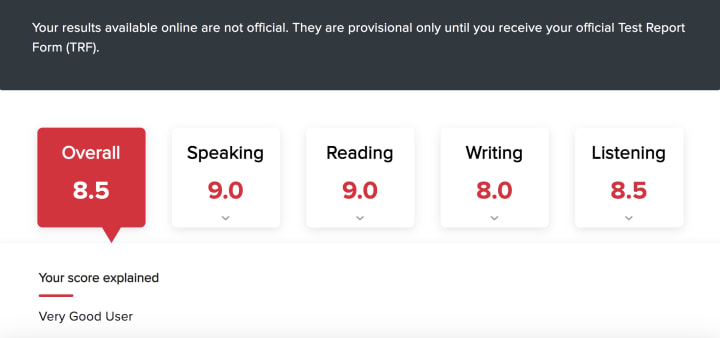
I completed my exam on Saturday, March 27, 2021, and got my results four days later. It typically takes 3-5 calendar days to receive the provisional results online, but I have friends who received feedback in as little as two days. Unsurprisingly, the lead time is longer if you do the paper-based test and averages approximately 13 days. My provisional results can be seen above. Though I got decent scores, I will admit that I made a few simple mistakes in the listening and writing sections. However, the good thing is I got more than the required score to apply for permanent residency, which is CLB 7. I'd like to use my experience to help as many potential test-takers as I can. Below are some tips that I am sharing based on my experience. Of course, everyone's situation won't be the same, but I believe that my advice will be applicable across the board.
Listening
Dos
Practice! It goes without saying that it is best to practice all sections, but this section probably got most of my attention prior to the exam. Why? Well, I confidently did the first practice test and hurriedly wrote down each answer as I heard them. Much to my dismay, my answers were wrong! I discovered this a few seconds later when I heard the rest of the recording. I've included the question below. I did not quote it word for word, but you'll still get the main point I am trying to put forward.
Question: Which job openings are available at Cloud Nine Superstore?
1. ____________
2. ____________
3. ____________
Recording: "Many superstores typically have job openings for designers, cashiers, and stockers. These roles tend to have a high turnover rate, which results in frequent vacancies. But, at Cloud Nine, we need other roles to function effectively. As such, we are currently in search of architects, accountants, and digital marketers..."
When I heard this recording while practicing, I wrote designers, cashiers, and stockers as my initial answer, and then I discovered that I was incorrect. The correct responses were architects, accountants, and digital marketers. The time it took me to erase the incorrect answers made me miss some of the recording. You will have a pencil and paper available to you for the exam. If you wrote or typed the wrong answers as I did, then caught on, quickly jot down the correct answers on the paper as you hear them. You can then make the necessary corrections in the little time that you will have to review your answers.
Don'ts
Do not focus on ANYTHING in the room except the recordings once they start. Remember, the recordings are played once, and you will only have thirty minutes to complete this section. This means that you won't have much time to check your answers. There will be a few minutes or seconds between each recording for revision, but you will likely forget any answers you completely missed, especially if you are nervous. When the first recording started in my exam, I got distracted by the loud typing in the room. Unfortunately, this caused me to miss a few answers. You need to remain present. Do not zone out and try to block out all other sounds. However, if for some reason you miss a few answers, make educated guesses as opposed to leaving sections blank. The same concept applies to the reading section. You do not lose marks for incorrect answers in these sections, so you may as well try.
Writing
Dos
If your writing skills aren't the best, you will want to take some time each day to practice your writing. You don't necessarily need to use IELTS practice questions, but they are great, so try to do a few. Find random topics such as those that you hear in news reports or documentaries. The goal is to find unfamiliar essay topics that will challenge you and lure you out of your comfort zone. Choose a few and write about them while timing yourself. In your introductory sentence, paraphrase the essay question that was given by using appropriate synonymous terms. This will hopefully help to expand your vocabulary and increase your confidence in your writing skills. Once you are done, you can use Grammarly or a similar platform to check what you wrote. If you know someone who has a good command of the English language, ask them to review your work as well. I know this might make you uncomfortable, but I promise it will pay off when you not only get great scores but also improve your English language skills. I did not practice for the writing test. I regret not doing so because I did not use my time effectively for that section of the exam.
Don'ts
Grammarly is quite a useful editing tool. Regardless, I implore you not to write your practice letters or essays using this platform or Microsoft Word. You should try as best as possible to mimic the exam conditions. You will not have editors or autocorrect in the writing test, so it is best to practice this way. As mentioned before, you can check your work after you're done writing. Also, don't spend your time learning sesquipedalian terms. Did that polysyllabic word throw you off? Yeah, I thought so. Sometimes, simple is better. If anyone told you to learn complex words and synonyms for the exam, don't. The examiners are concerned with how well you are able to put your ideas together and make them flow. Synonyms are necessary for paraphrasing but need not be complicated. The use of fancy terms might be impressive, but if you aren't entirely familiar with them, you risk misusing them and doing more harm than good. The most common mistake I've seen is synonyms incorrectly used in an effort to make an essay seem more intellectual. I have included an example of this.
Original: Her family is very rich.
Paraphrase: She is from a luscious family.
The sentence has been paraphrased effectively, but luscious is incorrectly used in this context. Luscious is, in fact, a synonym for rich, but it means "having a delicious taste or smell" or "sexually attractive." Therefore, it cannot be used to describe the female's family. This isn't to say there are no appropriate synonyms. Below is a sentence depicting the proper use of a synonym.
Paraphrase: She is from a luscious wealthy family.
It is important not only to practice to pass the exam but also to boost your skills. Many test-takers tend to learn just enough to pass the exam but forget the bulk of what they studied after. If you will be relocating to an English-speaking country and English is not your first language, it is useful to improve your written and verbal communication skills in the language. This skillset is a requirement for many jobs.
Lastly, during the exam, be sure to manage your time properly. There is no harm in arranging your thoughts before you write, but you will only have 60 minutes to write a letter and an essay, so you want to spend as little time as possible brainstorming. You also do not want to have too many ideas in your essay, resulting in it lacking direction. Aim to bring your points across succinctly while addressing the essay question in its entirety. Additionally, use a 20/40 ratio for the time. Spend 20 minutes on the letter and 40 minutes on the essay that is worth more. The perfectionist in me failed to consider the time, so I did not have sufficient time to review for typos and any other mistakes. I am certain this is where I lost marks for writing.
Speaking
Dos
Be confident and positive when preparing for your exam and while sitting in the room with the examiner. This section worried me the most because I was fearful that I would unintentionally use slang and lose points. I also consider myself an introvert, and I wasn't sure if that would affect my ability to speak eloquently during a conversation with the examiner. What worked for me was practicing at home by talking aloud to myself or my cat. If you have someone to practice with that won't respond with meows, then take advantage of that. There are many websites with practice questions that you can use.
While in the exam, speak slowly and enunciate your words. Also, give substantial answers; responding "yes" or "no" is unsatisfactory. Pretend you are speaking to a friend and speak with emotion and elaborate. If you make a mistake, correct yourself, as this is a display of your proficiency too. During your "long turn," try to speak for the full minute or two. Some examiners may prompt you to speak more if your answers are too short; others may not. If you have more thoughts, keep talking. They will stop you once the time has passed.
Don'ts
Don't be afraid to ask the examiner to repeat a question. However, do not ask them to explain a full question to you. That would defeat the purpose of you being tested even if they were willing to explain. Another thing that you don't want to do is act like a know-it-all or have an attitude because the questions seem too simple. Having this demeanor doesn't usually bode well for your score. This tip is for everyone but mainly targeted at native English speakers. On that note of attitude, do not feel offended if your examiner stops you mid-sentence. Feeling this way might affect the quality of your conversation thereafter. Understand that there is a strict time limit that they need to adhere to, and sometimes that means not allowing you to finish a thought. They mean well.
While speaking (and writing), avoid common English phrases and idioms as much as possible. They come across as memorized terms used by a lazy candidate. Most importantly, do not listen to negative comments from persons who've done the exam. Their experience is not your experience. I heard several pessimistic remarks about the exam and examiners but chose to ignore them and entered my exam with a positive mindset. Had I not done this, I probably would have defeated myself before the exam as I would have been too plagued with negative thoughts to give it my best.
Some Idioms and Phrases to Avoid:
- "The elephant in the room"
- "In a nutshell..."
- "Cost an arm and a leg"
- "At the end of the day..."
Reading
Dos
Read a bit every day about topics you aren't familiar with and reread until you grasp the concept of what is being said. During your reading sessions, try as best as possible to remain focused, as it can be easy to lose interest in topics that bore you. I can't tell you how many times I zoned out while doing the practice tests because I found the passages boring. Each time, I started over until I was able to read without my mind straying.
You can read books, newspapers, journals, or online articles. When you do, try to increase your reading speed and ability to scan or skim a passage, especially if it is long. Once you feel confident in your ability to read and comprehend, you can try practice tests and gauge how well you find the answers. Most times, the questions follow the order of the text, so the answer to question 6 is likely to appear in the passage before the answer to question 7. Exceptions to this that I have encountered are during matching information exercises.
There are also matching headings exercises which I like since there is an easy way to answer these. I find that reading the topic sentence of each paragraph is sometimes sufficient for determining the appropriate headings. However, this isn't always the case, and I would not suggest this strategy if you do not have a very good grasp of the language. Instead, read the topic sentence thoroughly and skim the rest of the paragraph until you figure out the answer. Ensure that these answers are spelled correctly. Achieving this should not be too hard since the words you will be using are given in the passage. Hopefully, you will have time to review your answers. If you do, double-check or even triple-check to ensure that you have no misspelled words or typos.
Don'ts
It is pertinent that you read the instructions carefully to determine how many words should be in each answer. Also, I cannot emphasize this enough; your responses must be words taken from the passage. It is not a knowledge test; it is a comprehension test. If you get a passage about tourism and that happens to be your area of expertise, forget everything you know about the field at that moment and only focus on the passage. The examiner will not be impressed by any knowledge you try to impart, and you will lose points for not following instructions. When you start the reading section, do not read the passage first. Browse the questions and then read what is given. You will find that as you read, you're finding answers to the questions.
This turned out to be my favorite section of the exam. Don't be terrified; it is more manageable than you think. Below is an example of one type of question in this section and a brief explanation of how the answer was selected.
Reading Passage Extract: While doing field research, Aditi discovered a tiny calliope hummingbird, the smallest bird native to the United States and Canada.
Answer the question below with words taken from the reading passage.
Use NO MORE THAN TWO WORDS for each answer.
Aditi found a small _________________ during her field research.
Correct Answer: Aditi found a small calliope hummingbird during her field research.
Incorrect Answers:
Aditi found a small tiny calliope hummingbird during her field research.
Aditi found a small hummingbird during her field research.
Aditi found a small calliope during her field research.
Though the instructions ask for no more than two words, responding with calliope or hummingbird as opposed to calliope hummingbird may result in loss of marks. Since you are able to put two words in your response, it's best to put the full name of the bird to be on the safe side. When responding, be sure not to provide more than the number of words that are required. In the example above, the response should have no more than two words, so responses such as tiny calliope hummingbird would be incorrect since it consists of three words. Furthermore, pay attention to the words before and after the blank space. They are usually quite helpful in helping you select the correct answer. In the sentence given above, the word "small" is placed before the blank space. As such, "tiny" would not be one of the missing words since tiny and small are synonymous. Including tiny in your response would lead to a tautology.
I hope these help! Please note that I am not an IELTS instructor but rather someone who typically excels in English language tests and has done well in the exam. This isn't to say that I know everything there is to know about English—I don't. I am currently working and residing in Canada, but my journey started as an international student. I also work in the Student Services department at my alma mater, so I interact with many students daily, both domestic and international. My first-hand experience of the challenges faced by students encourages me to help them make their journeys smoother in any way that I can. This article is one such way as I know how nerve-racking it can be to complete these exams. However, I hope anyone who wishes to sit the IELTS exam will find this article useful. Good luck!
About the Creator
Keep reading
More stories from Donziikinz and writers in Education and other communities.
Honouring Black Academic Superstars 🙌🏾
As I co-planned Black History Month events at my university in February 2020, I found myself reflecting on the barriers to success for Black students in my immediate environment. The one that stood out to me at the time was financial barriers and their associated opportunities for relief or lack thereof. After perusing the list of financial awards available, I noticed that there was no award specifically for Black students despite there being awards for other identities. Being a Black student who dabbled in activism, I knew that I had to embark on a journey to change this promptly.
By Donziikinz5 years ago in Education
How Aerospace Electronics Depend on Winbond Electronics Components in Modern Aviation
When I analyze the supply chain behind aviation electronics, I often return to the role of semiconductor memory manufacturers. One company that frequently appears in component databases is Winbond Electronics Corporation, a global semiconductor producer known for reliable memory solutions used in embedded systems.
By Beckett Dowhan6 days ago in Education




Comments
There are no comments for this story
Be the first to respond and start the conversation.