
How does Virtual Reality Encourage Simulation-Based Learning?
Let's Learn How Simulation-based learning is helpful in Virtual Reality

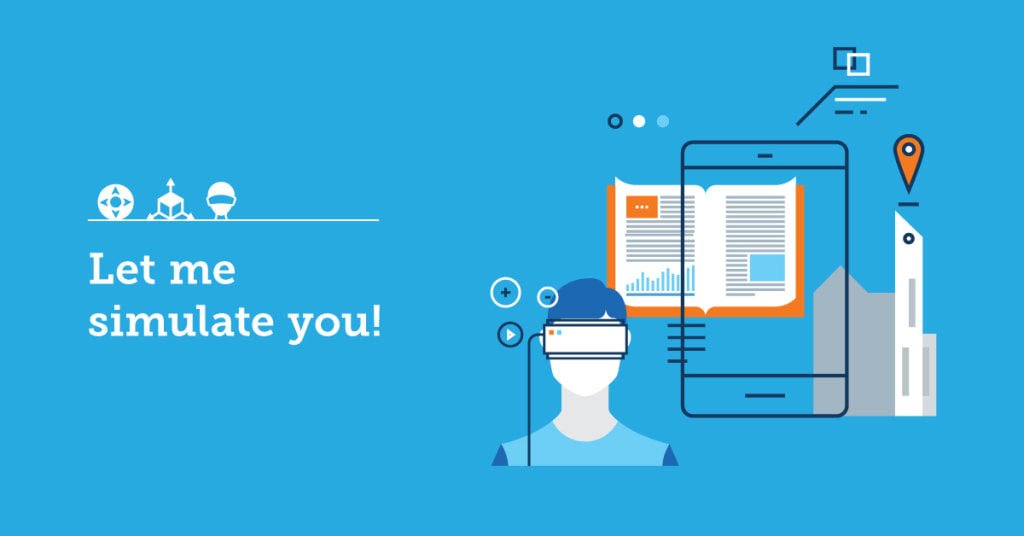
Decades ago, schools used to have less numbers of students. Also, there were not so many schools earlier. From that situation, education scenarios have changed to now every individual having access to multiple educational platforms at a single click. In addition, there are various technologies that nurture learning in different ways.
For example, technologies such as augmented reality, virtual reality, extended reality, and the metaverse have very much potential. Moreover, the benefits of virtual reality in the classroom are phenomenal. Amongst many advantages of using these technologies simulation-based learning is one of them.
Simulation-based education can make productive learning possible. In addition, with technology like virtual reality, it can be quicker. So, let us first understand what exactly simulation-based education looks like.
What is simulation-based learning?
Simulation-based education is recreation of real-life aspects for education purposes. Or simulation means replication in a real-life learning environment. Let us try to understand this by an example.
Suppose there is training for pilots. Then, creating the exact environment in which a student pilot will fly the plane, with all controls is a simulation-based environment. In such an environment pilot training will be maximum productive.
But how does virtual reality support this characteristic?
How does virtual reality offer it?
Virtual reality is technology known for its immersive environment. What does it mean by an immersive environment?
In an immersive learning environment, students get completely surrounded by an academic environment. For example, a classroom in virtual reality technology will let students walk around in a real-life.
In virtual reality, there is a 3D environment that boosts engagement. To offer simulation-based learning, there is a comprehensive environment that gives realistic experience to students.
For example, in virtual reality labs, students can perform experiments just as they do it in real, physical labs. Suppose there is a virtual reality lab for chemical engineering. Then in this lab, students will be able to control all the parameters and characteristics of solutions required. Further, they can perform these experiments in the same manner as that of the physical environment except for a few differences.
• There is no time limit to access virtual reality labs.
• Students can perform experiments as many times as they want.
• Every student gets a chance to use instruments and perform experiments.
• There is no maintenance cost.
• It is safe to perform experiments in a simulation-based learning environment.
• There is no or less risk while using hazardous chemicals.
• Such labs can be much more productive than traditional labs.
Another application of simulation-based learning with virtual reality can be found in medical education. Medical students need practical knowledge before treating any real-life patient. But letting students do so may harm someone’s health. To avoid this, virtual reality has a solution.
Virtual reality-based simulations can even offer complex surgery experiences to medical students. They can perform surgery in virtual reality simulators and can understand every inch of it. In addition, it will not even harm anyone’s health.
Simulation-based learning can result in productive academic outcomes. Students will perform on their own and master the subject thoroughly with virtual reality. In addition to this benefit, virtual reality offers many other benefits to the education system.
What are some other advantages of virtual reality in education?
Virtual reality in education can bring a plate full of advantages. You have already read about its immersive nature. But how does it help education?
Imagine an engineering student learning about a tunnel-boring machine. Though he reads about it or watches a few videos, will it be enough to understand the machine and the application well?
Or what if he actually walks through the tunnel boring machine to understand each part and learns about its application in a guided mode? What will be more effective?
Learning in an immersive, simulation-based environment can help students understand the concepts better. They will quickly grasp the concepts. Or even if students need to learn at their own pace, virtual reality allows it.
Another excellent advantage of virtual reality is the fun part it brings. Due to its 3D environment, students can get engaged in every activity going around them. Therefore, the challenge often found in remote education of lack of attention and engagement can be coped with simulation-based learning with virtual reality. In addition, features of virtual reality and VR labs can enhance learning.
Conclusion:
Virtual reality in education can be very effective. Especially when the world demands a technological environment for work, learning and training in the same environment can help students stay ahead of the competition. Therefore, institutes and universities should adopt such immersive technologies for teaching and training. Because technologies like virtual reality in education can be effective, immersive, and revolutionary.
About the Creator
iXRlabs
iXRlabs provides highly immersive, interactive and insightful virtual reality experiences for higher education that helps you keep up with the rapidly changing pace of industry and technology.
Keep reading
More stories from writers in Education and other communities.
Understanding FSC 47 Pipe, Tubing, Hose, and Fittings in Aerospace & Aviation
From my experience working around aerospace supply chains and aviation components, I’ve realized how critical Federal Supply Classification (FSC) 47 — Pipe, Tubing, Hose, and Fittings is in aircraft manufacturing and maintenance. These components may look small, but they are essential for hydraulic pressure systems, fuel transfer, lubrication flow, and structural fastener connections in aircraft.
By Beckett Dowhan3 days ago in Education
Why the 3D Concrete Printing Market Is Transforming Modern Construction?
The construction industry involves the building and assembling of infrastructure. While it is still commonly used, this has some shortcomings, because it is often inefficient, requiring a lot of time, materials, and labor. The 3D concrete printing market is emerging as a revolutionary technology, ushering in advantages of automation, precision, and material efficiency in the construction industry.
By Akshay Kumar3 days ago in Education
There's A Hole in My Bucket
It’s a well-known fact that Liza Dufresne was always the brains in the family. She was the one who always came up with the brilliant schemes the Dufresne kids carried out when they were younger. Like when they tricked Mrs. Claybourn into paying for a trip to Disney World. Liza convinced her that their parents had been kidnapped and were being held for ransom for the total price of three tickets. In reality, they were away on a weekend getaway for their anniversary. When they returned, Liza told the Claybourns that they did not like to talk about the ordeal. Their parents never found out how they got the money. Mrs. Claybourn never found out that the Dufresne parents were never really in any danger.
By David E. Perry2 days ago in Fiction



Comments
There are no comments for this story
Be the first to respond and start the conversation.