

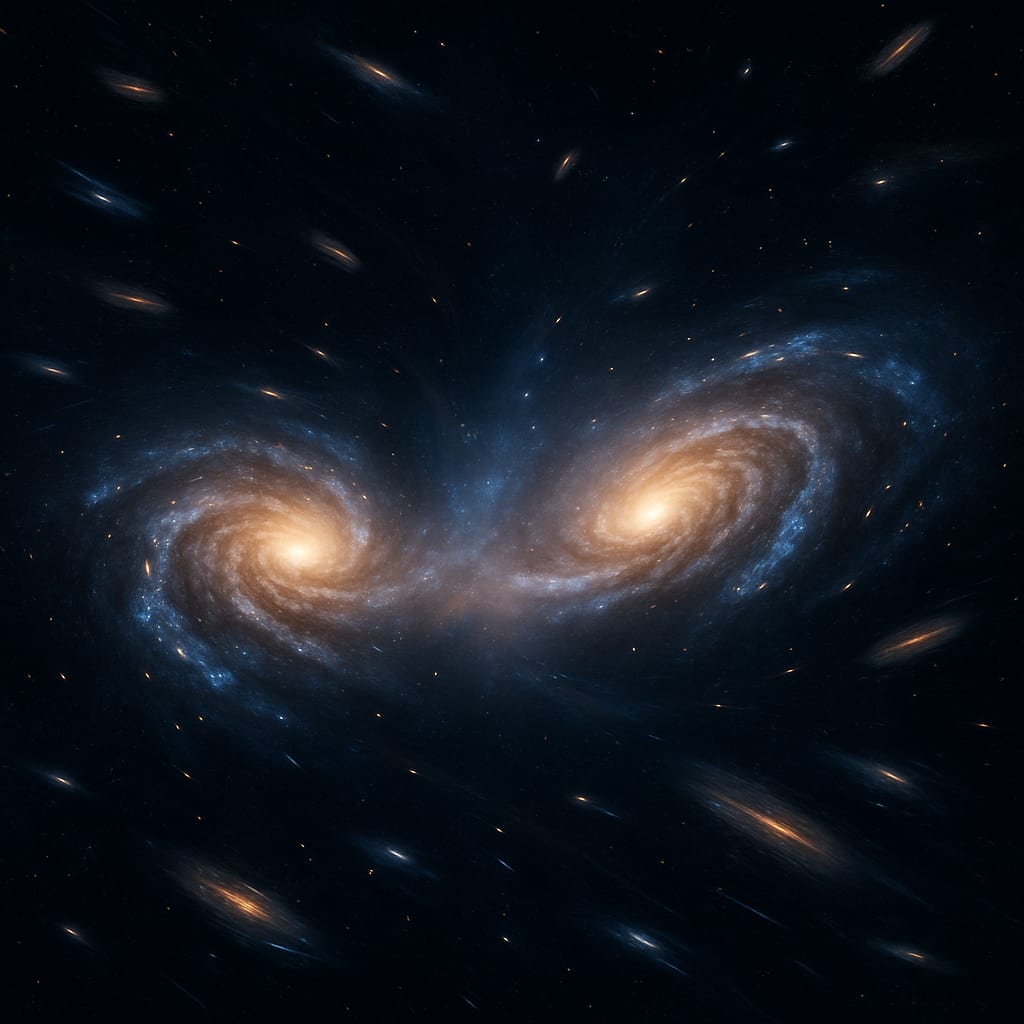
The universe isn’t some silent, motionless canvas where stars and galaxies sit frozen in space. Quite the opposite — it's a place of nonstop motion, often on unimaginable scales. Galaxies — those enormous collections of stars, gas, dust, and dark matter — are constantly on the move. They spin, collide, drift, and race through the cosmos at incredible speeds. But what exactly makes them move — and where are they going?
Galactic Motion: A Multi-Layered Journey
Galactic movement happens on several levels, each more mind-blowing than the last:
1. Spinning from Within
Every galaxy spins. Spiral galaxies like our Milky Way showcase this beautifully — their arms curl into spirals as stars orbit around a dense central core. But here's the twist: the speed of this rotation can’t be explained by visible matter alone. This is actually how scientists first suspected the presence of dark matter — an invisible force adding extra gravity and keeping galaxies from flying apart.
2. Orbiting Within Clusters
Galaxies don’t like to be alone. They tend to form groups and clusters, bound together by gravity. Within these clusters, galaxies orbit one another in complex dances — sometimes drawing closer, sometimes drifting apart. Their speeds? Up to thousands of kilometers per second. That’s like crossing Earth’s entire diameter in under 15 seconds!
3. Streaming Across the Universe
Beyond their motion within clusters, galaxies are also caught in cosmic flows — large-scale movements shaped by the uneven distribution of mass in the universe. Our own galaxy, the Milky Way, along with its neighbors in the Local Group, is being pulled toward a massive gravitational anomaly called the Great Attractor, located around 250 million light-years away.
The Expanding Universe: Galaxies on the Run
Here’s where it gets really wild: the entire universe is expanding. That means galaxies are, on the largest scales, moving away from each other — and the farther they are, the faster they recede. This isn’t ordinary motion through space; it’s space itself that’s stretching, like dots on the surface of an inflating balloon.
This effect, known as cosmic redshift, is one of the strongest pieces of evidence for the Big Bang. It’s not that galaxies are flying away under their own power — it’s that the space between them is literally growing.
Galactic Collisions: Cosmic Close Encounters
You might be thinking: “If galaxies are all racing away from each other, how do they still collide?” Good question — and the answer lies in gravity. On smaller scales, gravity can overpower cosmic expansion. That’s why the Milky Way and Andromeda galaxies are currently on a collision course. They’re set to merge in about 4 billion years, forming a single, massive galaxy.
And no — stars inside galaxies don’t usually smash into one another during these collisions. Space is vast. But gas clouds, dust, and dark matter do interact, often triggering intense star formation in the aftermath.
Final Takeaway: A Universe in Motion
Galaxies aren’t static islands of light — they’re dynamic players in a grand cosmic dance. Influenced by gravity, dark matter, and the ever-expanding fabric of space, they form a swirling, shifting, interconnected web of motion. And here we are, flying right through it — passengers on a starship called the Milky Way, rocketing through the universe without ever feeling the ride.
About the Creator
Keep reading
More stories from Holianyk Ihor and writers in Education and other communities.
How Many Galaxies Are in the Universe — And Why the Number Keeps Changing
When we gaze up at the night sky, it feels like we're seeing the entire universe stretched out before us. Stars shimmer, planets twinkle, and the Milky Way arcs overhead. But in reality, what we see is just a microscopic sliver of the cosmos. Beyond the familiar stars and nebulae lie billions — maybe trillions — of galaxies: vast cosmic islands made of stars, gas, dust, and dark matter.
By Holianyk Ihor8 months ago in Education
The steps to losing a child
Step One: Lose a child. Not what anyone wants to happen and nothing you can do to change it, but you can go through steps to becoming happy again. You can go through steps to loving again. You can go through steps to become a new you because after losing a child you will never be the same person you once were.
By Tabitha Hinkley3 days ago in Fiction


Comments
There are no comments for this story
Be the first to respond and start the conversation.