
How Coloring Pages Can Teach Kids About U.S. Geography?
Coloring Pages and U.S. Geography


In today's screen-saturated world, fast-paced learning often means short attention spans. Finding creative ways to teach kids about geography can be challenging. Many children can't remember state names, capitals, or even where their state lies on the map. What if learning U.S. geography could be turned into a relaxing, hands-on, and enjoyable experience?
That's where coloring pages come in.
These days, coloring pages are not just about having fun; they are powerful tools for teaching and learning. If used strategically, they could even help children learn about the geography of the United States in a way that will stick with them. Here, we will find how coloring book pages can teach kids about U.S. geography,educational benefits they offer, and some creative ways parents and teachers can bring those geography lessons to life
1. Why Geography Matters for Kids
Before we dive into how coloring pages can help, it is essential to understand why geography education is so crucial for children. Geography is more than memorizing maps; it's about places, cultures, environments, and how they connect.
When kids learn geography, they:
Develop spatial awareness—understanding where they are in relation to others.
Learn to appreciate diversity; each state, each city, each region has its own story.
Develop critical thinking skills: analyze how geography can impact weather, economy, and culture.
Gain global awareness: Knowing the geography of their own country is the first step in understanding the world.
Unfortunately, traditional geography lessons—such as reading atlases or filling in map worksheets—can be pretty dull. Coloring pages offer a different approach that is both informative and entertaining.
2. How Coloring Boosts Memory and Learning
Coloring engages both sides of the brain,the creative right and the logical left ,which makes it a very effective learning method for youngsters, especially those who learn best through tactile and visual experiences.
Here's how coloring enhances learning about U.S. geography:
- Visual reinforcement: coloring a state helps kids remember its shape, size, and borders.
- Repetition without boredom: children can color several maps, each time focusing their attention on different details.
- Mindfulness: The repeating movements involved in coloring help induce calm and improve attention to detail.
- Kinesthetic learning: For children who learn through activity, coloring makes abstract ideas very concrete.
By associating colors, landmarks, and patterns with each state or region, children naturally and memorably internalize geographic detais.
3. Starting Simple: U.S. Map Coloring Pages
One of the easiest ways to introduce geography is through a U.S. map coloring page.
Step 1: Outline Map
Start with a plain blank map of the United States. Have children color each state a different color. This helps them:
- Recognize the boundaries of each state.
- Identify their own state and neighboring ones.
- Develop an understanding of the location of regions such as the Midwest or the Pacific Northwest.
Step 2: Add Labels
Once they're comfortable with the map, introduce labels:
- State names
- Capitals
- Major rivers and mountain ranges
Coloring while labeling reinforces memory. A child who colors Florida bright yellow and writes "Tallahassee" in blue is far more likely to remember that information later.
Step 3: Regional Themes
You can also create coloring maps with themes such as:
- The Rocky Mountains area
- The Great Lakes states
- The Southern states
- The New England region
This enables children to zoom into an area and really understand what is unique about each one.
4. Making It Fun: State-by-State Coloring Adventures
Break the lesson down into "50 States Adventures" rather than showing all of the United States at once.
Every week, children can color one page dedicated to one state. Each state coloring page can include:
- State outline and its capital
- State flag
- State bird, flower, and tree
- Famous landmarks or monuments
- Fun facts like nicknames, motto, and population
For instance,

- California: golden poppy, grizzly bear, Golden Gate Bridge
- Texas: Lone Star flag, bluebonnet flower, and Alamo
- New York: Empire State Building, Apple, and Statue of Liberty
This turns coloring time into mini-lessons on geography and culture. Kids learn not only where a state is but also what makes it special.
For teachers, this can be turned into a "Passport Across America" activity—after coloring each state, students stamp or sign their "passport" before moving to the next destination.
5. Color: Learning About U.S. Regions
Teaching your kids about different U.S. regions helps them compare how geography affects climate, economy, and lifestyle. Coloring pages make this easy.
You can divide the U.S. into regions and assign each one a different color theme:
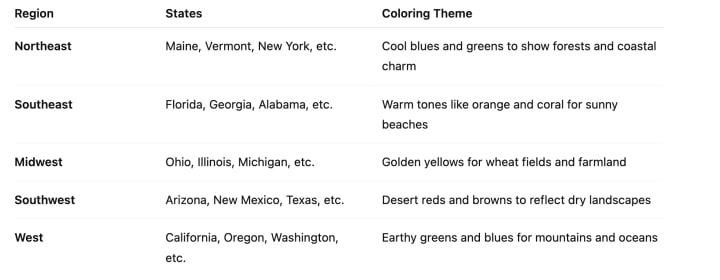
While the children color each region, they begin to understand how geography connects with nature, weather, and culture. They may notice that Western states have mountain icons while the Southeast shows palm trees.
6. Introducing Landmarks and Natural Wonders
Geography isn't all about borders; it's about what makes each place unique. Coloring pages can depict everything from iconic landmarks to parks and natural wonders of the United States.
Here are some examples of what kids can learn through themed coloring pages:

National Parks:
- Yellowstone National Park (Wyoming)
- Grand Canyon (Arizona)
- Great Smoky Mountains (Tennessee)
Yosemite (California)
- Monuments and Memorials:
- Mount Rushmore (South Dakota)
- Statue of Liberty
- Gateway Arch (Missouri)
- Washington Monument
Natural Features:
- Great Lakes
- Mississippi River
- Appalachian and Rocky Mountains
By coloring the above coloring pages, children learn to associate more geographic locations with visual landmarks, thereby retaining information about where these famous places are located.
You can even turn it into a storytelling activity
Color the Grand Canyon sunset, naming states from which you can visit it and animals that live nearby.
This always brings geography to life through imagination and curiosity.
7. Cultural Geography: People, Food, and Traditions
Geography is not just physical, but it's cultural, too. The coloring pages can help children explore how people, traditions, and foods differ across the U.S.
Here are some creative coloring page ideas that mix geography with culture:
Food Across America:
- New York pizza
- Texas BBQ
- Louisiana gumbo
- Maine lobster
- California sushi rolls
Festivals and Traditions:
- Mardi Gras in Louisiana
- Cherry Blossom Festival in Washington, D.C.
- Albuquerque Balloon Fiesta in New Mexico
- Kentucky Derby in Louisville
Famous Architecture and Icons:
- Seattle Space Needle
- Chicago skyline
- Golden Gate Bridge
- Disney World in Florida
When children color these cultural elements, they understand that every region has its particular flavor, history, and lifestyle, all shaped by the geography.
8. Coloring Pages in the Classroom
U.S. Geography coloring pages are so easy to incorporate into the classroom.
Geography Centers
Provide a "Color & Learn" station where kids can pick any state or region to color on their own time. Place books, maps, and trivia cards nearby so they can engage with them.
Interactive Quizzes
After coloring, quiz students with fun questions such as:
Which state has the Rocky Mountains?
"What's the capital of the state you just colored?"
"Can you name a landmark in that state?
Group Projects
Have students work in small groups to color different parts of the U.S., then have them put their maps together to create a giant class map mural. This builds teamwork and a sense of shared learning.
Homework Extension
State coloring pages can be sent home for families to work on together; parents can discuss road trips taken or family members living in other states to connect geography to real life experiences.
9. Digital Coloring Pages for Tech Savvy Learners
Nowadays, geography lessons don't need to be confined to paper. Many online resources use interactive coloring maps that respond to a click-and-color approach.
- Digital coloring pages can include
- Clickable state names displaying fun facts.
- Sound effects, such as ocean waves or city noises, can enhance learning.
- Instant feedback on state capitals or landmarks.
This integrates creativity with technology and provides digital-native students with access to learning about U.S. geography.
Teachers can also use printable PDFs for blended learning. Kids can learn and color them on tablets at school or print them at home.
10. Geography Through Art and Imagination
One of the most potent benefits of coloring pages is how they inspire artistic expression.
Encourage children to:
- Design their own U.S. map by coloring in what each state reminds them of.
- Draw imaginary landmarks inspired by real ones, for example, "Rainbow Canyon" in Arizona or "Starfish Beach" in Florida.
- Make a poster about their favorite state, incorporating art, facts, and fun doodles.
These artistic projects deepen geographic understanding while nurturing creativity-a combination that supports long-term memory and confidence.
11. Geography and Emotional Connection
Coloring pages help children create an emotional bond with the places they are learning about.
When coloring their home state, a child develops pride and curiosity about their surroundings. The act of coloring, which shows they have never visited, instills wanderlust and empathy for other regions.
This emotional engagement makes passive learning an active, heartfelt experience. Kids begin to think:
- "I want to visit the mountains I colored!"
- "My grandma lives in that state—I know where it is now!"
- "The desert looks so hot and dry—what animals live there?"
With color, geography becomes personal.
12. Combining Colouring with Storytelling
For even more fun learning about U.S. geography, pair stories with coloring activities.
For example:
- Read a children's book set in a specific state = Sarah, Plain & Tall for Kansas
- After reading, color in a map to show where the story takes place
- Discuss how geography influenced the story: was it flat, mountainous, snowy, or coastal?
Story based coloring activities always help kids conect narratives and locations, strengthening their more geographic knowledge through imagination.
13. Advantages Beyond Geography
Teaching geography through coloring pages supports broader educational goals:
- Fine Motor Skills: Improves hand-eye coordination and pencil control.
- Color Recognition: Color Theory and matching.
- Patience and Focus: Fosters calm, sustained attention.
- Confidence: Completing a page gives a sense of accomplishment.
- Collaboration: It encourages sharing and teamwork in group coloring projects.
So, beyond the maps themselves, it instills lifelong learning habits.
14. How Parents Can Reinforce Learning at Home
Parents can turn coloring into a fun geography challenge at home:
- Hang a U.S. map poster on the wall and color one state a day.
- Keep a "State of the Week" binder with coloring pages and trivia.
- Watch short travel videos about the state they just colored.
- Cook a dish from that region, allowing the taste to be connected to the geography.
This approach integrates family bonding, creativity, and education, while helping kids naturally absorb U.S. geography.
15. Using Coloring Pages for Homeschool Geography
For homeschooling families, coloring pages provide an inexpensive and flexible way to construct geography lessons.
You can structure a full year geography unit like this

Include optional crafts, such as making salt dough maps or postcard collages, to extend the learning.
16. Printable vs. Interactive Geography Coloring Books
There are two vital kinds of educational geography coloring tools
Printable Coloring Pages
Ideal for hands on learners. Easy to print, staple, and store. Great for classrooms, homeschooling, or on-the-go travel.
Interactive Digital Books
Perfect for iPads or Chromebooks, as kids can tap, color, and explore interactively. Some even keep track of progress and quiz them on states.
Both formats complement each other: print for quiet learning time, digital for dynamic exploration.
17. Real World Examples: Coloring Geography in Action
Indeed, many teachers and parents are using coloring successfully to teach geography.
- Elementary class projects included coloring the U.S. regions and presenting a "State Fair" sharing fun facts from a chosen state.
- Travel Journals: Families color each state they visit, creating a colorful scrapbook of memories.
- Scout Troops: Scouts use coloring pages to earn geography or travel-related badges.
- Museums and Libraries can host "Color the USA" events during educational programs.
Each of these examples shows how coloring pages can change geography from memorization into exploration.
18. Suggested U.S. Geography Coloring Topics
If you're creating or selecting coloring pages, here are some popular and effective themes to include:
- United States Outline Map
- State-by-State Coloring Pages
- State Flags and Symbols
- Famous Landmarks
- National Parks and Rivers
- Weather and Climate Zones
- Wildlife of Each State
- Regional Foods and Culture
- Transportation and Routes: Route 66, for instance
- American History through Geography (e.g., Lewis and Clark Trail)
These themes merge education, creativity, and adventure-the perfect trio to engage young learners.
19. Why Coloring Geography Works for Every Age.
While most think coloring is only for little ones, geographical coloring pages offer benefits for people of all ages.
- Preschoolers: Learn basic state shapes and colors.
- Elementary Students: Identify capitals, landmarks, and borders.
- Middle Schoolers: Study regional patterns, population, and climate zones.
- High School Students: Use coloring for review in AP Human Geography or U.S. History.
Coloring grows with the learner: from entertaining play to a detailed study tool.

20. Conclusion
Creating Masterpieces from Maps, In a world saturated with digital maps and GPS, the hands on approach to learning about maps is often overlooked, even though it shapes youngsters' minds. Coloring pages always offer a unique blend of creativity and knowledge, enabling children to grasp their country one color at a time. As they color the rolling plains of Kansas, the skyscrapers of NYC and the canyons of Arizona, they're not just coloring images,they're developing an understanding of the U.S. They're learning how vast, diverse, and beautiful the USA truly is. Geography coloring pages can ignite a lifelong curiosity in students, from the classroom to the playroom to the virtual world. So, the next time your child picks up a crayon, give them a map,and watch America come alive through color.
About the Creator
Shenal Jay
All about Free Coloring Pages and Learning Materials (Pre-K to 5th)
For free download
Visit
https://freecoloringpagepro.com/
Or
https://www.patreon.com/FreeColoringPagesPro
Keep reading
More stories from Shenal Jay and writers in Education and other communities.
How Coloring Can Improve Overall Mental Clarity?
In the hectic pace of life today, finding simple yet powerful practices to improve our mental clarity is more vital than ever. Among the most surprisingly helpful and accessible is coloring ,whether an intricate mandala, a fanciful pattern, or a freeing sketchbook page. Though often dismissed as a child's pastime, coloring for adults is gaining serious attention for its ability to calm the mind, sharpen focus, and support clearer thinking. In this extended blog post, we'll explore how coloring promotes mental clarity, why it works (from neuroscience to psychology), what kinds of coloring work best, and how to incorporate it into your daily routine for maximum benefit.
By Shenal Jay5 months ago in Education
Justice Begins With Character
Conscience, Character, and Justice While laws and institutions are necessary to maintain order, they alone cannot create a truly just society. The foundation of justice is built within the hearts and minds of people, long before legal decisions are made or courtroom debates occur.
By A.Petrovski3 days ago in Education
How Financial Advisors Make Millions Behind the Scenes
Many people trust financial advisors to guide their money decisions. Advisors help clients save, invest, and plan for retirement. They often appear helpful and knowledgeable. Yet many people do not know how advisors earn their real income. The truth is simple. Financial advisors are secretly making millions through systems that most clients never notice.
By Keith D'Agostinoabout 19 hours ago in Education



Comments
There are no comments for this story
Be the first to respond and start the conversation.