
How Chaos Theory Shapes Weather, Orbits, and Life
At first glance, the universe seems governed by precise laws. Planets follow predictable paths, weather systems obey physics, and biological life evolves under natural rules. Yet beneath this apparent order lies a powerful and surprising truth: small changes can produce enormous effects. This idea is the foundation of chaos theory—a branch of science that explains why many systems are fundamentally unpredictable, even though they follow strict physical laws. From weather forecasting and planetary orbits to heartbeats and ecosystems, chaos theory shapes the natural world in profound ways. In this article, we explore what chaos theory is, how it works, and why it plays a critical role in weather, astronomy, and life itself.

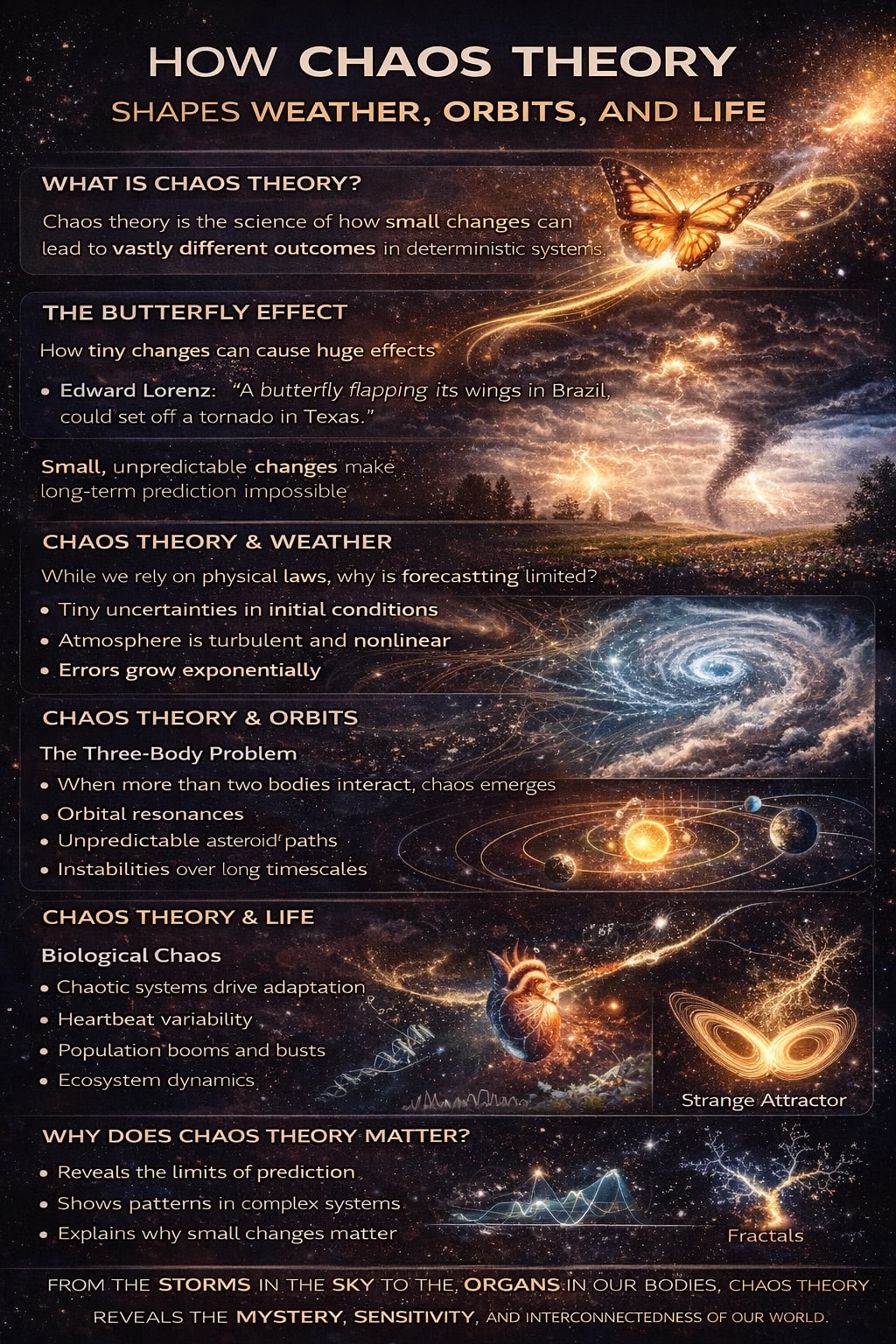
What Is Chaos Theory?
Chaos theory is the study of deterministic systems that are extremely sensitive to initial conditions.
Key Idea
Even when a system follows clear rules, tiny differences in starting conditions can lead to vastly different outcomes.
This sensitivity makes long-term prediction impossible, even though the system is not random.
________________________________________
Chaos Is Not Randomness
A common misconception is that chaos means disorder or randomness.
In Reality
• Chaos follows precise mathematical laws
• Outcomes are unpredictable, not unstructured
• Patterns still exist
Chaos is deterministic unpredictability, not chance.
________________________________________
The Butterfly Effect
The most famous concept in chaos theory is the butterfly effect.
What It Means
A tiny change—like the flap of a butterfly’s wings—can eventually cause large-scale effects, such as storms.
This metaphor illustrates how:
• Small disturbances amplify over time
• Long-term predictions become unreliable
________________________________________
The Origins of Chaos Theory
Chaos theory emerged in the 1960s.
Edward Lorenz and Weather Models
• Lorenz used computer models to simulate weather
• He rounded off a number slightly
• The new simulation produced completely different results
This accidental discovery revealed that weather systems are chaotic.
________________________________________
Why Weather Is So Hard to Predict
Weather follows the laws of physics, yet accurate forecasts rarely extend beyond a few days.
Reasons
• Atmosphere is highly sensitive to initial conditions
• Measurements can never be perfectly precise
• Small errors grow exponentially
Chaos theory explains why perfect weather prediction is impossible.
________________________________________
Chaos in Weather Systems
Atmospheric Turbulence
• Air currents interact at many scales
• Feedback loops amplify disturbances
• Clouds, storms, and winds evolve unpredictably
Even advanced supercomputers cannot overcome chaos in the long term.
________________________________________
Climate vs Weather: Not the Same
Chaos affects weather, not climate.
• Weather: short-term chaotic behavior
• Climate: long-term statistical patterns
While individual storms are unpredictable, climate trends can still be studied reliably.
________________________________________
Chaos in Planetary Orbits
For centuries, astronomers believed planetary motion was perfectly predictable.
Chaos theory revealed a more complex picture.
________________________________________
The Three-Body Problem
When two objects orbit each other, motion is predictable. Add a third body, and chaos emerges.
Examples
• Moons interacting with planets
• Asteroids influenced by multiple gravitational sources
• Long-term stability of planetary systems
The solar system is stable—but not perfectly predictable forever.
________________________________________
Chaotic Motion in Space
Some celestial systems exhibit:
• Orbital resonances
• Sudden changes in trajectories
• Sensitive dependence on initial positions
Chaos helps explain:
• Asteroid belt structure
• Planetary migration
• Moon system evolution
________________________________________
Is the Solar System Chaotic?
Over millions of years:
• Planetary orbits can shift
• Small gravitational interactions accumulate
• Predictions become uncertain
Chaos does not mean collapse—it means limited predictability.
________________________________________
Chaos and Life
Living systems are deeply influenced by chaos.
Biological Systems Are Nonlinear
• Feedback loops dominate
• Small changes can trigger major effects
• Adaptability emerges from instability
Life thrives at the edge between order and chaos.
________________________________________
Chaos in the Human Heart
The human heartbeat is not perfectly regular.
Why That’s Healthy
• Natural variability indicates adaptability
• Too much regularity may signal illness
• Too much chaos leads to dysfunction
Healthy systems balance stability and chaos.
________________________________________
Chaos in Population Dynamics
Ecosystems show chaotic behavior.
Examples
• Predator-prey cycles
• Insect population booms
• Disease spread
Simple mathematical models can produce wildly unpredictable population changes.
________________________________________
Chaos and Evolution
Chaos theory helps explain:
• Sudden evolutionary shifts
• Sensitivity to environmental changes
• Complex patterns in biodiversity
Small mutations or environmental pressures can reshape entire species over time.
________________________________________
The Mathematics of Chaos
Chaos theory relies on nonlinear mathematics.
Key Concepts
• Nonlinear equations
• Feedback loops
• Strange attractors
• Fractals
These tools describe how complex behavior emerges from simple rules.
________________________________________
Strange Attractors
A strange attractor is a pattern that chaotic systems tend toward.
Features
• Never repeats exactly
• Confined to a region of space
• Displays fractal structure
The Lorenz attractor is a famous example in weather models.
________________________________________
Fractals: Geometry of Chaos
Fractals are shapes that repeat patterns at every scale.
Found in Nature
• Coastlines
• Clouds
• Blood vessels
• Tree branches
Fractals are closely linked to chaotic processes.
________________________________________
Chaos in Technology
Chaos theory has practical applications.
Used In
• Secure communication
• Electrical circuits
• Robotics
• Artificial intelligence
Understanding chaos improves system control and resilience.
________________________________________
Can Chaos Be Controlled?
Surprisingly, yes.
Chaos Control
• Small, timely adjustments
• Prevent instability
• Guide systems toward desired behavior
This is used in engineering and medicine.
________________________________________
Chaos and Free Will
Chaos challenges traditional determinism.
• Laws exist
• Outcomes are unpredictable
• The future is not fully fixed
This opens philosophical questions about free will and causality.
________________________________________
Why Chaos Theory Matters
Chaos theory teaches us:
• Prediction has limits
• Complexity arises naturally
• Uncertainty is fundamental
It reshapes how we think about nature, science, and life.
________________________________________
Chaos Is Everywhere
From:
• Weather patterns
• Planetary motion
• Heartbeats
• Brain activity
• Ecosystems
Chaos is not an exception—it is the norm.
________________________________________
Living on the Edge of Chaos
The most adaptable systems:
• Are neither rigid nor random
• Operate at the boundary of chaos
• Balance flexibility and stability
Life itself exists at this edge.
________________________________________
Conclusion: Order Within Unpredictability
Chaos theory reveals a profound truth: the universe is governed by laws, yet remains unpredictable. Weather systems, planetary orbits, and living organisms all follow deterministic rules—but their sensitivity to initial conditions creates endless variety.
Chaos is not a flaw in nature; it is a source of creativity, diversity, and resilience.
Understanding chaos does not give us perfect control—but it gives us deeper insight into how the world truly works.
About the Creator
Keep reading
More stories from shahkar jalal and writers in Education and other communities.
How Intentional Listening Transforms Leadership and Team Excellence
Leadership has long been associated with decisiveness, direction, and the ability to articulate vision. While these qualities remain essential, the most effective leaders today are distinguished by a different capability: their ability to listen with intention. As workplaces become more collaborative and knowledge-driven, leadership success increasingly depends on understanding people rather than simply directing them. Intentional listening allows leaders to grasp not only what is being said, but also what remains unspoken. This deeper understanding strengthens relationships, improves decision-making, and fosters trust. In high-performing teams, listening is not passive but strategic, shaping how leaders connect with individuals and guide collective effort.
By Thomas Kuriakose, MD4 days ago in Education
UMPCO Inc: My Insider View on an Unsung Aerospace Fastener Maker
When I first learned about UMPCO Inc, I had no idea how deep its influence ran through aviation and aerospace hardware. Today, I want to take you behind the scenes of this fastener and hardware solutions manufacturer — a company that quietly supports every aircraft clip, clamp, and bracket that helps keep our skies safe.
By Beckett Dowhan3 days ago in Education



Comments
There are no comments for this story
Be the first to respond and start the conversation.