
How Audio Transcription Strengthens Academic Research
Enhancing the Research Process with Accurate and Accessible Transcripts


In academic research, spoken content is critical, from in-depth interviews and oral histories to recorded lectures and focus group discussions. These audio recordings often hold the richest insights, but without transcription, that information remains locked in a complex format to analyze, share, or cite. Audio transcription transforms hours of spoken material into accurate, readable text, making qualitative data more manageable to work with and more impactful. Whether you're preparing for peer-reviewed publication, coding themes for analysis, or collaborating with colleagues across institutions, transcription is the bridge between raw data and meaningful discovery.
Explore how academic transcription strengthens academic research at every step—from data collection to final presentation.
The Increasing Role of Audio in Academic Research
Over the past decade, audio has become a dominant format in research. Interviews, group discussions, oral histories, and recorded lectures form a large portion of qualitative data. These recordings often contain the most valuable insights for researchers in fields like sociology, anthropology, education, or linguistics.
The challenge, however, lies in how this data is processed. Listening back to hours of recordings can be inefficient and prone to error. Key moments may be missed, and subtle details can be lost over time. By converting speech into written text, transcription helps researchers preserve the integrity of their data while making it easier to access, search, and analyze.
1. Improves Accuracy and Reliability
Imagine quoting a participant from a two-hour interview you conducted weeks ago. Without a transcript, you likely rely on memory or repeatedly scrubbing through the audio to find the right section.
Transcription eliminates that guesswork. A suitably formatted transcript captures every word, including pauses, interruptions, and tone markers. This level of accuracy is especially important in qualitative research, where meaning often lies in how something is said, not just what is said.
For instance, in a psychological or sociolinguistic study, a participant's hesitation or choice of words may be just as significant as the content itself. A suitable transcript preserves these nuances, ensuring researchers interpret data correctly and consistently.
2. Makes Analysis More Efficient
Once spoken content is transcribed, the analysis process becomes significantly faster and more structured. Researchers can quickly highlight key themes, identify repeating phrases, or extract direct quotes for papers and presentations.
Many academic teams also use software like NVivo, MAXQDA, or Atlas.ti, which require written input. Transcripts allow researchers to code responses, categorize patterns, and run textual analysis tools that are impossible with raw audio.
Having text-based data also makes revisiting interviews or group discussions easier when a new research question arises. Instead of relistening to entire recordings, you can skim or search the transcript for relevant insights in seconds.
3. Saves Time and Reduces Cognitive Load
Academic researchers often work with tight deadlines and heavy workloads. Without transcription, reviewing audio can become a time-consuming bottleneck. Just imagine relistening to ten different one-hour interviews when trying to write a single paper. It's not just inefficient; it's mentally draining.
With transcripts in place, that workload is significantly reduced. You can scan for key quotes, copy text directly into your notes, and spend more time developing insights rather than trying to locate them.
Many researchers find that using professional transcription services also allows them to delegate this part of the process entirely, freeing them up to focus on what matters: the research itself.
4. Supports Collaboration Across Teams
Research is rarely a solo endeavor. Whether you're working within a university department or across institutions, transparent and accessible communication is essential.
Transcripts make it much easier for multiple team members to review the same data at their own pace. Colleagues can add notes, comments, or highlights directly to the text. This encourages collaboration, speeds up consensus-building, and ensures everyone is aligned during the data analysis phase.
For interdisciplinary projects, where different team members bring different perspectives, having transcripts helps maintain consistency in how data is interpreted and discussed.
5. Promotes Accessibility and Inclusion
Transcription also plays a key role in making research more inclusive. Team members or participants with hearing impairments can fully engage with transcripts, ensuring that essential insights are not missed or misrepresented.
Additionally, international collaborators who may not be fluent in the speaker's accent or dialect often find it easier to follow along with written transcripts. In educational contexts, students and researchers benefit from audio and text, especially when reviewing complex material.
By providing accessible written records, transcripts allow more people to participate in the research process and benefit from the findings.
6. Fields That Benefit Most from Transcription
While almost every research area can benefit from transcription, specific fields depend on it more heavily:
- Sociology and Anthropology: Transcripts help preserve field notes, participant interviews, and oral histories in a way that allows for deep thematic analysis
- Psychology: Therapy sessions or behavioral interviews often require detailed, word-for-word records for ethical review or longitudinal comparison.
- Linguistics: Phonetic studies, discourse analysis, and syntax research rely on highly accurate transcription that includes tone, pitch, and rhythm
- Education: Classroom recordings, student reflections, and curriculum evaluations become more usable when transcribed
- Journalism and History: Recorded testimonies and interviews provide rich narrative data that must be preserved with precision
7. Human vs. AI Transcription: What Works Best for Academia?
With transcription tools becoming more accessible, many researchers are considering using AI-based solutions. These can be helpful in some cases but often fall short in accuracy and context, especially in complex academic environments.
Here's a quick comparison:
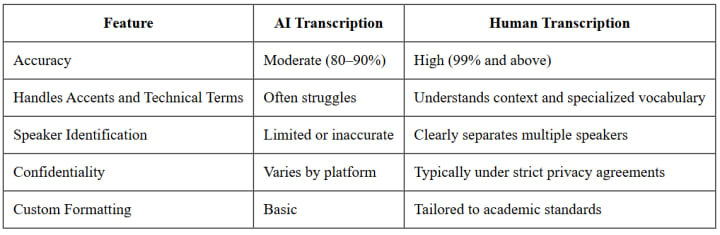
Human transcription is always the better option if your research depends on precision, context, and clarity. Professional transcriptionists can understand jargon, manage multiple speakers, and adapt to formatting requirements for dissertations, journal submissions, or grant reports.
8. Best Practices for Researchers Using Transcripts
To get the most value from transcription, it's essential to approach it strategically. Here are a few tips:
- Review transcripts for accuracy before analysis, primarily if they were generated by software
- Anonymize sensitive content to protect participant privacy and comply with ethical standards
- Use timestamps to connect specific quotes with their location in the original recording
- Standardize formatting across all transcripts to make comparison easier
- Store transcripts securely, mainly when they include personal or confidential information
These small steps can significantly impact the quality of your research.
9. Choosing the Right Transcription Partner
If you decide to outsource transcription, look for a provider with experience in academic work. You'll want someone who:
- Understand academic terminology and citation standards
- Offers high-accuracy human transcription
- Follows strict confidentiality protocols
- Provides custom formatting to meet your project needs
- Delivers transcripts on time and ready for analysis
For example, GMR Transcription has worked with hundreds of researchers, universities, and graduate students. They offer 100 percent US-based human transcriptionists, which helps ensure both linguistic accuracy and data security.
Conclusion: Transcription Is More Than a Time-Saver, It's a Research Enabler
Transcription is no longer just a convenience for researchers. It's a foundational part of analyzing, interpreting, and sharing academic data. From improving accuracy to enabling better collaboration and accessibility, transcripts help transform complex audio content into meaningful, actionable insights.
If you want to make your research process more efficient, precise, and ultimately more impactful, turning to professional transcription services like those offered by experienced providers such as GMR Transcription can be a valuable step toward achieving your research goals.
About the Creator
Beth Worthy
Beth Worthy is President of GMR Transcription Services, Inc., a U.S. company offering 100% human transcription, translation, and proofreading for academic, business, legal, and research clients.
Keep reading
More stories from Beth Worthy and writers in Education and other communities.
Focus Group Data: Your Step-by-Step Guide to Insightful Analysis
Focus groups are a powerful way to gather insights. They bring people together to share opinions, experiences, and ideas. But gathering this data is only half the process. The real value lies in analyzing the conversations to uncover deeper meanings, patterns, and trends. Done right, it can lead to decisions that make a real difference.
By Beth Worthyabout a year ago in Education
The Value of Respect
On a cold winter morning, the school hallways were still quiet when Bashir arrived, as he always did before sunrise. He unlocked the gates, swept the corridors, wiped the classroom windows, and cleaned the floors before the students came rushing in.
By Waleed khanabout 20 hours ago in Education
How Problem-Solving Shapes the Success of Modern Entrepreneurs
Entrepreneurship today is defined by constant change and relentless challenges. Business leaders are no longer operating in stable, predictable environments; instead, they face shifting markets, evolving customer expectations, and rapid technological advancements. In this environment, problem-solving has become the cornerstone of entrepreneurial success. The ability to identify issues, analyze them critically, and create practical solutions separates thriving ventures from those that struggle to survive. Entrepreneurs who develop strong problem-solving skills are better equipped to innovate, make strategic decisions, and guide their businesses toward sustainable growth.
By Greg Warnock2 days ago in Education



Comments
There are no comments for this story
Be the first to respond and start the conversation.