
How AI Transforms Learning Environments
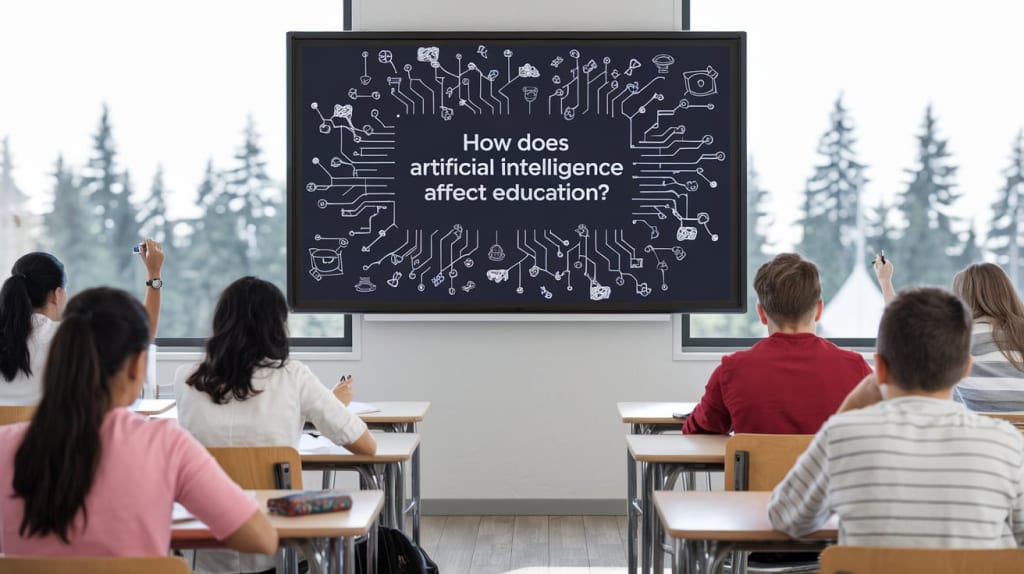
How does artificial intelligence affect education?
Introduction
Artificial Intelligence (AI) is revolutionizing various domains of human activity, and education is no exception. As students, educators, and administrators increasingly integrate AI-driven tools into learning environments, the implications are vast. This essay will explore how AI enhances personalization in education, improves accessibility and inclusivity, revolutionizes teaching methods, and streamlines administrative tasks.
Enhancing Personalization in Education
Tailored learning experiences
AI's capacity to analyze large sets of data enables it to tailor learning experiences to individual students' needs. By assessing a student's strengths, weaknesses, and learning styles, AI systems like IBM Watson Education and Knewton can create customized lesson plans that adapt to each learner. This personalized approach has been shown to improve student engagement and academic performance. For instance, a study conducted by WestEd found that students using Knewton's adaptive learning technology outperformed their peers in traditional settings by 33% in mathematics.
Adaptive learning technology
Adaptive learning technology uses algorithms to adjust the difficulty of educational content in real-time, based on a student's performance. This ensures that students are neither bored by material that is too easy nor overwhelmed by content that is too difficult. Companies like Smart Sparrow and DreamBox are at the forefront of this innovation, providing platforms where lessons dynamically change in response to student interactions. For example, DreamBox's math lessons adapt based on whether students provide correct or incorrect answers, ensuring a pace that matches each student’s proficiency.
Personalized feedback systems
AI-powered personalized feedback systems provide instant and detailed feedback to students, helping them understand areas for improvement. Traditional feedback mechanisms can be delayed and generic, but with AI, students can receive specific guidance immediately after completing an assignment. Grammarly, an AI-powered writing assistant, offers personalized feedback on grammar, style, and coherence, assisting students in enhancing their writing skills. Moreover, platforms like Gradescope use AI to categorize student errors and suggest targeted areas for review, ensuring that feedback is both relevant and timely.
Improving Accessibility and Inclusivity
Learning tools for differently-abled students
AI is significantly improving accessibility for differently-abled students by providing specialized tools that cater to their unique needs. For example, Microsoft's Seeing AI app uses computer vision to describe the environment to visually impaired users, while Text-to-Speech (TTS) applications like Kurzweil 3000 read text aloud for students with reading difficulties. These tools not only enhance learning opportunities but also foster greater independence among differently-abled students. Additionally, AI-driven speech recognition software, such as Dragon NaturallySpeaking, allows students with motor impairments to use voice commands to interact with their devices and complete written assignments.
Bridging geographical barriers
AI bridges geographical barriers by enabling access to quality education regardless of a student's location. Online platforms such as Coursera and edX leverage AI algorithms to recommend courses based on a student's interests and career goals, providing a personalized learning path. Virtual classrooms powered by AI, like those offered by VIPKid, connect students with teachers from around the world, facilitating a global exchange of knowledge. This democratization of education ensures that students in remote or underserved areas have access to the same high-quality resources as their urban counterparts.
Affordable learning resources
AI has the potential to reduce the cost of educational resources, making learning more affordable and inclusive. OpenAI's GPT-3, for example, can generate high-quality educational content at a fraction of the cost of traditional publishing. Online platforms such as Khan Academy use AI to provide free, personalized education in subjects ranging from mathematics to history. By lowering the financial barriers to education, AI helps ensure that all students, regardless of socioeconomic status, have access to the resources they need to succeed.
Revolutionizing Teaching Methods
AI-driven content creation
AI is revolutionizing teaching methods by enabling AI-driven content creation. Tools like Quillionz and Content Technologies, Inc. use natural language processing to generate educational content, such as quizzes, summaries, and lesson plans, allowing educators to focus more on teaching and less on content preparation. For instance, McGraw-Hill Education's LearnSmart platform uses AI to create adaptive learning modules that are tailored to individual student needs, thus enhancing the effectiveness of the instructional material.
Virtual and augmented reality
Virtual and augmented reality (VR and AR) are transforming the way students learn by providing immersive and interactive experiences. AI enhances these technologies by making them more intuitive and responsive. Platforms like zSpace and Google Expeditions offer VR and AR experiences that allow students to explore historical sites, conduct scientific experiments, and even perform virtual dissections, all from the safety of their classroom. These immersive experiences not only make learning more engaging but also help students retain information more effectively. A study by the University of Maryland found that students using VR for learning had an 8.8% higher retention rate compared to traditional methods.
Intelligent tutoring systems
Intelligent tutoring systems (ITS) leverage AI to provide one-on-one instruction to students, replicating the benefits of personal tutoring on a larger scale. Systems like Carnegie Learning's MATHia and Pearson's Smart Sparrow adapt to a student's learning pace and provide targeted assistance in areas where they struggle. These systems use data analytics to track student progress and adjust their teaching strategies accordingly, ensuring that each student receives personalized support. Research by the U.S. Department of Education has shown that students using ITS score approximately 0.3 standard deviations higher on average compared to those in traditional classrooms.
Streamlining Administrative Tasks
Automated grading systems
AI-powered automated grading systems save educators time by quickly and accurately evaluating student work. Tools like GradeScope and Hewlett Packard's Intelligent Grading system use machine learning algorithms to assess assignments and provide feedback. By automating routine tasks, these systems allow educators to focus more on interactive and high-impact teaching activities. Additionally, automated grading can provide immediate feedback to students, helping them understand their mistakes and learn from them in real-time.
Efficient scheduling and planning
AI enhances the efficiency of scheduling and planning by managing complex timetables and optimizing resource allocation. Platforms like Clara and X.ai use natural language processing to schedule meetings and coordinate events, reducing administrative burdens. In an educational setting, AI can analyze student data to create personalized learning schedules, ensuring that each student attends the classes and sessions most beneficial to their development. Furthermore, AI-driven tools like Timetabler can create efficient school timetables by taking into account both educator availability and student preferences, thus maximizing productivity and satisfaction.
Data-driven decision making
AI empowers educational institutions to make data-driven decisions by analyzing vast amounts of data to identify trends and insights. Tools like BrightBytes and Civitas Learning aggregate data on student performance, attendance, and engagement, providing educators and administrators with actionable insights. For example, predictive analytics can identify students at risk of dropping out, allowing timely interventions. A case study by the University of Arizona showed that using predictive analytics to identify at-risk students led to a 6% increase in retention rates. By leveraging AI for data analysis, educational institutions can make informed decisions that enhance student outcomes and operational efficiency.
Conclusion
AI is undeniably transforming learning environments across the globe. By enhancing personalization in education, AI allows for tailored learning experiences, adaptive learning technology, and personalized feedback systems, which collectively improve student engagement and academic success. The technology also promotes accessibility and inclusivity by providing tools for differently-abled students, bridging geographical barriers, and offering affordable learning resources. Furthermore, AI is revolutionizing teaching methods through AI-driven content creation, virtual and augmented reality, and intelligent tutoring systems that enhance engagement and retention.
Lastly, AI streamlines administrative tasks, freeing up educators' time and resources. Automated grading systems, efficient scheduling and planning tools, and data-driven decision-making platforms all contribute to a more efficient and effective educational environment. The integration of AI in education holds the promise of a more personalized, inclusive, and efficient learning experience for all students. As AI continues to evolve, it will undoubtedly play an increasingly vital role in shaping the future of education.
About the Creator
Keep reading
More stories from Wajd Mohamed and writers in Education and other communities.
AI: How It Acquires Knowledge
Introduction Artificial Intelligence (AI) is revolutionizing various sectors including healthcare, finance, and transportation. The key to AI's success lies in its ability to acquire, process, and utilize vast amounts of knowledge. To understand how AI accomplishes this, one must delve into its fundamental concepts, training processes, data sources, and algorithmic developments. This essay offers a structured exploration of these areas and discusses the challenges in AI knowledge acquisition.
By Wajd Mohamedabout a year ago in Education
Governance Risk and Compliance Platforms Supporting Secure and Compliant Operations
Governance, risk and compliance platforms have become essential tools for organizations navigating complex operational, regulatory, and digital environments. These platforms help businesses establish clear governance structures, identify and manage risks, and ensure compliance with evolving regulations. As organizations face increasing pressure to protect sensitive data, maintain transparency, and meet regulatory obligations, governance, risk and compliance platforms provide a structured and integrated approach to managing these challenges.
By Bobby Yadava day ago in Education
Killing him slowly
There’s an intruder in my house again. He stumbles through the door, wet carrier bags in hand. He’s bought me offerings. I show my appreciation, letting him caress my beautiful body. He wants to touch me. I rub myself against his legs. He sighs, dropping the bags. He can’t resist touching me. Running his hand slowly down my spine, I arch my back towards his caress, let out a low purr. It’s what we both need.
By N J Delmas7 days ago in Horror



Comments (1)
Artificial intelligence has a breakthrough future 👌🏻