
"Hitler: The Rise and Ruin of a Tyrant"
"From Obscurity to Dictatorship—And the Dark Legacy Left Behind"
By Haris khanPublished 8 months ago • 3 min read
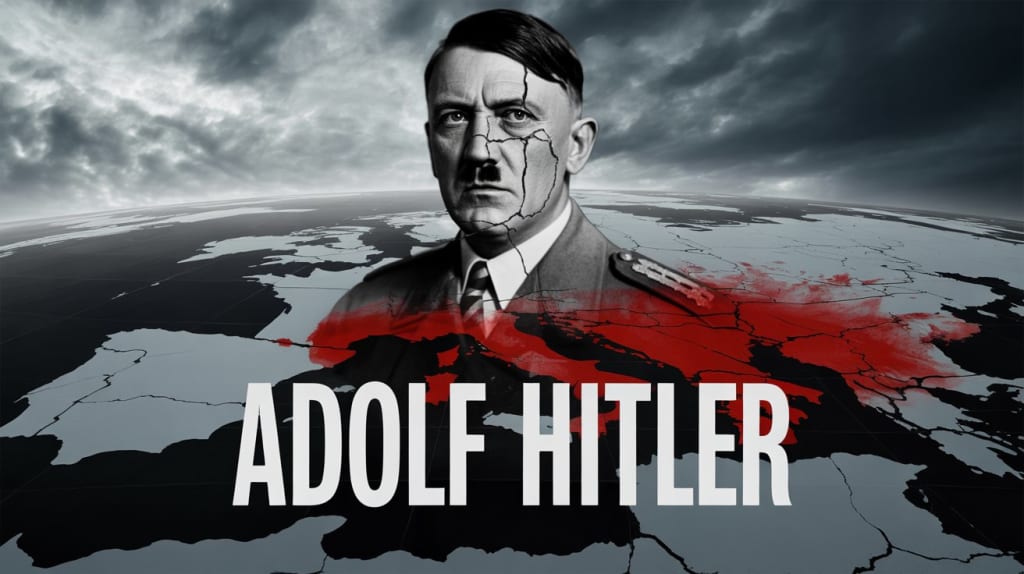
Adolf Hitler: Rise, Reign, and Ruin
Adolf Hitler, born on April 20, 1889, in Braunau am Inn, Austria, would become one of the most infamous figures in world history. His leadership of Nazi Germany led to the devastation of World War II and the horrors of the Holocaust. Understanding Hitler’s life is essential to understanding how one man’s ideology and ambition caused destruction on a global scale.
Hitler’s early life was marked by difficulty. He had a strained relationship with his strict father and was deeply attached to his mother. After dropping out of high school, he moved to Vienna with dreams of becoming an artist. However, he was rejected twice by the Academy of Fine Arts. During this period, he struggled financially and developed many of the ideas that would later define his political ideology, including strong German nationalism and a deep hatred of Jews and Marxists.
In 1913, Hitler moved to Munich, Germany. When World War I broke out the next year, he enlisted in the German army. He served as a messenger on the Western Front and was wounded twice. The defeat of Germany in 1918 deeply affected him. He viewed the surrender as a betrayal and blamed Jews and communists for Germany’s humiliation — a belief shared by many nationalists at the time.
In 1919, Hitler joined a small nationalist group called the German Workers’ Party, which he quickly helped transform into the National Socialist German Workers’ Party (Nazi Party). With powerful speeches filled with emotion and blame, Hitler gained attention and support. He condemned the Treaty of Versailles, called for the restoration of German pride, and promoted Aryan racial superiority.
In 1923, Hitler and his followers attempted a coup in Munich — the Beer Hall Putsch. It failed, and Hitler was arrested and sentenced to prison. During his time behind bars, he wrote Mein Kampf ("My Struggle"), a political manifesto that outlined his extreme views on race, leadership, and the future of Germany. After serving less than a year in prison, Hitler resumed political activities with a strategy to gain power legally.
As Germany faced severe economic hardship during the Great Depression, Hitler’s promises of jobs, strength, and national revival attracted more supporters. In 1933, he was appointed Chancellor of Germany. Within months, after the Reichstag Fire and the passing of the Enabling Act, he consolidated power, outlawed political opposition, and established a dictatorship.
As Führer, Hitler controlled every aspect of German life. He used mass propaganda, secret police (Gestapo), and fear to maintain control. He promoted aggressive nationalism, militarism, and antisemitism. In 1935, the Nuremberg Laws stripped Jews of citizenship and rights. In 1938, the Kristallnacht pogrom marked a violent escalation of Jewish persecution.
In 1939, Hitler signed a non-aggression pact with the Soviet Union and invaded Poland, sparking World War II. His blitzkrieg tactics allowed Germany to conquer much of Europe rapidly. By 1941, he had invaded the Soviet Union and declared war on the United States. At the same time, the Nazi regime began the systematic extermination of Jews in occupied territories. This would become known as the Holocaust, in which six million Jews and millions of other victims — including Roma, disabled individuals, Poles, Soviet prisoners, and more — were murdered in ghettos, camps, and gas chambers.
As the war dragged on, Hitler’s strategic decisions began to fail. His invasion of the Soviet Union stalled, and the harsh Russian winter contributed to heavy losses. The Allied invasion of Normandy in 1944 pushed German forces westward, while the Soviets closed in from the east.
By early 1945, Germany was collapsing. Hitler retreated to a bunker beneath Berlin as Soviet forces encircled the city. Refusing to surrender, and unwilling to be captured, Hitler committed suicide on April 30, 1945, alongside his wife, Eva Braun, whom he had married just one day earlier.
After his death, Germany surrendered unconditionally on May 7, 1945, marking the end of the war in Europe. The world was left to confront the full horror of Nazi crimes. The Nuremberg Trials prosecuted many of Hitler’s top officials for war crimes and crimes against humanity.
Adolf Hitler's rise and fall is a stark reminder of how dangerous ideologies can gain power during times of crisis. His dictatorship left tens of millions dead and reshaped the 20th century. His legacy is one of tyranny, destruction, and human suffering — and a powerful lesson about the cost of silence, hatred, and unchecked authority.
About the Creator
Keep reading
More stories from Haris khan and writers in Education and other communities.
How to earn money from TikTok.
How to Earn Money from TikTok: The Complete 2025 Guide TikTok is no longer just an entertainment app — it’s now one of the fastest-growing platforms for creators to build influence, promote products, and make real money. With over a billion monthly active users, the opportunity to turn your passion into income is bigger than ever.
By Haris khan6 months ago in Education




Comments
There are no comments for this story
Be the first to respond and start the conversation.