
History.
Earth,water,air and fire.


Now I’ve read a lot lately about proving or disproving God exists and created the Earth in 6 days and rested on the 7th to be unable to comprehend that God created or could create such beauty out of Earth,Wind, Air and Fire 6,000 years ago, that they could only go by the creation of dust,particles and gases in the atmosphere spinning around and hey presto there is Man. I’m presuming Women came after spinning the opposite way? Guess we will never know.
I however am not getting into the playpen of any religion other than a study of the Mangas colerades (“Red Sleeves “) or Dasoda hae (1797-Jan 18th 1863” ) was a Native American Leader of the earliest years of the Apache War.some consider him the warlord of the 19th century, particularly because he was who United the Apaches against the settlers. The texts of the time present him as an influential head of state,a diplomatic, a sage as well as a fierce, intransigent and brutal warrior. Mangagas always left the hat on his victims heads, even when they had been scalped.
Mangas Colorado War. Now for me as an outsider looking in am looking purely on what has been written down as time as gone by for heritage purposes to pass to the generations to follow, like Toras, Bibles written down to be passed on to generation to generation. Now sage is burning smells and oudour into the atmosphere, like Catholic use oils burning to sway all around the alter to “ward off any unwanted spirits.” They like to burn the insense when clearing off unwanted energy, you can’t see this energy with the naked eye unless you were gifted and could see energetic energy, particles, gases of the atmosphere, even aura’s it is proclaimed, which are situated around a humans body and the sage was able to see and read a person health, stealth, and their actual real intentions. (Bit hard to believe right? ) Hold you breathe for half hour come back and answer where does it actually originate from? Who invented the air that we do breathe as do all living things on this earth? Guess your going back up into the cosmo’s to find hey? Well they believe in a greater force than ourselves out there and to honour earth, wind,water and fire as all elements are as equally important as each other and have to be in line with the atmosphere. Which we will talk more about the importance of the earth,wind.air,fire elements and how important they are in a Tribal setting.

These were the first indigenous people to come into contact with the "settlers". The "settlers" are the English and Irish folk who set sail on the Mayflower.
The Jesus and Mary Chain never made it.
Although The Vikings were there 800yrs before the settlers, it's a fact that became known only fairly recently.
The Algonquian are one of the most populous and widespread North American native language groups. Historically, the peoples were prominent along the Atlantic Coast and into the interior along the Saint Lawrence River and around the Great Lakes. This grouping consists of the peoples who speak Algonquian languages.
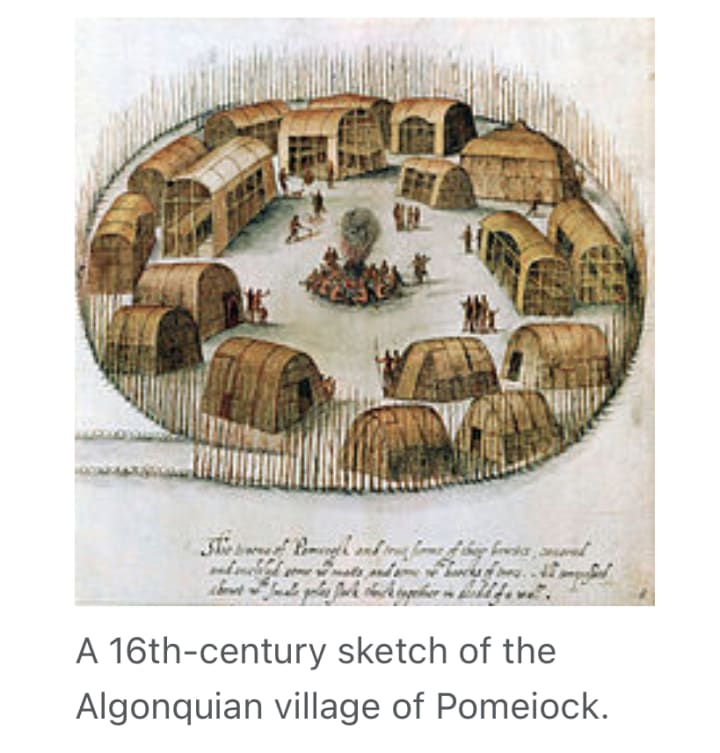
Again relying totally on Man or maybe Woman depiction and texts and writing, we can surely sadly say this existed yes.? Before Europeans came into contact, most Algonquian settlements lived by hunting and fishing, although quite a few supplemented their diet by cultivating corn, beans and squash (the "Three Sisters"). The Ojibwe cultivated wild rice.At the time of the first European settlements in North America, Algonquian peoples occupied what is now New Brunswick, and much of what is now Canada east of the Rocky Mountains; what is now New England, New Jersey, southeastern New York, Delaware and down the Atlantic Coast through the Upper South; and around the Great Lakes in present-day Minnesota, Wisconsin, Michigan, Illinois, Indiana and Iowa. The homeland of the Algonquian peoples is not known. At the time of the European arrival, the hegemonic Iroquois Confederacy, based in present-day New York and Pennsylvania, was regularly at war with Algonquian neighbours. New England area
Colonists in the Massachusetts Bay area first encountered the Wampanoag, Massachusett, Nipmuc, Pennacook, Penobscot, Passamaquoddy, and Quinnipiac. The Mohegan, Pequot, Pocumtuc, Podunk, Tunxis, and Narragansett were based in southern New England. The Abenaki were located in northern New England: present-day Maine, New Hampshire, and Vermont in what became the United States and eastern Quebec in what became Canada. They traded with French colonists who settled along the Atlantic coast and the Saint Lawrence River. The Mahican were located in western New England in the upper Hudson River Valley (around present-day Albany, New York). These groups cultivated crops, hunted, and fished.[4]
The Algonquians of New England such as the Piscataway (who spoke Eastern Algonquian), practised a seasonal economy. The basic social unit was the village: a few hundred people related by a clan kinship structure. Villages were temporary and mobile. The people moved to locations of greatest natural food supply, often breaking into smaller units or gathering as the circumstances required. This custom resulted in a certain degree of intertribal mobility, especially in troubled times. In warm weather, they constructed portable wigwams, a type of hut usually with buckskin doors. In the winter, they erected the more substantial longhouses, in which more than one clan could reside. They cached food supplies in more permanent, semi-subterranean structures.[citation needed]
In the spring, when the fish were spawning, they left the winter camps to build villages at coastal locations and waterfalls. In March, they caught smelt in nets and weirs, moving about in birch bark canoes. In April, they netted alewife, sturgeon and salmon. In May, they caught cod with hook and line in the ocean; and trout, smelt, striped bass and flounder in the estuaries and streams. Putting out to sea, they hunted whales, porpoises, walruses and seals. They gathered scallops, mussels, clams and crabs[5] and, in southern New Jersey, harvested clams year-round.
From April through October, natives hunted migratory birds and their eggs: Canada geese, brant, mourning doves and others. In July and August they gathered strawberries, raspberries, blueberries and nuts. In September, they split into small groups and moved up the streams to the forest. There, they hunted beaver, caribou, moose and white-tailed deer.
In December, when the snows began, the people created larger winter camps in sheltered locations, where they built or reconstructed longhouses. February and March were lean times. The tribes in southern New England and other northern latitudes had to rely on cached food. Northerners developed a practice of going hungry for several days at a time. Historians hypothesize that this practice kept the population down, according to Liebig's law of the minimum.
The southern Algonquians of New England relied predominantly on slash and burn agriculture.They cleared fields by burning for one or two years of cultivation, after which the village moved to another location. This is the reason the English found the region relatively cleared and ready for planting. By using various kinds of native corn (maize), beans and squash, southern New England natives were able to improve their diet to such a degree that their population increased and they reached a density of 287 people per 100 square miles as opposed to 41 in the north.
Scholars estimate that, by the year 1600, the indigenous population of New England had reached 70,000–100,000.
Midwest
The French encountered Algonquian peoples in this area through their trade and limited colonization of New France along the Mississippi and Ohio rivers. The historic peoples of the Illinois Country were the Shawnee, Illiniwek, Kickapoo, Menominee, Miami, Sauk and Meskwaki. The latter were also known as the Sac and Fox, and later known as the Meskwaki Indians, who lived throughout the present-day Midwest of the United States.
During the nineteenth century, many Native Americans from east of the Mississippi River were displaced over great distances through the United States passage and enforcement of Indian removal legislation; they forced the people west of the Mississippi River to what they designated as Indian Territory. After the US extinguished Indian land claims, this area was admitted as the state of Oklahoma in the early 20th century.
Upper west.
Ojibwe/Chippewa, Odawa, Potawatomi, and a variety of Cree groups lived in Upper Peninsula of Michigan, Western Ontario, Wisconsin, Minnesota, and the Canadian Prairies. The Arapaho, Blackfoot and Cheyenne developed as indigenous to the Great Plains.
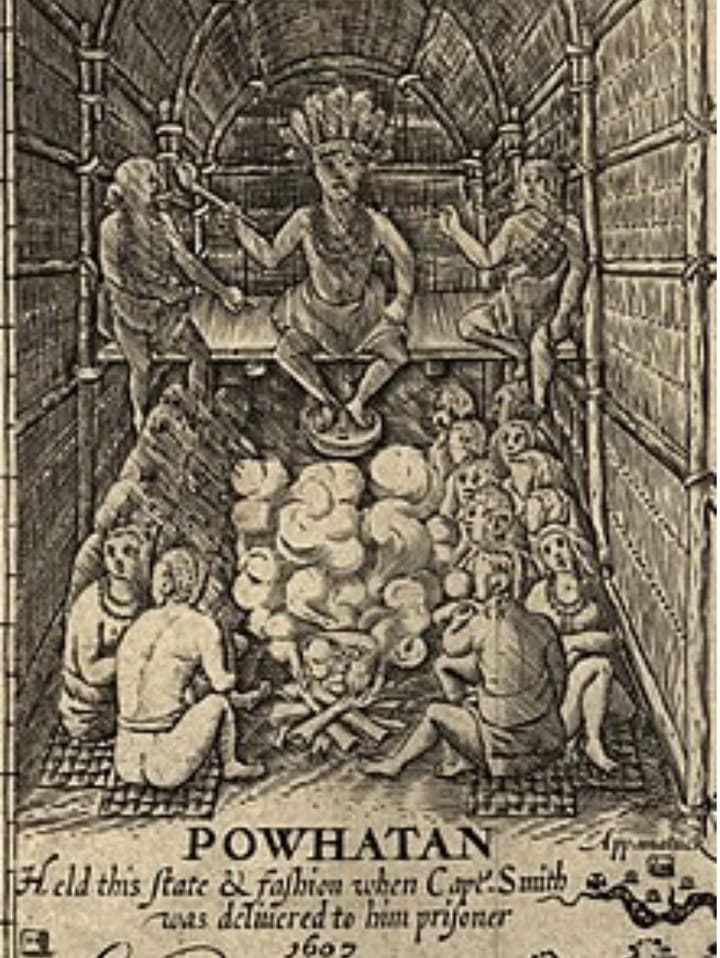
the late 16th and early 17th centuries, a mamanatowick (paramount chief) named Wahunsenacawh created an organization by affiliating 30 tributary peoples, whose territory was much of eastern Virginia. They called this area Tsenacommacah ("densely inhabited Land"). Wahunsenacawh came to be known by English colonists as "The Powhatan (Chief)".Each of the tribes within this organization had its own weroance (leader, commander), but all paid tribute to The Powhatan (Chief).
After Wahunsenacawh's death in 1618, hostilities with colonists escalated under the chiefdom of his brother, Opchanacanough, who sought in vain to expel encroaching English colonists. His large-scale attacks in 1622 and 1644 met strong reprisals by the colonists, resulting in the near elimination of the tribe. By 1646, what is called the Powhatan Paramount Chiefdom by modern historians had been decimated. More important than the ongoing conflicts with the English colonial settlements was the high rate of deaths the Powhatan suffered due to new infectious diseases carried to North America by Europeans, such as measles and smallpox. The Native Americans did not have any immunity to these, which had been endemic to Europe and Asia for centuries. The wholesale deaths greatly weakened and hollowed out the Native American societies.
By the mid-17th century, the leaders of the colony were desperate for labor to develop the land. Almost half of the European immigrants to Virginia arrived as indentured servants. As settlement continued, the colonists imported growing numbers of enslaved Africans for labor. By 1700, the colonies had about 6,000 black slaves, one-twelfth of the population. It was common for black slaves to escape and join the surrounding Powhatan; some white servants were also noted to have joined the Natives. Africans and Europeans worked and lived together; some natives also intermarried with them. After Bacon's Rebellion in 1676, the colony enslaved Indians for control. In 1691, the House of Burgesses abolished native slavery; however, many Powhatan were held in servitude well into the 18th century.
In the 21st century, eight Native tribes are officially recognized by Virginia as having ancestral ties to the Powhatan confederation.The Pamunkey and Mattaponi are the only two peoples who have retained reservation lands from the 17th century. The competing cultures of the Powhatan and English settlers were united through unions and marriages of members, the most well known of which was that of Pocahontas and John Rolfe. Their son Thomas Rolfe was the ancestor of many Virginians; many of the First Families of Virginia have both English and Virginia Algonquian ancestry.
Some survivors of the Powhatan confederacy have relocated elsewhere. Beginning in the late 19th century, individual people identifying collectively as the Powhatan Renape Nation settled a tiny subdivision known as Morrisville and Delair, in Pennsauken Township, New Jersey. Their ancestry is mostly from the Rappahannock tribe of Virginia and the related Nanticoke tribe of Delaware.They have been recognized as a tribe by the state of New Jersey.
So as you can hear,see,listen, discuss how important it is our Earth and the footprints we leave on it and rely on the functioning of the Earth, water,air and fire. One tiny malfunction in one of them can set a complete catastrophe ophthalmologist on earth due to man’s uneducated knowledge of the earth in 2023. But we are learning from Countries heritage together and learning from each other best practices to protect the Earth we inhabit.
When the Three Gorges Dam was built, 39 trillion kilograms of water from the Yangtze River built up behind it to 175 meters above sea level. This altered the Earth’s moment of inertia changed ever so slightly, causing the rotation to move more slowly. This is the same principle behind why figure skaters tuck in their arms to spin faster.
NASA has calculated that the dam only slows the rotation by 0.06 microseconds, which is six hundredths of a millionth of a second. Our planet’s rotation speed actually fluctuates fairly often, as it can be influenced by earthquakes, the moon, and the climate change-induced movement of the North Pole. This again just highlights how important it is to be aware of Mother Earth when we observe the tsunami and earthquake’s we have had more frequently than ever in history, Earth, Wind, Water and Fire in sequence with each other is paramount. You have read that the mountain would give a volcano when the land feels discomfort.

Credits all go to Native Americans Long Ago
Wikapidia
Kinetica
About the Creator
Dawn Earnshaw
Loves writing short stories and poems - learning punctuation and Grammar.ADHD
Keep reading
More stories from Dawn Earnshaw and writers in Education and other communities.
Darkness.
This bloody war causing havoc with the electric, we are going to have to buy candles soon with the amount going up into space , interfering with the ozone layer, I’ve got out my old record player . They just do not know what they are dealing with. The Lord said to Moses regarding gazing upon at the stars , yes study them but you’re main purpose is Mother Earth don’t forget that Moses. “The darkest hour is upon us”, Churchill they are having a war like no other, mother is making food to last us all over the summer, testing all the newly built missiles and tanks out to blast all the buildings down in Russia and Ukrainian and now Poland have been attacked and NATO have done nothing about it, regardless of removing the president of Russia who is starting on Poland. It really is a figure eight or red pill , blue pill matrix, We will be in complete darkness for quite sometime and the air we are breathing is toxic, I can taste it at the back of my throat. We surely cannot be taking any food provisions from those War torn countries with the amount of toxic waste going about, we have the new covid variant coming through the air spreading like wildfire, so it’s safer to have our masks on, “the world is but a stage and we are all just merely actors upon it.” Shakespeare.
By Dawn Earnshaw3 years ago in Education
10 Unusual Quiz Round Ideas That Will Make Your Next Game Night Unforgettable
Most pub quizzes follow the same pattern. You get a geography round, a history round, maybe a music round, and then everyone argues about whether the answer to question seven was technically correct. It works - but it rarely surprises anyone.
By Faabul Quizzes3 days ago in Education



Comments
There are no comments for this story
Be the first to respond and start the conversation.