
Harmonics of Hush: How Silence Is Rewriting the Script of Human Connection
Reimagining Minds, Cultures, and Societies Through the Unspoken Power of Stillness

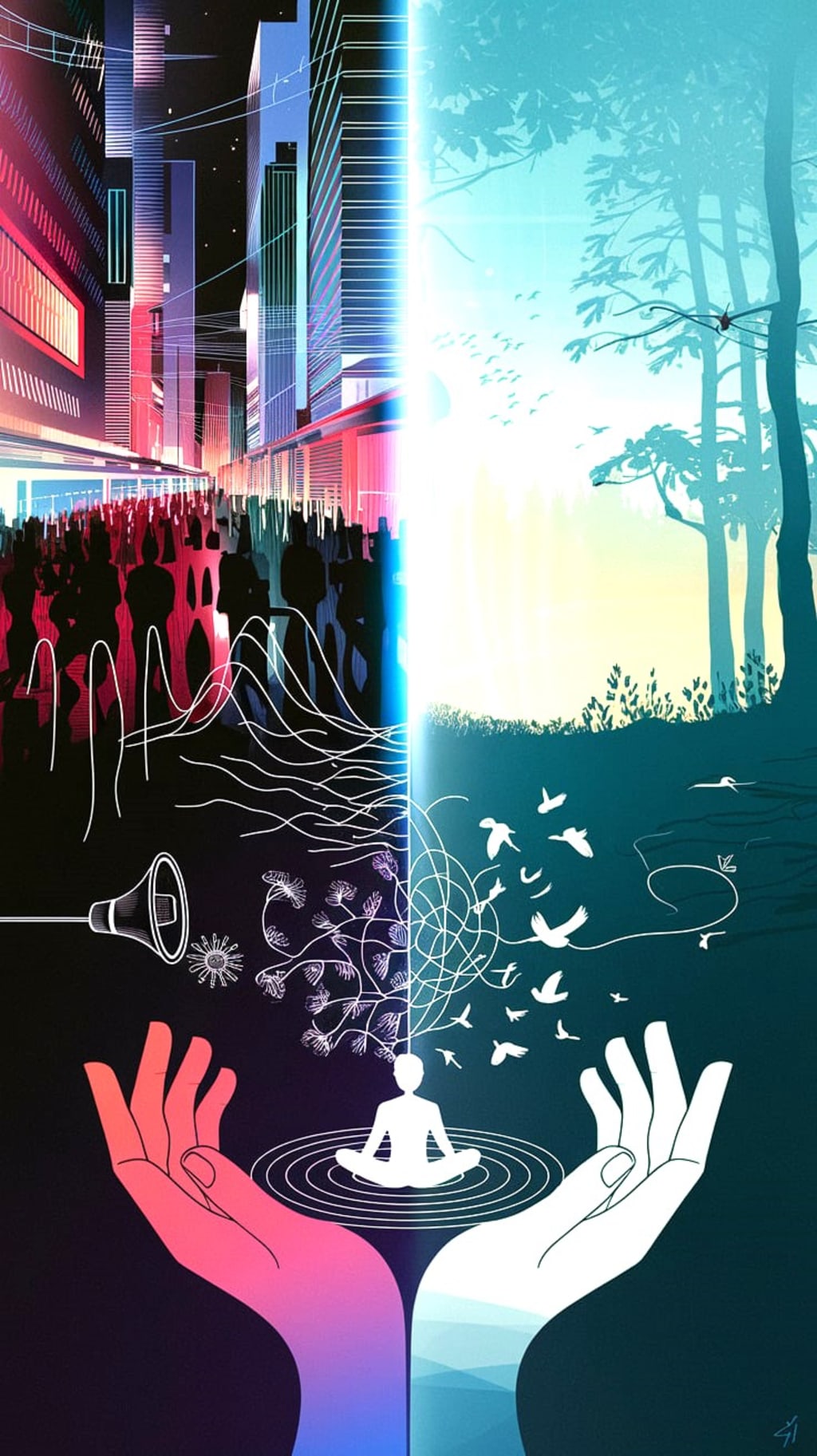
A quiet revolution is taking place in a world that never stops talking, where notifications, debates, and incessant chatter make every second count. This movement isn’t about disconnecting from technology or retreating to mountaintops; it’s about reclaiming the transformative power of silence in a hyperconnected age. The Symphony of Silence, as it has come to be known, is reshaping lives, communities, and cultures, demonstrating that stillness might be the most radical response to the chaos of the present day. The Rise of the Quiet Revolution
In 2023, the World Health Organization declared noise pollution a “stealth toxin” for mental health, linking chronic noise exposure to skyrocketing stress levels, sleep disorders, and impaired cognitive function. Noise levels in major cities like Mumbai and New York now average 80 decibels per day, or the volume of a blender running continuously. However, a countermovement is gaining traction in the midst of this chaos. From Tokyo’s “ma”-inspired architecture (celebrating the space between sounds) to Berlin’s noise-free co-working hubs, silence is being reimagined as both a sanctuary and a form of rebellion.
Ironically, the quiet revolution has become a megaphone on social media. Hashtags like SilentRevolution and QuietPower have amassed over 10 million posts, while influencers share minimalist soundscapes of rustling forests or morning tea rituals. Even corporations are listening: Google’s “quiet pods” and Sweden’s “silent trains” reflect a growing demand for spaces where the mind can breathe. “We’re not anti-technology,” says Mikael Jensen, founder of Copenhagen’s Silence Foundation. “We’re pro-humanity. Instead of being empty, silence serves as a canvas for creativity. Stillness in Neuroscience Why does silence hold such power? Neuroscience offers compelling answers. Studies at Duke University reveal that silence activates the brain’s default mode network (DMN), a web of regions responsible for introspection, memory consolidation, and creative problem-solving. Silence, in contrast to passive rest, induces an "active calm" state in which the mind processes emotions and makes breakthroughs. According to MRI scans, a daily silence of just two hours can stimulate neurogenesis—the development of new neurons—in the hippocampus, which is essential for learning and emotional regulation. Take, for instance, software engineer Emma Carter, who had burnout in 2022. “My brain felt like a browser with 100 tabs open,” she recalls. She went to Scotland for a seven-day silent retreat on the advice of a friend. “By day three, the mental fog lifted. I began sketching solutions to coding issues that I had been unable to solve for months. Her innovations after the retreat streamlined the workflow of her team and cut project deadlines by 30%. Emma’s story isn’t unique: A 2023 Harvard Business Review study found that employees who practice daily silence report 40% higher creativity scores.
The universal language of silence What makes the Symphony of Silence extraordinary is its universality. Silence transcends languages, ideologies, and borders in a fractured world. It’s the breath before a musician plays, the pause between heartbeats, the shared stillness of grief or awe. From Hong Kong’s candlelit vigils to Black Lives Matter’s silent marches, quiet solidarity has become a potent political language. As climate activist Greta Thunberg noted during a 2022 protest: “Silence isn’t passive. It’s the space where urgency meets clarity.”
This collective power is exemplified by the annual Rognan Dagur (Day of Silence) in Iceland. There is no honking, loud music, or idle conversation for 24 hours. Cafés serve “quiet coffee,” schools hold nature walks, and families gather for wordless board games. Helga Hansdotter, a resident of Reykjavik, asserts, "You notice sounds you would normally ignore." “Wind humming through lava fields, your child’s giggles, the crackle of a fireplace. It’s like the world resets.”
Composing Your Own Silence
Joining the Symphony of Silence requires no grand gestures. Start small: Micro-Moments: Dedicate 10 minutes daily to “unplugged” time—sip tea by a window or journal without distractions.
Design Quiet Zones: Mark a corner of your home or office as a tech-free sanctuary. Create an auditory buffer by employing white noise apps or noise-cancelling headphones. Listen Deeper: Practice “active silence” in conversations—pause before responding, and notice unspoken emotions.
Post a picture with the hashtag Symphony Of Silence of your favorite quiet moment to share the silence. Give the reminder to someone who needs it. The Future of Quiet As AI-generated content and virtual realities amplify sensory overload, the hunger for silence will only grow. Urban planners are integrating “quiet parks” into cities, while architects design buildings with sound-absorbing materials. In Japan, the Forest Therapy Society certifies “silent trails” for mindfulness hikes. Even tech giants like Apple now feature “silence mode” ads, framing disconnection as a luxury.
However, the Symphony of Silence's true promise lies in its capacity to unite. Whether a CEO meditating before a keynote or a student finding calm in a library, silence is the thread weaving through humanity’s noise. As composer John Cage once wrote: “There is no such thing as empty space or empty time. There is always something to see, something to hear.” Listening, not only to the quiet but also to the answers it contains, may be the most revolutionary action in a world filled with shouts. So, when the weight of the world feels deafening, remember: Silence isn’t an absence. It's a call to action. And in answering it, we might just find the harmony we’ve been missing.
About the Creator
Keep reading
More stories from Rocky Brahma and writers in Education and other communities.
Tracy Morgan: The Unbreakable Comedian Who Redefined Resilience
The story of Tracy Morgan is not just one of fame and comedic moments. It is a raw, unadulterated account of survival that demonstrates how humor can serve as both a shield and a lifeline. From his gritty upbringing in Brooklyn to the glittering stages of Saturday Night Live and 30 Rock, Morgan’s life has been a rollercoaster of triumphs and tragedies. However, his unwavering ability to rise, reinvent, and roar back from the brink is what truly distinguishes him, not just his comedic genius. The Concrete Roots of a Comedy King
By Rocky Brahma12 months ago in Education
The Impact of Virtual Reality on Healthcare Innovation and Medical Practice
Virtual reality is steadily transforming the healthcare industry by offering immersive digital environments that support medical education, treatment planning, and patient care. Unlike traditional tools, VR allows healthcare professionals to interact with highly detailed simulations that replicate real medical situations. These interactive experiences provide opportunities for learning and preparation that were previously difficult to achieve through conventional training methods.
By Alex Kipman4 days ago in Education
Why the Sun Will Become a Red Giant: The Future of Our Solar System Explained
Every morning, the Sun rises as it has for billions of years, bathing Earth in light and warmth. To us, it feels permanent and unchanging. Yet in the vast timeline of the universe, the Sun is only halfway through its life.
By shahkar jalala day ago in Education




Comments
There are no comments for this story
Be the first to respond and start the conversation.