
Great Emperor Tipu Sultan’s sword sold over $17 million at London auction
Great emperor Tipu sultan sword
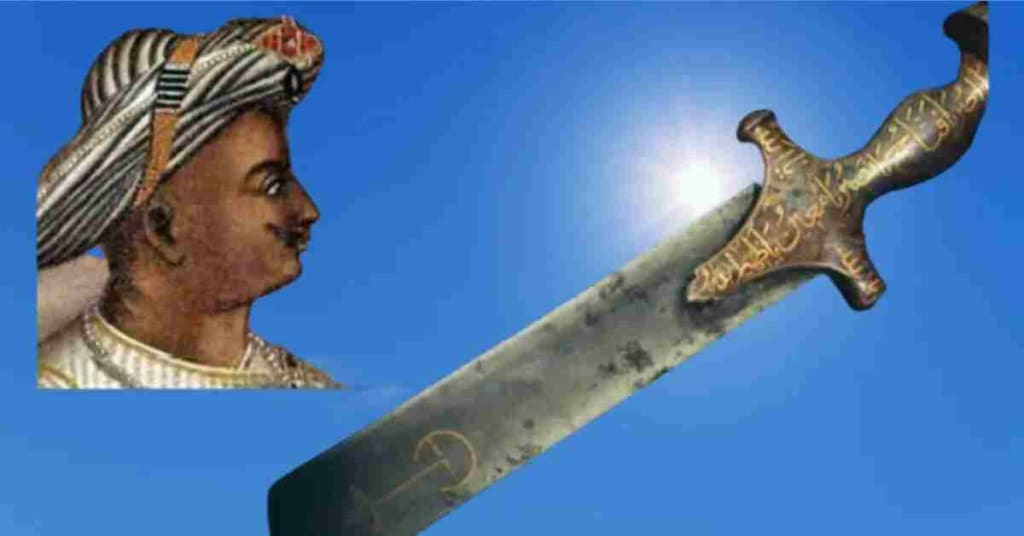
London, May 26: The 'greatest emperor Tipu Sultan sword had sold for more than 14 million pounds ($17 million) at an auction in London.
The sword was described as "one of the world's rare artefacts" and sold on Tuesday by Bonhams, a privately held international auction house in London, for 14,080,900 pounds against an estimate of 1.5 million to 2 million pounds.
The sword was discovered in Tipu Sultan's palace after he was murdered by British forces on May 4, 1799, according to the auction house.
According to Bonams, after his death, the sword was delivered to British Major General David Baird as a tribute of his bravery.
The sword's "extremely rare calligraphic hilt is a masterpiece of late-18th century Indian manufacture, intricately inlaid in gold with fine calligraphic invocations to God," according to the auction house.
The English inscription on the blade, presumably added by Baird or a descendant, explains how it was found in Tipu Sultan's bedchamber following the fall of Seringapatam (now Srirangapatna) and presented to the General as a trophy of his victory."
A gold inlaid inscription on the blade's spine reads 'Shamshir-e Malik,' or "The Sword of the King."
The sword has an extraordinary history, astonishing provenance, and unrivalled craftsmanship,said by group head of Islamic and Indian Art It was no surprise that it was fought over by two phone bidders and a bidder in the room. "We are delighted with the outcome,
According to Bonhams CEO Bruno Vinciguerra, the "spectacular sword" is "the greatest of all Tipu Sultan-related weapons still in private hands."
Its close personal association with the Sultan, its impeccable provenance traceable to the very day it was captured, and the outstanding craftsmanship that went into its manufacture make it unique and highly desirable.
Introduction of Great emperor:
Tipu Sultan, also known as the Tiger of Mysore, was a prominent ruler in South India during the late 18th century. Born on November 20, 1750, in Devanahalli, Karnataka, Tipu Sultan was the eldest son of Sultan Hyder Ali, the ruler of the Kingdom of Mysore, and his wife, Fatima Fakhr-un-Nisa. Here is a glimpse into the early life of this legendary figure.
Tipu Sultan grew up in a tumultuous period marked by conflicts between the British East India Company and various regional powers in India. As a child, he displayed a keen interest in military strategies and administration. His father recognized his abilities and involved him in state affairs from a young age.
Educated in various subjects, including Islamic theology, mathematics, and Persian literature, Tipu Sultan was well-versed in several languages, such as Kannada, Urdu, and Arabic. His educational background laid the foundation for his later accomplishments as a scholar and enlightened ruler.
Education
Educated in various subjects, including Islamic theology, mathematics, and Persian literature, Tipu Sultan was well-versed in several languages, such as Kannada, Urdu, and Arabic. His educational background laid the foundation for his later accomplishments as a scholar and enlightened ruler.
tipu sultan ,in 1767, at the age of 16, Tipu Sultan accompanied his father during the Second Mysore War against the British. This experience allowed him to witness firsthand the tactics and strategies employed by the British, and he quickly developed a deep aversion towards their colonial ambitions.
After the death of his father in 1782, Tipu Sultan ascended to the throne of Mysore. He faced numerous challenges, including external threats from the British and internal conflicts with neighboring princely states. Determined to protect his kingdom's sovereignty, he embarked on a series of military campaigns.
Tipu Sultan was a progressive ruler who implemented several reforms to modernize his kingdom. He introduced a new coinage system, standardized weights and measures, and encouraged trade and industry. He also established a diplomatic relationship with France to counter British influence in the region.
One of the defining features of Tipu Sultan's reign was his resistance against British imperialism. He waged a fierce struggle against the British forces, leading multiple wars against them. His military acumen and innovative tactics, such as the use of rockets in warfare, earned him a fearsome reputation.
Despite facing significant odds, Tipu Sultan managed to secure notable victories against the British. However, his fortunes began to decline with the advent of the Third Mysore War, during which he faced a formidable alliance between the British and their local allies.
In 1799, the British launched a final assault on Srirangapatna, Tipu Sultan's capital. Despite putting up a valiant defense, he was killed in the battle, marking the end of his rule. His death was mourned by his subjects and became a symbol of resistance against British colonialism.
Tipu Sultan's legacy continues to inspire admiration and debate. He is celebrated as a national hero in India, particularly in the state of Karnataka, where he is regarded as a symbol of resistance and a pioneer of technological advancements. However, his policies towards non-Muslims have been a subject of controversy.
In conclusion, Tipu Sultan's early life shaped him into a determined and visionary ruler. His passion for learning, military prowess, and commitment to his kingdom made him a formidable opponent to the British. Despite his eventual defeat, his legacy lives on as a symbol of courage and defiance in the face of imperialism.
War of Tipu sultan
Tipu Sultan, the Tiger of Mysore, achieved notable successes in various military conflicts during his reign. Known for his strategic acumen and innovative tactics, he led his forces with determination and skill. Here are some of the significant war successes of Tipu Sultan:
First Anglo-Mysore War (1767-1769): Tipu Sultan, at a young age, accompanied his father, Hyder Ali, in this conflict against the British East India Company. Although the war ended inconclusively, it provided Tipu Sultan with valuable experience and insights into the British military tactics and strategies.
Second Anglo-Mysore War (1780-1784): Tipu Sultan's military prowess became evident during this war against the British. He successfully resisted the British forces led by General Sir Eyre Coote, inflicting heavy losses on them. Tipu Sultan's innovative use of rockets in warfare was particularly effective, causing panic and disruption among the British troops.
Capture of Mangalore (1783): In a significant military success, Tipu Sultan's forces captured the port city of Mangalore from the British. This victory not only showcased his military strength but also allowed him to gain control over a strategically important coastal area.
Siege of Mangalore (1783-1784): After capturing Mangalore, Tipu Sultan faced a British counter-offensive to regain control of the city. However, he successfully defended his position during a prolonged siege, displaying his ability to withstand and repel determined British attacks.
Third Anglo-Mysore War (1790-1792): Tipu Sultan faced a formidable coalition comprising the British East India Company, the Marathas, and the Nizam of Hyderabad. Despite the odds, he put up a resilient defense and inflicted heavy losses on the British forces in several engagements. However, the war ended with the signing of the Treaty of Seringapatam, which imposed territorial concessions on Tipu Sultan.
Siege of Mangalore (1791): In a remarkable display of military strategy, Tipu Sultan launched a surprise attack on the British forces besieging Mangalore. His forces achieved a decisive victory, breaking the siege and forcing the British to retreat temporarily.
Fourth Anglo-Mysore War (1798-1799): Tipu Sultan's final war against the British proved to be his most challenging. Faced with a powerful British force led by General Sir Arthur Wellesley (later Duke of Wellington), Tipu Sultan fought valiantly to defend his capital, Srirangapatna. Despite his efforts, Srirangapatna fell, and Tipu Sultan was killed in the final assault
Rocket invention by Great emperor Tipu sultan
read more visit-https://namethe.in/tipu-sultans-sword/
About the Creator
The Importance of Strong Leadership in IT and Cybersecurity Teams
In today’s rapidly evolving digital landscape, IT and cybersecurity are no longer support functions—they are central to business success and resilience. With growing threats, complex infrastructures, and constant technological change, these departments face intense pressure to perform at the highest levels. At the heart of their performance is a critical factor that often determines whether a team succeeds or struggles: strong leadership.
By Keith Brautigam5 days ago in Education




Comments
There are no comments for this story
Be the first to respond and start the conversation.