
Google Ads vs. Meta Ads for Real Estate Marketing: Which One Delivers Better Results?
Choosing the Right Platform: Google Ads vs. Meta Ads for Real Estate

The evolving preferences of property buyers and tenants demand a strategic, targeted online advertising approach. Two of the largest players in the field are Google Ads and Meta Ads (previously Facebook Ads). Both platforms provide robust features for targeting an audience, generating leads, and building brand awareness — but which is more effective for real estate marketing?
This article presents a clear comparison of Google Ads vs Meta Ads for real estate marketing, providing information to assist businesses in making educated decisions.
Why Digital Advertising is Important in Real Estate?
Prior to discussing platform specifics, it’s important to know why online digital advertising for real estate agents has become essential:
- With so many developers and brokers competing in the market, standing out is paramount.
- Online media provides sophisticated targeting on demographics, interests, and behavior.
- Digital campaigns can be tracked and optimized in real-time, providing better cost management and campaign improvement.
Understanding Google Ads for Real Estate
Google Ads is based on a search-led model, exploiting user intent. It is a pay-per-click (PPC) advertising platform that shows advertisements on Google Search, YouTube, and the websites of the Google Display Network.
Such intent-based targeting proves especially useful in real estate, where active research by consumers precedes most decisions.
Key Features of Google Ads
- Search Ads: Text-only ads on Google’s search result pages, well-suited to catch high-intent leads.
- Display Ads: Visual banners on partner sites, increasing brand presence.
- Local Service Ads: Specifically for service industry businesses, the ads link local real estate agents with local customers.
- Remarketing: Targets past visitors of a real estate website, encouraging them to visit again.
Advantages of Google Ads

Challenges
- Real estate as a category is competitive, resulting in increased bidding costs.
- Intent is high, but demographic and interest-based targeting is not as specific as Meta Ads.
Understanding Meta Ads for Real Estate
Meta Ads allow companies to place ads on Facebook, Instagram, Messenger, and the Meta Audience Network.
Ads appear in people’s feeds, stories, or as sponsored posts, which is why they are an important marketing tool for today’s social media marketing campaigns. The platform aims audiences by age, income, location, homeownership status, and lifestyle.
Major Features of Meta Ads
- Carousel Ads: Display multiple property images, ideal for showcasing listings.
- Video Ads: Deliver virtual tours to engage the user.
- Lead Ads: Streamline lead generation with forms within the platform.
- Audience Network: Deliver ads to third-party sites and apps.
Benefits of Meta Ads

Challenges
- Although users might interact with compelling properties ads, their intent could be exploratory instead of transactional.
- Frequent exposure to the same ads will eventually lower the engagement level.
Comparing Google Ads and Meta Ads for Real Estate Marketing
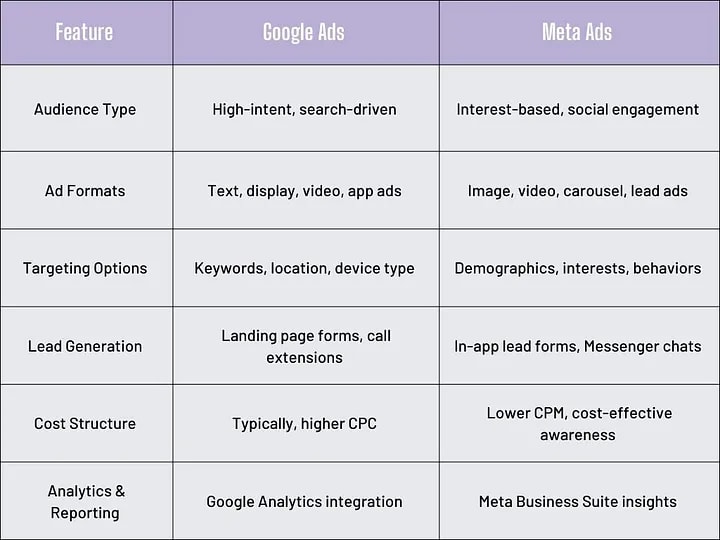
Which Platform Should Real Estate Businesses Choose?
Selecting the best ads platform for real estate marketing between Google Ads and Meta Ads mostly depends on your business on your business objectives, budget, and audience behavior:
Use Google Ads if:
- Your main goal is to capture high-intent leads actively looking for properties.
- You have a higher budget to bid on competitive keywords.
- You need to drive immediate traffic to landing pages or websites.
Use Meta Ads if:
- Your goal is to establish brand awareness or cultivate leads through visually stimulating campaigns.
- You need to reach specific lifestyle or interest-based groups.
- You require an affordable medium for driving inquiries through in-app lead forms.
For maximum impact, most successful real estate marketing campaigns employ a combination of both platforms.
Google Ads targets active search volume, whereas Meta Ads cultivates audiences and generates interest through compelling, visual content.
Best Practices for Real Estate Advertising
To drive optimal ROI on either platform, keep the following marketing strategies in mind:
- Have ads lead to user-friendly, mobile-optimized landing pages with clear calls-to-action.
- For Meta Ads, spend money on professional photography or virtual tours to present properties.
- Conduct A/B tests to determine top-performing ad copy, graphics, or targeting options.
- Utilize Google Ads for high-intent leads and Meta Ads for brand-building to achieve a balanced digital strategy.
Conclusion
Google Ads and Meta Ads are both promising avenues for real estate marketing, but their usefulness depends on campaign goals and targeting audience. Google Ads is unbeatable for extracting high-intent leads, and Meta Ads excel in reaching larger audiences with visually rich content. Coupled with professional digital marketing services, the platforms enable real estate brands to reach qualified leads and remain competitive.
Don’t wait — let’s make your real estate campaigns stand out. Get in touch today!
About the Creator
Gurneet Kaur
I'm Gurneet Kaur, I am working in the Marketing and advertising firm Woosper. I leverage SEO, social media marketing, and content creation to craft strategic campaigns that get noticed and generate engagement.
Keep reading
More stories from Gurneet Kaur and writers in Education and other communities.
How to Connect with Your Audience Through Social Media for Food Brands?
Social media is a vital instrument for developing relationships and increasing revenue, not only a place for content distribution. A well-planned social media marketing strategies enables food brands to promote their products, amplify their distinctive voice through shared food passions. With the right combination of visuals, storytelling, and engagement strategies, food brands can convert casual browsers into loyal fans.
By Gurneet Kaur9 months ago in Education
From Stove to Strategy: Steve Wolfe’s Take on Scaling Your Food Business from Kitchen to Boardroom
Every food business begins with passion—late nights in the kitchen, handwritten recipes, and the joy of seeing someone love what you’ve made. But when demand grows, passion alone isn’t enough. Scaling your food business from kitchen to boardroom requires a shift in thinking, planning, and leadership.
By Steven Joseph Wolfe7 days ago in Education




Comments
There are no comments for this story
Be the first to respond and start the conversation.