
Girls Education
When a Girl Is Taught, a Nation Is Raised

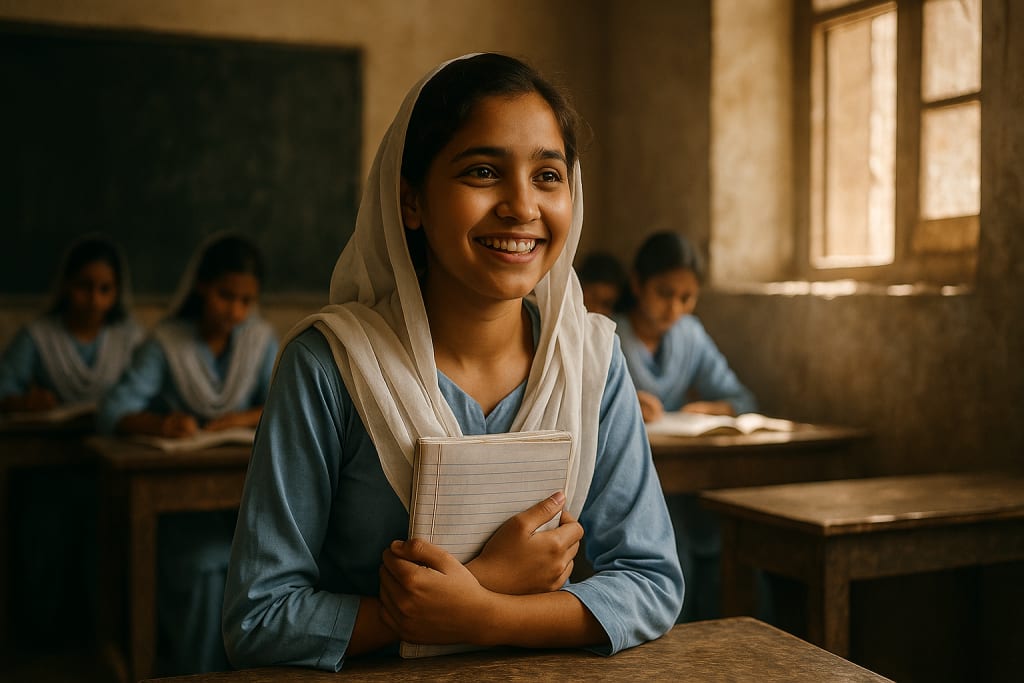
In a small rural village surrounded by mountains and muddy paths, lived a young girl named Samina. She was the eldest of four siblings and the only daughter of a widowed mother who worked in the nearby fields to feed them. Their mud-brick house had no electricity, no fan, and no comforts—only silence, survival, and forgotten dreams.
Every morning, Samina would wake up early, sweep the floors, make tea for her mother, and help her younger brothers get ready for school. They would wear their uniforms, sling bags over their shoulders, and vanish into the rising sun. Samina, however, would watch them from the doorway, holding a broken piece of chalk in her hand, drawing invisible letters on the wall, pretending she too was a student.
Her heart ached not because she was missing school—but because she had never been allowed to attend. When she was seven, her uncle had said, “Girls don’t need education. They need training—for marriage, not for books.” Her mother, burdened with debt and fear, had remained silent.
But silence couldn’t stop Samina’s spirit. Every evening, when her brothers came home, she would secretly borrow their books. In the dim lantern light, she would trace the letters with her fingers, copying them onto pages of torn newspapers. She taught herself the alphabet. Then words. Then sentences. Soon, she could read entire stories.
Education, for Samina, was not a privilege. It was a rebellion. It was an act of courage in a place where girls were taught to disappear.
One afternoon, while helping her mother carry firewood, she overheard women from the village whispering about a local organization that was starting free education for girls. Samina’s heart leapt. That night, while her family slept, she whispered into her pillow, “Ya Allah, give me just one chance.”
The next day, barefoot and determined, Samina followed the NGO workers around the village. She tugged at the kurta of one of the volunteers and said, “Please, I want to study. Take me.”
The woman looked at her—the cracked heels, the sunburned skin, the eyes that refused to surrender. She asked, “Does your family allow it?” Samina paused, then softly replied, “No. But maybe if someone speaks to them, they will.”
Two days later, a team visited her house. They sat with her mother, spoke of rights, of opportunities, and of Islam’s emphasis on seeking knowledge. Her mother listened quietly. And then she did something she hadn’t done in years—she cried. “If I had studied,” she whispered, “maybe I wouldn’t be washing other people’s clothes today.”
That night, Samina was given her first real notebook. Her first pencil. Her first uniform. It was second-hand, slightly loose, and torn near the sleeve—but to her, it felt like a crown.
She walked to school the next morning like a warrior walking into battle. The other girls laughed at her age—she was 13 and sitting with 8-year-olds—but she didn’t care. She sat straight, eyes fixed on the blackboard, absorbing every word like it was rain on dry soil.
She studied hard. At home, she faced resistance. Her uncles mocked her. Neighbors said she would bring shame. Even her mother, though supportive, feared for their safety. But Samina had already seen the truth—that ignorance was more dangerous than any rumor.
Years passed. Samina not only completed her basic schooling, she excelled. She scored the highest marks in her district and earned a scholarship to attend a teacher training college in the city. For the first time in her life, she sat on a bus, left the village, and entered a world of libraries, ideas, and possibilities.
When she returned three years later, she wasn’t the same girl. She was a teacher. And she didn’t come alone—she brought books, pencils, story cards, and a vision.
She started a small learning center in her old village. The same uncles who once insulted her now sent their daughters to her class. The same women who once scoffed at her mother now came to her for help writing their names.
Samina taught more than letters. She taught confidence. She told her students, “When you read, you don't just open a book. You open your world.”
Some of her students became artists. Some became nurses. One even became a journalist.
One day, during a community gathering, a young girl asked her, “Apa, why did you want to study so badly?”
Samina smiled and replied, “Because I was tired of being invisible. Education made me visible. It gave me a voice when no one wanted to hear me.”
Her journey wasn’t perfect. It was filled with fear, resistance, and sleepless nights. But it was hers. And it lit the path for hundreds of other girls who now dared to hope.
About the Creator
TrueVocal
🗣️ TrueVocal
📝 Deep Thinker
📚 Truth Seeker
I have:
✨ A voice that echoes ideas
💭 Love for untold stories
📌 @TrueVocalOfficial
Locations:
🌍 Earth — Wherever the Truth Echoes
Misplaced Optimism: A Year of Accountability Promised — and Withheld at LAUSD
“We must hold the Superintendent accountable” – Karla Griego (2024) Ten years ago, I ran for a seat on the LAUSD Board of Education to change the district I believed was failing its students, especially those with Special Education needs. My opponent was Tamar Galatzan, an entrenched incumbent who was backed by the charter school industry. I achieved the lowest cost per vote, just 69 cents, in the entire city during that election cycle. While it wasn’t enough to win the seat, our campaign helped knock Galatzan out of office. This helped to clear a pathway for change and raised expectations that accountability might finally follow.
By Carl J. Petersen3 days ago in Education
FPS: The Last Flame Challenge Winners
Welcome to our first Winners Announcement of the year and to the final challenge in the Fall Poetry Series. The Last Flame invited writers to sit with endings, using fire as a central image to consider what remains when something burns out: ash, warmth, memory, silence, or the faint promise of what comes next. The strongest pieces treated endings as gradual rather than sudden, allowing them to flicker, dim, and linger.
By Vocal Curation Team6 days ago in Resources



Comments (1)
This story is so powerful. It makes me think about how lucky we are with education. Samina's determination is amazing.