
Getting Medical AI Right: The Best Way to Approach Healthcare Annotation
Accurate Medical Image Annotation for Healthcare AI Solutions


Quality medical annotation forms the foundation of AI-based diagnoses. To support this, image annotation is a mission-critical source of information. In the high-stakes healthcare industry, researchers and data scientists rely on annotated patient data for medical research, especially in developing AI models for new therapies, drugs, and diagnoses.
A comprehensive image annotation process forms the basis for machine-learning models that detect diseases, recommend treatments, and support medical decision-making. This dependence highlights the importance of data annotation in medical AI development.
This blog offers information on the ethical issues that need to be considered when using imaging data. We will also explore AI-driven labeling vs. human image data annotation services and which one to go for.
Need for AI-driven Annotation
The healthcare industry is embracing AI to make accurate diagnosis predictions and assist doctors in providing quality patient care. Since AI does not fatigue, it can work around the clock without distractions. From faster diagnoses to robot-assisted surgeries, it can deliver crucial assessments and enable medical teams to begin treatments quickly.
In the process of bettering diagnostic imaging, training with diverse data is needed. These data constitute diagnosis documents, visual observations, health application forms, etc., and hospitals contribute to the vast influx of data for model training. These data need quality labeling, whether in visual (image-like) or textual form. What AI tools do is annotate these data quickly, lowering human effort. These data serve various purposes for model training, ranging from clinical trials and research applications to administrative functions.
Can we trust AI-driven diagnoses?
AI tools have the potential to spot even the most minute anomalies. It adds labels accurately just like an experienced radiologist but much faster. But, if we rely on datasets annotated by computers, the potential for bias could exist.
While AI-powered systems can improve diagnostic accuracy during telehealth visits, doctors still cannot fully trust the algorithms. This underscores the ongoing need to improve human-AI collaboration.
Counterarguments: Bias is Unavoidable
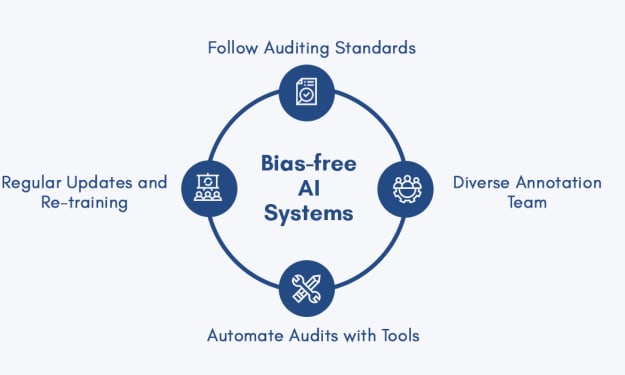
Sometimes, annotators' biases in interpreting certain clinical cases confuse what constitutes a "normal" vs. "abnormal" image or in interpreting ambiguous cases. The underrepresentation of certain demographic groups in training medical models exacerbates healthcare disparities.
These models are not inherently objective, and they mirror the prejudices of those who train them. A misdiagnosis due to biased annotation can have life-altering consequences. Should AI even be trusted with diagnostic decision-making when its knowledge is built upon a potentially flawed foundation?
The Patient’s Right to Consent: Are They Truly Aware?
Using patient images in AI model training raises serious ethical concerns about informed consent.
• Using real-world patient data enables AI models to learn from diverse cases, improving diagnostic capabilities.
• AI-enhanced imaging tools have led to the early detection of diseases like cancer, significantly increasing survival rates.
• Patient data, when anonymized, can be ethically used for research without compromising individual privacy.
Who Takes Responsibility for AI Mistakes?
Did you know that a major ethical challenge in AI-powered diagnosis is its opacity especially in case of inaccurate annotations? How will AI-driven annotation be held liable? We need to understand that human supervision cannot be undermined, unless we overcome model biases.
Defending AI's Role in Healthcare
• AI can assist radiologists and doctors but does not replace human judgment. The responsibility still lies with the medical professional overseeing the diagnosis.
• AI-driven diagnostic tools reduce fatigue-based human errors, ultimately increasing patient safety.
• If an AI-assisted tool is used correctly, it should enhance, not diminish, medical accountability.
Lack of Accountability
• AI models operate as black boxes; even their developers often cannot explain why they reach specific conclusions.
• When an AI misdiagnoses a life-threatening condition, the responsibility becomes blurred—should we blame the data annotators, the developers, or the hospitals deploying the AI?
• Regulatory frameworks for AI accountability in medicine are still evolving, leaving room for unethical loopholes.
If AI is making decisions about human lives, shouldn’t it be held to the same ethical and legal standards as human professionals?
Kinds of medical images and documents annotation
Depending on the project type model must be annotated for training, validation, and testing datasets.
• MRI, CT, and X-rays provide essential information about health conditions and help plan treatment. One mistake can have fatal consequences. Labelers also tag details to X-rays, ultrasound images, and MRI and CT scan images.
• Image segmentation is a task that breaks an image down into more concise components in the healthcare domain. Two main types of image segmentation are used i.e., semantic and instance segmentation. Segmentation is used for precision image annotation in oncology, dentistry, neurology, ophthalmology, hepatology, and dermatology.
• AI models can also recognize medical conditions in images, photographs, or videos. They can also use audio or text data from notes to assist with diagnoses. Cutting-edge computer vision projects require error-free annotation, and image segmentation methods add granular detail to medical annotations.
Artificial intelligence technology is crucial for medical personnel to minimize the risk of errors. The precise medical imaging annotation process brings significant benefits. Models can also be trained for other specialized images to recognize typical and atypical neuroimaging informatics technology initiative (NIFTI) scans, mammograms, electroencephalograms (EEGs), and echocardiograms.
One of the biggest issues for medical companies is finding training data for their computer vision AI. Sourcing quality X-ray, CT, and MRI data can be difficult, but it can become easy with the right annotation partner.
Conclusion
Looking forward, we can conclude that ethics cannot be an afterthought. Medical image annotations ensure that ethical practices are followed, and so any AI-driven healthcare innovation must be balanced with fairness.
Several ethical issues need monitoring when diagnostic imaging data is incorporated into clinical trials. While precision is crucial to ensuring reliable diagnoses, the reality is far more complex. We need medical experts to label the medical data, as it is complex, and an untrained labeler may struggle.
AI for medical diagnosis is a vital and impactful field for computer vision researchers. This technology helps us quickly diagnose illnesses and treat patients better. To achieve its potential, AI for medicine models must be trained with pixel-perfect image labeling.
Image annotation companies support this medical AI innovation by providing clean data and affordable image labeling for machine learning applications. Choose your partner wisely!
About the Creator
Anolytics
Anolytics provides a high-quality and low-cost annotation service for the construction of machine learning and artificial intelligence, generative ai llm models.
Prototyping Products in Electronics: Essential Tools for Modern Circuit Development
In the world of electronics design and product development, prototyping products play a crucial role in transforming theoretical circuit designs into real, testable systems. These tools allow engineers, developers, and hobbyists to experiment with electronic components, test circuit functionality, and refine designs before moving to full-scale production.
By Beckett Dowhan3 days ago in Education
"Beware the Ides of March"
Superstitious people may believe some days are unlucky. For instance, some think Friday the 13th is an unlucky day. Another day some people consider unlucky is March 15 because the English playwright William Shakespeare said in his famous play, Julius Caesar:
By Margaret Minnicks3 days ago in Education
A System That Isn’t Working Challenge Winners
Systems promise order. They organize behavior, distribute opportunity, and suggest that if everyone follows the rules, things will work. The entries in A System That Isn’t Working look closely at what happens when that promise begins to slip.
By Vocal Curation Team5 days ago in Resources



Comments
There are no comments for this story
Be the first to respond and start the conversation.