

Geography is the study of the Earth's surface, its features, and the relationships between them. The Earth is a complex system of interconnected land, water, and air masses that work together to create the conditions necessary for life. In this article, we will explore the geography of Earth, including its physical features, climate, and natural resources.
Physical Features
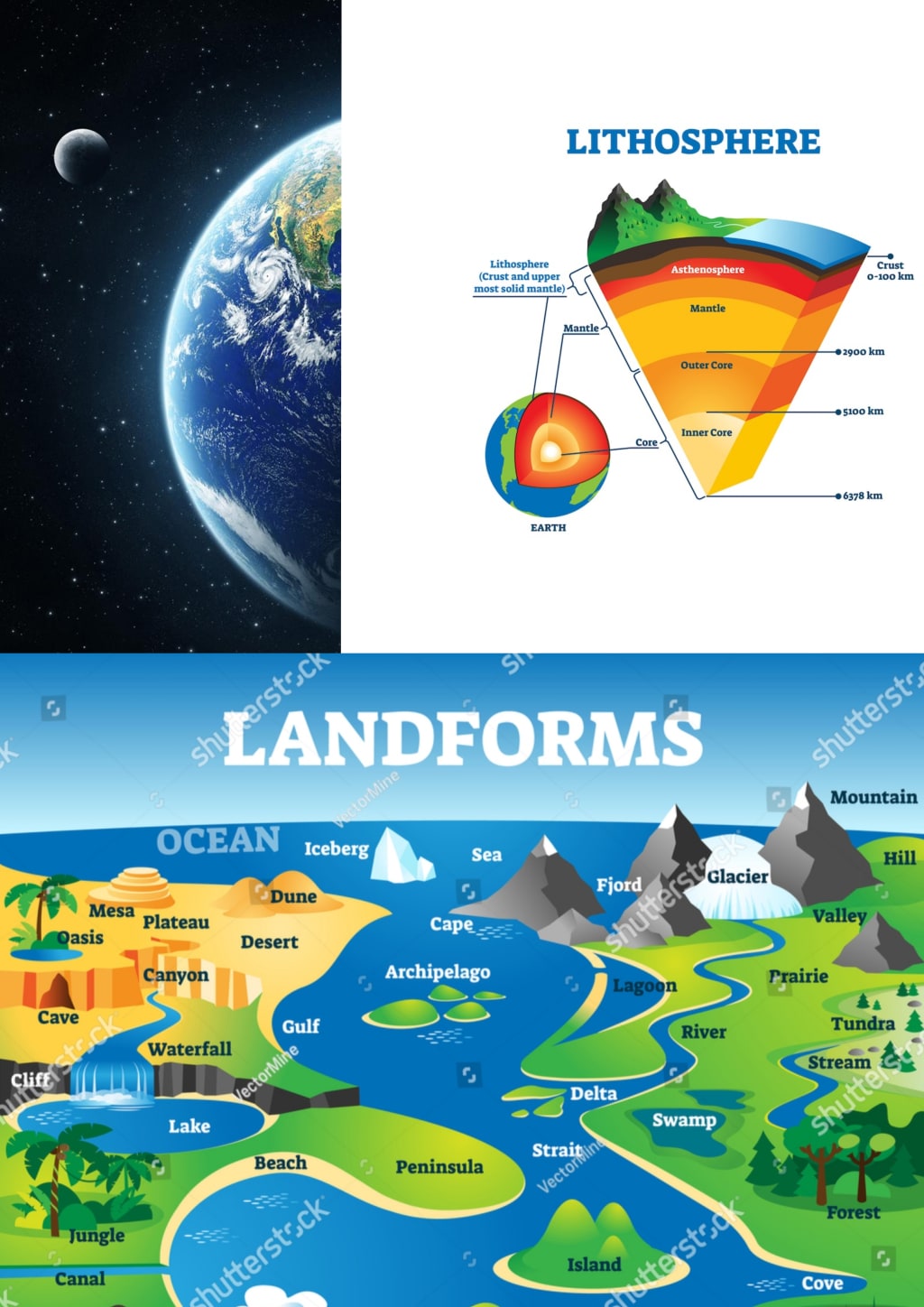
The Earth's physical features can be divided into several categories, including landforms, water bodies, and atmospheric features. Landforms are the natural features of the Earth's surface, including mountains, hills, plains, valleys, and plateaus. Mountains are the highest landforms on Earth, and they are formed by the movement of tectonic plates. The Himalayas, located in Asia, are the highest mountains on Earth, with Mount Everest standing at 29,029 feet (8,848 meters). Hills are smaller than mountains and are generally less steep. Plains are flat areas of land, and they are often used for agriculture. Valleys are low areas between mountains or hills, and they are often formed by the erosion of water. Plateaus are flat-topped mountains, and they are often found in areas of tectonic activity.
Water bodies are another important physical feature of the Earth. Oceans are the largest bodies of water on Earth, and they cover more than 70% of the planet's surface. The five oceans are the Atlantic, Pacific, Indian, Southern, and Arctic. Rivers are another important water feature, and they are formed by the movement of water from higher to lower elevations. The longest river on Earth is the Nile River in Africa, which is 4,135 miles (6,650 kilometers) long. Lakes are another important water feature, and they are formed by the movement of water into low-lying areas. The largest lake on Earth is the Caspian Sea, which is located between Europe and Asia.

Atmospheric features are the third category of physical features on Earth. The atmosphere is the layer of gases that surrounds the Earth, and it is composed of nitrogen, oxygen, and other trace gases. The atmosphere is divided into several layers, including the troposphere, stratosphere, mesosphere, thermosphere, and exosphere. The troposphere is the layer closest to the Earth's surface, and it is where weather occurs. The stratosphere is the layer above the troposphere, and it contains the ozone layer, which protects the Earth from harmful ultraviolet radiation from the sun.
The Earth is composed of several layers, each with its own unique properties and characteristics. These layers are divided into two categories: the crust and the interior.
The crust is the outermost layer of the Earth, and it is divided into two types: continental and oceanic. The continental crust is thicker and less dense than the oceanic crust, and it is composed of a variety of rocks, including granite, shale, and sandstone. The oceanic crust is thinner and more dense than the continental crust, and it is composed of basaltic rocks.
Beneath the crust is the mantle, which is the largest layer of the Earth. The mantle is composed of semi-solid rock, and it is divided into two layers: the upper mantle and the lower mantle. The upper mantle is composed of solid rock, while the lower mantle is composed of partially molten rock.
Beneath the mantle is the core, which is divided into two layers: the outer core and the inner core. The outer core is composed of liquid iron and nickel, and it is responsible for generating the Earth's magnetic field. The inner core is composed of solid iron and nickel, and it is the hottest and most dense layer of the Earth.
The layers of the Earth are important because they play a crucial role in the planet's geology and its overall function. The Earth's magnetic field, for example, is generated by the movement of molten iron in the outer core. The layers of the Earth also help to regulate the planet's temperature and provide a stable environment for life to thrive.
About the Creator
Keep reading
More stories from writers in Education and other communities.
ISO Implementation Challenges Dubai Companies Face, And How Consultants Solve Them
ISO certification is widely viewed as a marker of credibility in Dubai. Many organizations begin the journey with confidence, expecting a structured path to better control and consistency. But once implementation starts, reality looks different. Timelines slip. Teams resist change. Documents exist but daily operations remain unchanged.
By Umar Quality Jounal7 days ago in Education
Instructions Included Challenge Winners
For the Instructions Included challenge, we asked writers to tell a story through instructions and to trust the form to carry what could not be said outright. Across the top entries, that trust paid off in many different ways.
By Vocal Curation Team6 days ago in Resources


Comments
There are no comments for this story
Be the first to respond and start the conversation.